

Latex Mattress vs Memory Foam: A 2026 Buyer’s Guide


Most mattress shoppers start in the same place. One browser tab says latex is the smart long-term buy. Another says memory foam is the pressure-relief champion. Reviews conflict, marketing language gets slippery, and a simple purchase starts to feel bigger than it should.
The good news is that the choice becomes much easier once the noise gets stripped away. Latex and memory foam solve different sleep problems. One isn't universally better. One is just better for a specific body, sleep style, comfort preference, and budget strategy.
This guide takes a direct approach to latex mattress vs memory foam. It compares feel, movement, durability, long-term cost, and home-health considerations, then turns that information into clear recommendations a shopper can use.
Table of Contents
- Your Guide to a Better Night's Sleep
- The Feel Factor A Head-to-Head Comparison
- Long-Term Value Durability and True Cost
- Health and Home Allergies and Off-Gassing
- A Mattress for Every Sleeper Type
- How to Confidently Choose Your New Mattress
Your Guide to a Better Night's Sleep
Choosing a mattress shouldn't feel like studying for an exam, but that's where many shoppers end up. They read about contouring, responsiveness, open-cell construction, support layers, pressure relief, and cooling features, then still don't know what will feel good at midnight.
The smarter approach is simpler. A shopper needs to know three things. How the mattress feels, how long it lasts, and how well it fits the sleeper's real life. That means sleep position, body movement, temperature preference, health concerns, and willingness to replace a mattress sooner rather than later.
Practical rule: If a mattress sounds great online but doesn't match the way a person sleeps and moves, it's the wrong mattress.
Latex usually appeals to sleepers who want buoyant support, easier movement, and long-term durability. Memory foam usually appeals to sleepers who want deeper contouring, more of a body-hug feel, and strong motion absorption.
Neither category deserves blind loyalty. The right mattress is the one that helps a sleeper wake up comfortable, move naturally, and feel good about the purchase years later. That's the standard worth using.
The Feel Factor A Head-to-Head Comparison
Right away, several factors shape most decisions. Price matters, durability matters, and materials matter. But if the bed feels wrong, none of that saves the purchase.
| Feature | Memory Foam | Natural Latex |
|---|---|---|
| Overall feel | Deeply contouring, slower response | Buoyant, springy, faster response |
| Sleep sensation | More “in” the mattress | More “on” the mattress |
| Repositioning | Can take more effort | Usually easier |
| Pressure relief | Close body cradle | Gentle contour with push-back |
| Motion isolation | Stronger | Good, but usually less absorbent |
| Typical temperature feel | Often warmer | Often cooler |
| Durability | Shorter lifespan | Longer lifespan |
| Upfront cost | Broader price range | Higher initial investment |
How each one feels at bedtime
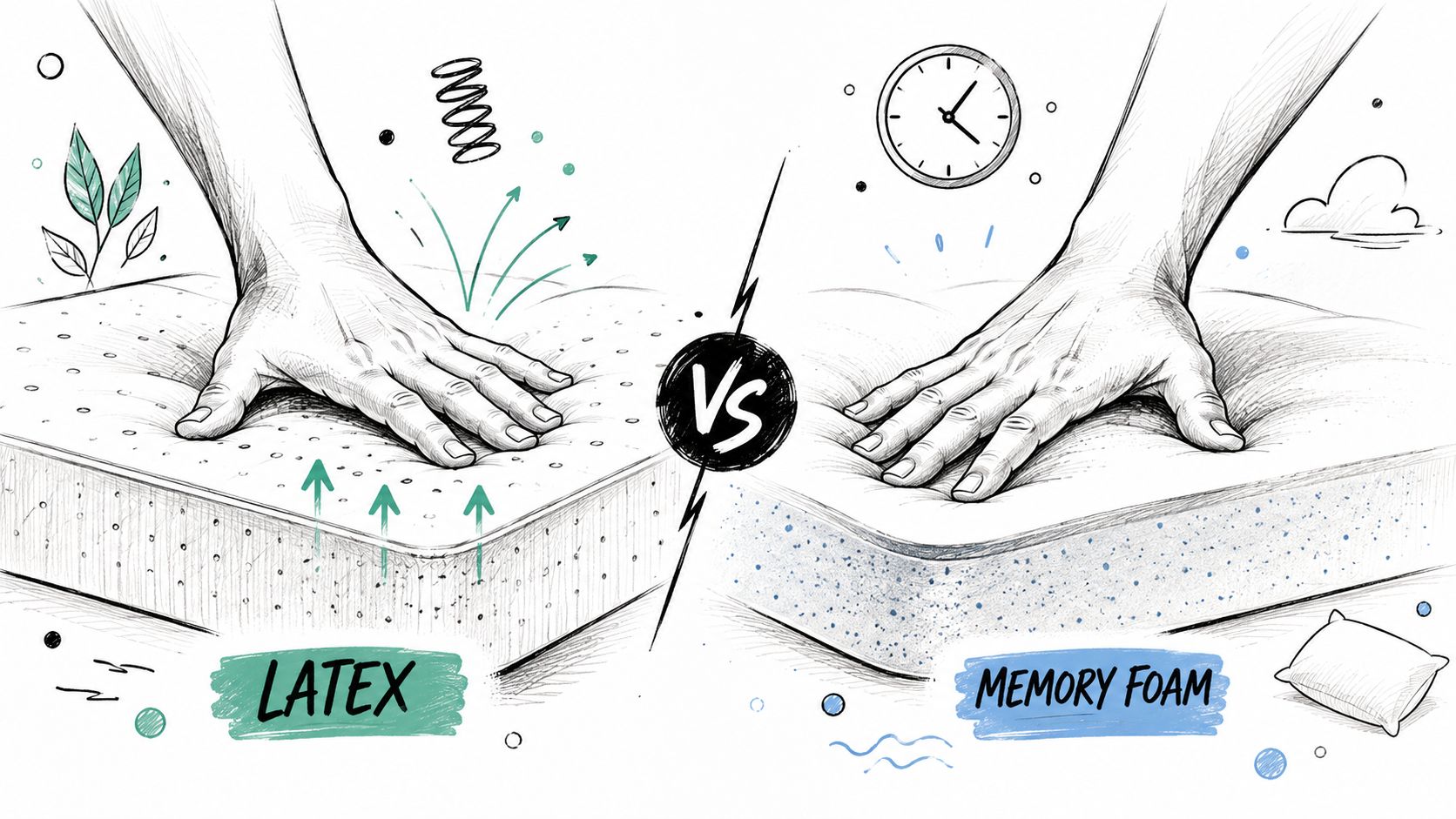
Memory foam has a slow, close-contouring response. It softens under body heat and pressure, then wraps around the sleeper more closely. People who love it often describe it as comforting and cocooning. People who dislike it usually say the same thing in less flattering terms. It can feel restrictive.
Latex feels different immediately. It compresses, but it also pushes back. Instead of letting the body settle down into the bed, it tends to hold the sleeper more on top of the surface. That creates a lifted, buoyant feel.
A simple way to think about it is this:
- Memory foam suits sleepers who want a hug.
- Latex suits sleepers who want support with freedom of movement.
For shoppers who want a deeper look at how body-conforming foam can work, this guide on the benefits of memory foam mattresses helps clarify why so many sleepers still prefer that enveloping feel.
Pressure relief and support
Memory foam usually wins the first impression test for side sleepers. It allows shoulders and hips to sink in more readily, which can reduce pressure buildup at obvious contact points. That's why so many side sleepers are drawn to it after just a few minutes of lying down.
Latex handles pressure relief differently. It doesn't erase contact with the mattress surface. It distributes weight with more push-back, which many back and stomach sleepers prefer because the body doesn't sink as far out of alignment.
A mattress can feel soft and still be wrong. If the hips dip too far or movement feels labored, comfort won't last.
This is the part many shoppers miss. Pressure relief without proper support becomes a problem fast. A mattress should cushion the body, but it also has to keep the spine from drifting into a shape that creates morning stiffness.
Cooling and motion control
Hot sleepers usually lean toward latex for a reason. According to Airpedic's comparison of latex and memory foam mattresses, high-quality natural latex mattresses typically last 15 to 20 years or more, while quality memory foam models generally last 7 to 10 years, and latex's resilience comes from an open-cell structure that maintains integrity over time. That same open-cell structure also helps explain why latex often feels more breathable. The same source notes that memory foam is a synthetic polyurethane-based viscoelastic material that tends to degrade faster under body heat and pressure. It also explains that memory foam was originally developed by NASA in the 1960s for seat cushioning, entered the consumer market in the 1980s, and that modern high-performance latex mattresses gained wider popularity in major markets in the early 2000s as demand for eco-friendly sleep solutions grew. The source also notes that natural latex often starts at $1,500 or more for a standard size, while memory foam spans a much broader range from budget to luxury.
Memory foam, even in modern versions designed to address heat, still tends to hold warmth closer to the body because of the way it contours. Some sleepers love that. Hot sleepers usually don't.
For couples, memory foam usually has the advantage in motion isolation. It absorbs movement more effectively, so one partner's turning is less likely to disturb the other. Latex still performs well, but its bounce means some movement can carry across the surface.
Long-Term Value Durability and True Cost
A mattress isn't a cheap impulse buy. Judging it only by sticker price is how shoppers talk themselves into replacing a bed sooner than expected.
Sticker price versus real value
A lower upfront price can still be the more expensive decision over time. That's the core issue in the latex mattress vs memory foam debate that many guides skip.
The clearest version of the math comes from Sleeping Organic's long-term cost comparison. It states that memory foam can cost $1,000 initially while latex costs $2,000, but natural latex lasts 15 to 25 years compared with memory foam's 7 to 10 years, making latex cheaper over time at $66 per year versus $143 per year.
That changes the conversation. A shopper who focuses only on the first payment may see latex as expensive. A shopper who focuses on years of ownership may see it as the more disciplined buy.
Latex vs Memory Foam True Cost Comparison
| Feature | High-Quality Memory Foam | High-Quality Natural Latex |
|---|---|---|
| Typical example upfront cost | $1,000 | $2,000 |
| Typical lifespan | 7 to 10 years | 15 to 25 years |
| Cost-per-year example | $143/year | $66/year |
| Replacement frequency | Sooner | Less often |
| Best value lens | Lower entry price | Better long-term value |
Another useful durability benchmark comes from Vaya Sleep's comparison of memory foam and latex, which says natural latex mattresses generally last 15 to 20 years, with high-quality models reaching up to 25 years, while memory foam mattresses typically last 6 to 10 years before sagging or permanent indentations become an issue. The same source notes that latex's natural elasticity helps it resist sagging and body impressions, while memory foam is more prone to thermal breakdown.
Buy for the years of sleep, not the moment of checkout.
That doesn't mean every shopper should stretch for latex. Some households need the lower entry cost of memory foam, and that's perfectly reasonable. But they should make that choice with open eyes. Memory foam often wins the upfront budget conversation. Latex often wins the ownership conversation.
Health and Home Allergies and Off-Gassing
Comfort isn't the only issue in a bedroom. Material choice also shapes how the room smells at first, how fresh it feels over time, and how well it supports a cleaner sleep environment.

What off-gassing actually means
Off-gassing is the release of odors and compounds that create that familiar “new mattress smell.” It's more commonly associated with synthetic foams, which is why many shoppers notice it more with memory foam than with natural latex.
That doesn't automatically make memory foam a bad option. It does mean sensitive sleepers should pay attention to materials, foam certifications, and how much synthetic smell they're comfortable tolerating during the break-in period.
A practical checklist helps:
- Check foam certifications: Certifications can help a shopper avoid lower-quality foams made with more questionable ingredients.
- Ask about material makeup: Natural, synthetic, and blended materials don't behave the same.
- Plan for ventilation: A new mattress should have airflow during setup, especially if odor sensitivity is a concern.
Which material fits a cleaner bedroom
Natural latex often appeals to shoppers who want a bedroom that feels less chemical-heavy and more breathable. It's also widely favored by people who want materials associated with resistance to dust mites and a generally cleaner sleep surface. The important caveat is simple. Anyone with a known latex allergy should steer away from latex products.
Memory foam can still work well in a health-conscious home, but it requires more attention to the specific build and materials used. A careful shopper shouldn't assume all foam mattresses are created equal.
For households trying to improve the whole sleep environment, not just the mattress, this guide on addressing indoor air for allergy sleep adds useful context. Better rest often comes from the full room setup, including air quality, dust control, and bedding choices.
A mattress can't solve every allergy issue by itself. The bedroom works as a system.
A Mattress for Every Sleeper Type
You can read reviews for hours and still end up with the wrong feel. This is the section where the choice gets practical.
The best mattress depends on how you sleep, how easily you move in bed, what kind of pressure relief you need, and how long you plan to keep it. That last point matters more than many shoppers realize. A lower sticker price can still cost more per year if the mattress wears out sooner.
Best match by sleep position
Side sleepers usually need stronger pressure relief at the shoulders and hips. Memory foam is often the better starting point because it contours closer to the body and softens sharp pressure points. If your arm falls asleep or your shoulder feels jammed by morning, start there.
Back sleepers usually do best on a mattress that cushions without letting the hips drop too far. Latex is a strong fit because it keeps the body more lifted and evenly supported. If you want support without that slow-sinking feel, latex is the smarter choice.
Stomach sleepers need firmer support under the midsection to keep the spine from bowing. Latex is usually the safer pick because it has more pushback and less sink. For many stomach sleepers, memory foam gets too soft, too fast.
Who should choose latex without overthinking it
Some sleepers have a clear answer.
Choose latex if you are:
- A hot sleeper who wants a mattress that feels cooler and less closed-in
- A combination sleeper who changes positions often and hates fighting the bed
- Planning to keep your mattress for years and care about the actual cost over time, not just the sale price
- Sensitive to that “stuck” feeling and want a surface that supports and pushes back
Latex also makes more sense for many older adults and anyone with mobility concerns. Getting out of bed and rolling from one position to another is usually easier on a buoyant surface. If you have arthritis, reduced strength, or just want the bed to cooperate with you, latex deserves serious attention.
Who should choose memory foam without overthinking it
Memory foam still wins for a specific group of sleepers.
Choose memory foam if you are:
- A side sleeper with sharp pressure points who wants more contouring around the joints
- Sleeping with a partner and bothered by movement transfer
- Shopping on a tighter budget and trying to get good comfort at a lower upfront cost
- Looking for a close body cradle instead of a lifted, springier feel
That lower entry price can be appealing, but measure it against lifespan. A mattress is not just a purchase. It is a cost per year decision. If one option feels good for a short window and another stays supportive longer, the better value may be the one with the higher ticket price.
There is also a full sleep-system piece to consider. If jaw tension, clenching, or facial pressure are part of the problem, these effective pillows for TMJ discomfort can help round out your setup. Your pillow and mattress should solve the same problem together.
If pain relief is a main reason you are shopping, our guide to the best mattress types for back pain will help you narrow the field before you step into the showroom.
How to Confidently Choose Your New Mattress
You read reviews, compare materials, and narrow the list to latex or memory foam. Then you lie down on one mattress for two minutes, like the price tag, and hope you got it right. That is how expensive mistakes happen.
Online research is useful. It helps you rule out bad fits and compare features. It does not tell you how your shoulders settle, whether your lower back stays supported, or if the mattress still feels right after you change positions three times in the night.

What to do in the showroom
Treat showroom testing like a real sleep trial, not a quick errand.
Use this checklist:
- Lie down long enough: Stay on the mattress for at least 10 to 15 minutes. Pressure buildup and support gaps often show up after the first impression fades.
- Use your actual sleep position: Side sleepers should stay on their side. Back sleepers should stay on their back. Test the way you sleep at home.
- Change positions: Roll over, shift your hips, and get in and out of bed. This matters even more in a latex mattress vs memory foam decision because response time and ease of movement feel very different in person.
- Pay attention to pressure points: Shoulders, hips, lower back, and ribcage usually tell the truth fast.
- Bring your partner if you share a bed: Motion, space, and comfort can change once two bodies are on the mattress.
Do not judge a mattress by pressing on it with your hand. That tells you almost nothing about overnight comfort.
If you want a practical framework before you visit the store, this guide on how to shop for a mattress will help you test more effectively and ask better questions.
What to confirm before buying
Feel matters, but the smart choice also shows up on paper. In such analysis, long-term value materializes.
- Warranty terms: Know what counts as a defect and what does not.
- Return or comfort policy: A mattress can take time to adjust to, but you still need a clear path if it is wrong for you.
- Foundation compatibility: Some mattresses need specific support underneath to perform the way they should.
- Full sleep setup: Your pillow, protector, sheets, and adjustable base can change how the mattress feels.
- Expected lifespan: A lower sticker price does not always mean lower cost. Divide the mattress price by the years you reasonably expect to use it. That yearly cost is the number that matters.
A mattress that costs less upfront but needs replacing sooner can cost you more per year. A mattress with a higher ticket that holds comfort and support longer often ends up being the better buy. That is why smart shoppers compare feel, policy, and cost per year together.
The final step is simple. Test the mattresses in person and talk through your sleep habits with a certified Sleep Expert. That combination closes the gap between online research and real-world comfort. You can compare latex and memory foam side by side, check how each one feels under your body, and decide with more confidence instead of guesswork.
Ready to stop guessing? Visit Miller Waldrop Furniture & Decor, work with a certified Sleep Expert, and test trusted options like Serta and Beautyrest in person so you can choose the mattress that feels right and makes sense for the long haul.