


Glass Coffee Table Sets: The Complete Buyer’s Guide


Are glass coffee table sets still practical for real homes, or are shoppers choosing them because a staged room makes every material look easy? The answer depends less on fashion than on household habits, room proportions, safety specifications, and maintenance tolerance. Glass can make a compact room feel open and polished, but the wrong table can also create daily frustration, visible fingerprints, and avoidable injury risks.
A glass coffee table set should earn its place through function, not just transparency. The right choice gives a living room a lighter visual footprint, supports the seating arrangement, and uses safety glass with a stable, well-designed base. The wrong choice prioritizes appearance while ignoring how children, pets, guests, spills, and everyday impact will affect the room.
Is a Glass Coffee Table Right for Your Home
Could a glass coffee table set improve your room, or would it turn everyday living into a constant cleaning and safety task? The answer depends on household habits, room proportions, safety specifications, and maintenance tolerance. Clear glass can preserve sightlines and make a compact room feel less crowded, but it still shows fingerprints, water rings, toys, paws, and edge damage.
Choose glass for a practical reason, not only because a staged room makes it look effortless. A well-made set supports the seating arrangement, keeps the floor visually open, and suits a household prepared to handle a more demanding surface. A poor match creates frustration, especially around children, pets, guests, and frequent spills.
Glass has a legitimate place in furniture design. Luigi Massoni's 1981 Supercalif coffee table for Gallotti & Radice is a notable example in the collectible glass coffee table category. Glass furniture also includes dining tables, desks, chairs, and display cases, so glass coffee table sets belong to a mainstream furniture category rather than a purely decorative niche. This evolution from functional surface to design statement is explored in Whoppah's overview of glass coffee table design history.
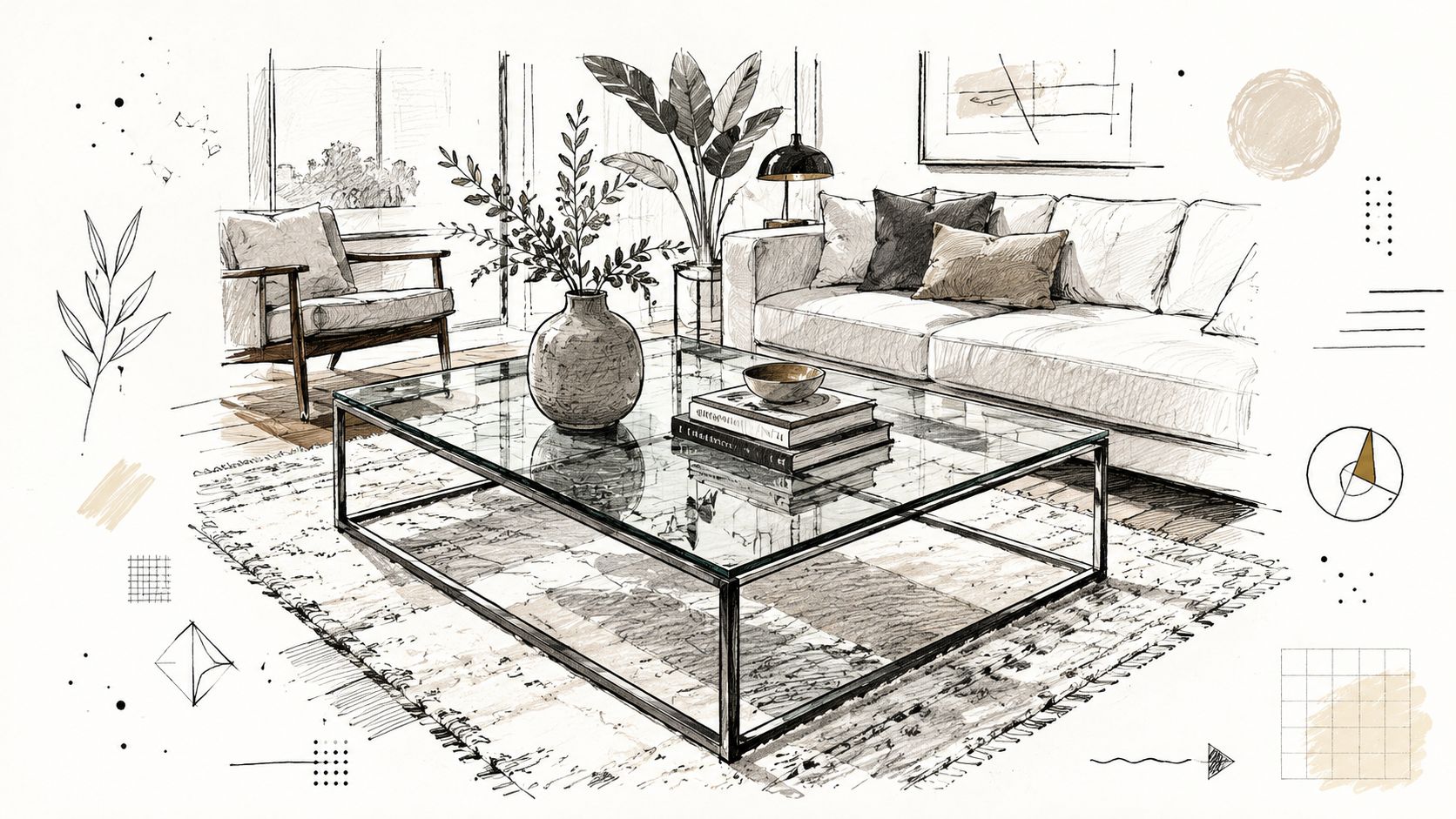
Where glass performs best
Glass suits small apartments, open-plan rooms, formal sitting areas, and interiors with strong rugs or architectural details. A clear top keeps the rug and flooring visible, while a slim metal or wood base adds definition without making the room feel closed in. Nesting or matched tables offer useful flexibility. Separate the smaller pieces when guests arrive, then regroup them afterward.
Glass also fits the longer history of architectural design, where transparent surfaces have helped bring light and openness indoors. For background on that development, see Cultivate House Detailing on window origins.
A set works well for buyers who want a refined surface and accept regular wiping. The broader glass furniture market includes residential, hospitality, and office use. HTF Market Insights estimates the category at USD 4.7 billion in 2024, with a projection of USD 12.5 billion by 2033 and a 12.9% compound annual growth rate from 2024 through 2033, as reported in HTF Market Insights' glass furniture market report.
Where another material makes more sense
Families with toddlers, children who play beside the seating area, or pets that jump onto furniture should assess glass with particular care. Rounded or oval edges reduce exposed corners, but they do not solve instability, impact, or poor construction. If the table will serve as a footrest, work surface, craft station, or informal seat, choose a material intended for that treatment.
Practical rule: If the room's real life is rougher than the showroom display, choose durability first and transparency second.
Glass is also a poor fit for anyone who dislikes visible maintenance. Wood hides minor smudges better, and textured or darker surfaces feel less demanding between cleanings. Select a glass set when its openness benefits the room and your household can live with its upkeep. Otherwise, another material will serve you better.
Understanding Glass Safety Standards and Quality
The most important question isn't whether a tabletop looks thick or expensive. It's whether the horizontal surface uses tempered or laminated safety glass, whether the base supports it correctly, and whether the seller can provide meaningful documentation.
ASTM F2813 covers desks and tables under 44 inches, or 1118 millimeters, and permits tempered or laminated safety glass while excluding monolithic annealed glass. The standard includes unenclosed horizontal surfaces such as coffee tables and calls for safety glass that complies with ANSI Z97.1. The ASTM F2813 standard details and the Glass Association's furniture guidance translate the requirement into a simple buying principle: don't accept ordinary annealed glass for a coffee table top.
Tempered and annealed glass behave differently
Annealed glass can break into large, sharp shards. Tempered glass is processed so it generally fragments into many smaller pieces when it fails, reducing the likelihood of severe cutting and piercing injuries. Tempered glass is often described as three to five times more durable than ordinary annealed glass, but that doesn't make it indestructible. Care guidance for tempered glass furniture emphasizes that edge impacts and thermal shock remain important vulnerabilities.
A buyer should ask the retailer for the glass type, certification information, and care instructions. If a product listing says only “glass top,” that description isn't enough. The seller should identify the safety treatment rather than leaving the shopper to infer quality from photographs.
Inspect the complete load path
A safe top still needs a safe base. Wobble, concentrated pressure at a small support point, poor edge finishing, and loose attachment hardware can create risks that the glass label alone won't fix.
Furniture testing guidance includes structural stability and impact resistance. SATRA notes that European furniture standards such as EN 12521 and EN 15372 include vertical impact testing, with safety-glass conditions using drop heights of 180 millimeters or 240 millimeters, depending on severity. SATRA's furniture glass safety guidance also highlights the trade-off between impact resistance and residual strength after critical damage.
Before purchase, check these points:
- Glass identification: Confirm tempered or laminated safety glass.
- Edge finishing: Look for smooth, polished edges without chips, rough corners, or exposed damage.
- Top attachment: Verify that the top sits securely and cannot slide easily across the frame.
- Base stability: Push gently from several directions. A quality set shouldn't wobble or rock.
- Corner exposure: Choose rounded or softened profiles when children or high foot traffic are part of daily life.
A consumer safety test found significant quality variation among glass-top tables, including samples that broke into long, uneven shards. Consumer Council guidance on glass-top table safety recommends checking the glass type, inspecting how the top attaches, using corner guards where appropriate, and avoiding sharp corners. Those are practical checks, not technical trivia.
Getting the Size and Proportions Right
A glass coffee table set can be beautifully made and still feel wrong if it blocks movement or sits too far from the sofa. Proportion determines whether the room feels relaxed or awkward, and clear glass doesn't excuse poor planning.
Start with the sofa seat. The tabletop should sit level with the sofa cushions or approximately one to two inches lower, with many coffee tables landing around 16 to 18 inches from the floor. This coffee table height guide gives shoppers a reliable starting point. A table that sits noticeably higher than the cushions can feel intrusive, while one that sits too low may make drinks and devices uncomfortable to reach.
Measure the seating relationship
Measure the sofa, sectional, chairs, and the open walking routes before looking at finishes. The table should serve the seating rather than dominate it. A rectangular set usually suits a standard sofa, while a round or oval arrangement softens a room filled with straight lines and makes circulation easier around corners.
For a long sofa, a longer main table gives each seat practical access. For a sectional, the usable opening inside the L-shape matters more than the sofa's full outside length. A nesting arrangement can solve uneven access because the smaller tables can move toward a chair or conversation area when needed.
A useful measurement process looks like this:
- Record the sofa seat height. Use the cushion surface, not the floor-to-frame measurement.
- Mark the table footprint. Painter's tape on the rug shows the visual and walking impact.
- Test every approach. A seated person should be able to reach the surface without leaning across another person's space.
- Check the traffic route. If people walk between the sofa and kitchen, a rounded profile may prevent repeated collisions.
- Account for the full set. Nesting tables need room to separate without blocking chair legs or doorways.
The coffee table selection guide from Miller Waldrop can help shoppers coordinate table scale with existing living room furniture. The key decision remains physical: tape the footprint, sit in the room, and test the route before ordering.
Match shape to the room
Rectangular glass coffee table sets make sense in narrow rooms because they follow the sofa's length. Round and oval sets suit compact or high-traffic spaces because their curves reduce hard visual stops. Square sets work best when seating surrounds the table on several sides, especially in a large conversation area.
A set should leave enough room for comfortable passage and access, but the exact clearance depends on the room, sofa depth, chair position, and household movement. The safest approach is to judge the actual layout rather than rely on a universal spacing formula.
Comparing Glass to Wood and Metal Alternatives
Glass offers visual lightness, while wood and metal handle everyday demands differently. Choose by the table's main job: keeping sightlines open, absorbing family wear, or adding structure and storage.
| Factor | Glass | Wood | Metal |
|---|---|---|---|
| Visual effect | Keeps sightlines open and makes rugs and flooring more visible | Adds warmth, texture, and visual weight | Creates a structured, industrial, or minimalist presence |
| Daily maintenance | Shows fingerprints, dust, and water marks quickly | Usually hides minor marks better, depending on finish | Easy to wipe, though polished finishes may show smudges |
| Impact behavior | Requires safety glass and careful edge protection | Often tolerates ordinary household knocks more forgivingly | Strong frame material, but edges and corners can still feel hard |
| Scratch and damage response | Scratches and chips can remain highly visible | Minor wear may blend into the character of the finish | Scratches may expose a different finish or create sharp damage |
| Family fit | Best for careful households and deliberate placement | Strong choice for busy family rooms | Useful for sturdy, contemporary arrangements |
| Styling role | Light, refined, and visually quiet | Warm, grounded, and tactile | Clean-lined, graphic, and architectural |
Use the household's behavior as the deciding test. If your family does more craft projects, homework, or snack-heavy activities at the table than decorative styling, choose wood. Its greater tolerance for ordinary dents and marks makes it safer for that routine, even if glass looks better in the showroom photo. If the table sits in a formal room with controlled use, clear glass can be the better fit.
Glass is the visual specialist
Glass wins when a room needs openness. It keeps a patterned rug visible and can balance a large sofa without adding another heavy block. A glass top also works well with metal frames, timber bases, stone details, and sculptural forms.
The trade-off is constant exposure. Fingerprints, dust, and water marks appear quickly, so this is a poor choice for households that do not want frequent wiping. A severe edge strike can cause serious failure even when the glass is tempered. Safety glass reduces the risk of dangerous breakage, but it does not make the top suitable for sitting, standing, or careless storage of hot and cold items.
Wood is the practical all-rounder
Wood suits households that want warmth, storage, and a forgiving finish. It absorbs the visual disorder of remotes, books, toys, and snacks more successfully than clear glass. Grain, color, and substantial proportions can add character without making a room feel visually busy.
Wood still needs care. Finishes can stain, dent, fade, or react to moisture, and an oversized wooden table can overwhelm a compact room. Its advantage is a more forgiving response to ordinary family life, not immunity from damage.
Metal brings structure
Metal works when the room needs a crisp base, strong contrast, or a contemporary edge. It can support a glass top while keeping the silhouette slim. An all-metal table, however, may feel colder and less comfortable in a soft family room.
Choose the shape and construction before trusting the material label. For children and pets, rounded forms and stable bases matter more than whether the table is glass, wood, or metal. A sharp-cornered metal frame can be less suitable than a well-finished wooden table, while a softened-edge glass set may work in a carefully managed formal room. The right material follows daily behavior, not showroom styling.
Styling Glass Tables in Different Room Settings
Glass coffee table sets create their strongest effect when the styling respects their transparency. The surface shouldn't become a crowded display shelf. It should frame a few deliberate objects while allowing the base, rug, and floor to remain part of the composition.

A minimalist room needs texture
In a modern room with a pale sofa, slim frame, and restrained palette, a glass top can risk looking sterile. The fix isn't more decoration. A low ceramic bowl, a small stack of books, and one plant with a sculptural silhouette create warmth without hiding the table.
A darker rug beneath the table can define the footprint and give the clear top something to sit against visually. Soft textiles on the sofa, a textured throw, and timber or woven accents elsewhere keep the transparent surface from becoming the only material statement.
A traditional room benefits from contrast
In a traditional living room, glass can prevent a collection of upholstered seating from feeling overly heavy. A table with a wood base or warm metal detail connects the transparent top to existing furniture, while a tray organizes smaller objects and protects the surface from scattered condensation.
For a room used for entertaining, the set can separate into practical landing spots. One table can hold drinks near the sofa, while the second supports books, flowers, or serving pieces near a chair. The arrangement should remain easy to clear before guests arrive.
Styling principle: Transparent furniture needs fewer objects, but those objects need stronger shape, texture, or color.
An open-plan room needs visual continuity
Open-plan spaces often benefit from glass because the table doesn't interrupt sightlines between living, dining, and kitchen areas. A rounded set can echo curved seating or lighting, while a rectangular design can reinforce the geometry of a long room.
Seasonal updates should stay simple. Replace a heavy winter arrangement with a lighter bowl or a small plant, then remove accessories entirely when the table needs to function as a serving surface. For more detailed arrangement ideas, the guide to decorating a coffee table offers a useful framework for balancing beauty and access.
The base deserves attention too. A sculptural frame can carry the visual interest, allowing the top to remain mostly clear. That approach works especially well with glass coffee table sets because it makes the structure visible from every angle.
Daily Care and Long-Term Maintenance
Glass coffee table sets stay presentable when cleaning, inspection, and hardware checks become routine. The goal is to catch small changes before they affect stability or create a larger repair problem.
Use a clean microfiber cloth for dust and a glass-safe cleaner for fingerprints. Spray the cloth, not the tabletop, so liquid does not collect around joints, metal fittings, or frame connections. Avoid abrasive pads, gritty powders, ammonia-heavy cleaners on sensitive finishes, and rough scraping tools. These can scratch glass or dull painted, plated, and wood frames. Use the cleaner recommended for each frame material, and test it on a hidden area first.
A simple household routine
Build maintenance into normal room care:
- Daily reset: Remove cups, crumbs, toys, and grit before wiping. Check that no object has been dragging across the surface.
- Spill response: Blot liquid promptly, then dry the tabletop and any frame contact points.
- Weekly inspection: View the glass at an angle under bright light. Hairline lines that catch the light, tiny star-shaped marks, cloudy spots, or a rough edge can signal a micro-fracture rather than ordinary dirt.
- Monthly hardware check: Test for wobbling, shifted pads, or a connector that turns by hand. Tighten fasteners according to the manufacturer's instructions, without forcing them.
- Seasonal refresh: Lift trays and décor to clean covered areas, inspect the supports, and confirm that protective pads remain flat and secure.
Keep the tabletop clear enough to inspect. Never sit or stand on it, and keep hard objects from contacting the edge. Use coasters and trivets to reduce routine wear, while leaving enough space around accessories for easy wiping.
Inspect the base, not just the shine
A loose suction pad, shifted connector, or uneven leg can change how weight travels through the set. Watch for a new wobble, a top that shifts when touched, gaps at a joint, or a fastener that repeatedly loosens. These are maintenance warnings, not cosmetic details. Stop rearranging or loading the affected table, photograph the condition, and ask the retailer or a qualified glass professional for advice.
For a clear cleaning routine, browse glass care tips from South Mountain Window Cleaning, LLC. Use clean tools, remove grit before wiping, and keep cleaner away from frame materials that may react to it. Never polish a suspected fracture or drill into a fitting, since either action can add pressure to the assembly.
Making Your Purchase with Confidence
A confident purchase starts with a product that can answer practical questions clearly. A photograph can show the finish and silhouette, but it can't prove that the top is safety glass, reveal a loose fitting, or show whether the base wobbles on a real floor.
A retailer should be able to explain the glass type, the table's dimensions, the construction of the base, the care requirements, and the delivery process. If those answers aren't available, the buyer is being asked to accept risk without enough information.
Use a showroom and online checklist
Before ordering glass coffee table sets, shoppers should verify:
- Safety documentation: The listing or sales consultant identifies tempered or laminated glass.
- Edge condition: The design uses smooth, finished edges and avoids unnecessary sharp corners.
- Base connection: The top attaches securely without visible looseness or sliding.
- Room fit: Measurements have been tested against the sofa, rug, chairs, and walking routes.
- Maintenance match: The household accepts regular wiping and careful handling.
- Delivery planning: The retailer explains how the glass will be protected, carried, placed, and inspected.
A showroom visit adds value because shoppers can test stability, see the edge treatment, compare transparency and tint, and judge whether the table feels substantial rather than fragile. Online shoppers should request missing specifications before placing an order, especially when the product description uses broad terms such as “premium glass” without identifying the safety treatment.
For broader coffee table ideas and category guidance, the coffee table collection from Miller Waldrop gives shoppers another place to compare silhouettes and room applications. Miller Waldrop Furniture & Decor also lists coffee tables and occasional table sets, including options with glass tops, so buyers can use its catalog as one tool while evaluating materials, proportions, and matching pieces.
The strongest purchase combines suitable glass, a stable base, correct scale, and a retailer that supports delivery and setup. A beautiful set becomes a smart investment only when it works for the people who use the room every day.
Miller Waldrop Furniture & Decor offers coffee tables, occasional table sets, and living room furnishings that can help shoppers coordinate glass surfaces with the right seating and room proportions. Visit Miller Waldrop Furniture & Decor to explore options and get personalized guidance for a safe, well-scaled living room arrangement.