


How to Identify Quality Sofa Brands That Last


A famous sofa name won't guarantee a sofa that survives real life. A household can spend heavily on a recognizable brand, then discover that the chosen model has a fragile frame, low-density foam, or upholstery that can't handle pets and children. The logo matters, but the specific construction, cushion fill, suspension, fabric, warranty, and delivery support matter more.
The practical question isn't which brands are reputable. It's which configuration fits the way a household sits, spills, cleans, moves, and lives. The checklist below turns quality sofa brands from a reputation exercise into something shoppers can test with their hands, verify with staff, and compare using actual specifications.
Why the Brand Name Is Only Half the Story
A family once replaced a sofa that had looked impressive in the showroom. The brand was well known, the silhouette suited the room, and the fabric felt luxurious. After daily movie nights, children climbing over the arms, and a dog claiming one cushion, the seats lost their shape and the frame began to feel loose. The problem wasn't necessarily the name on the tag. It was the particular combination of frame, suspension, fill, and upholstery selected for the room.
That distinction matters because the same manufacturer can offer entry-level, mid-range, and premium constructions. One model may use a strong hardwood frame and resilient cushion core, while another relies on less substantial materials to meet a lower price point. A brand reputation can help create a shortlist, but it can't replace model-level inspection.
The wider market explains why shoppers encounter so many different levels of construction under familiar names. In the U.S. upholstered furniture market, sofas were the largest product category, representing 34.70% of sales in 2025, while residential furniture represented 69.40% of demand and specialty furniture stores held 39.20% of distribution share, according to Grand View Research's U.S. sofa market analysis. The market was estimated at USD 21.15 billion in 2025 and USD 22.25 billion in 2026, with a projection of USD 28.63 billion by 2031 at a 5.18% CAGR, so brands serve a broad range of budgets and use cases.
The logo is a starting point, not a verdict
Quality shows up in details a shopper can request:
- Frame: Ask whether the wood is kiln-dried hardwood and how the joints are reinforced.
- Suspension: Find out whether the sofa uses eight-way hand-tied springs, high-quality sinuous springs, or another support system.
- Cushions: Request the foam density and ask whether the core is wrapped in fiber, down, or another comfort layer.
- Upholstery: Look for a Martindale abrasion rating and ask how the fabric responds to cleaning.
- Ownership support: Read the warranty and ask about replacement cushions, parts, repairs, and damaged deliveries.
A living room also needs visual balance. Shoppers planning artwork around a new sofa may find these gallery wall layout tips useful, especially when the sofa's height and arm profile affect the composition.
By the end of a showroom visit, a shopper should be able to explain why a particular sofa fits the household, not merely repeat that the brand is popular. That shift protects the budget and makes the final choice more personal.
Inside a Well-Built Sofa From Frame to Cushions
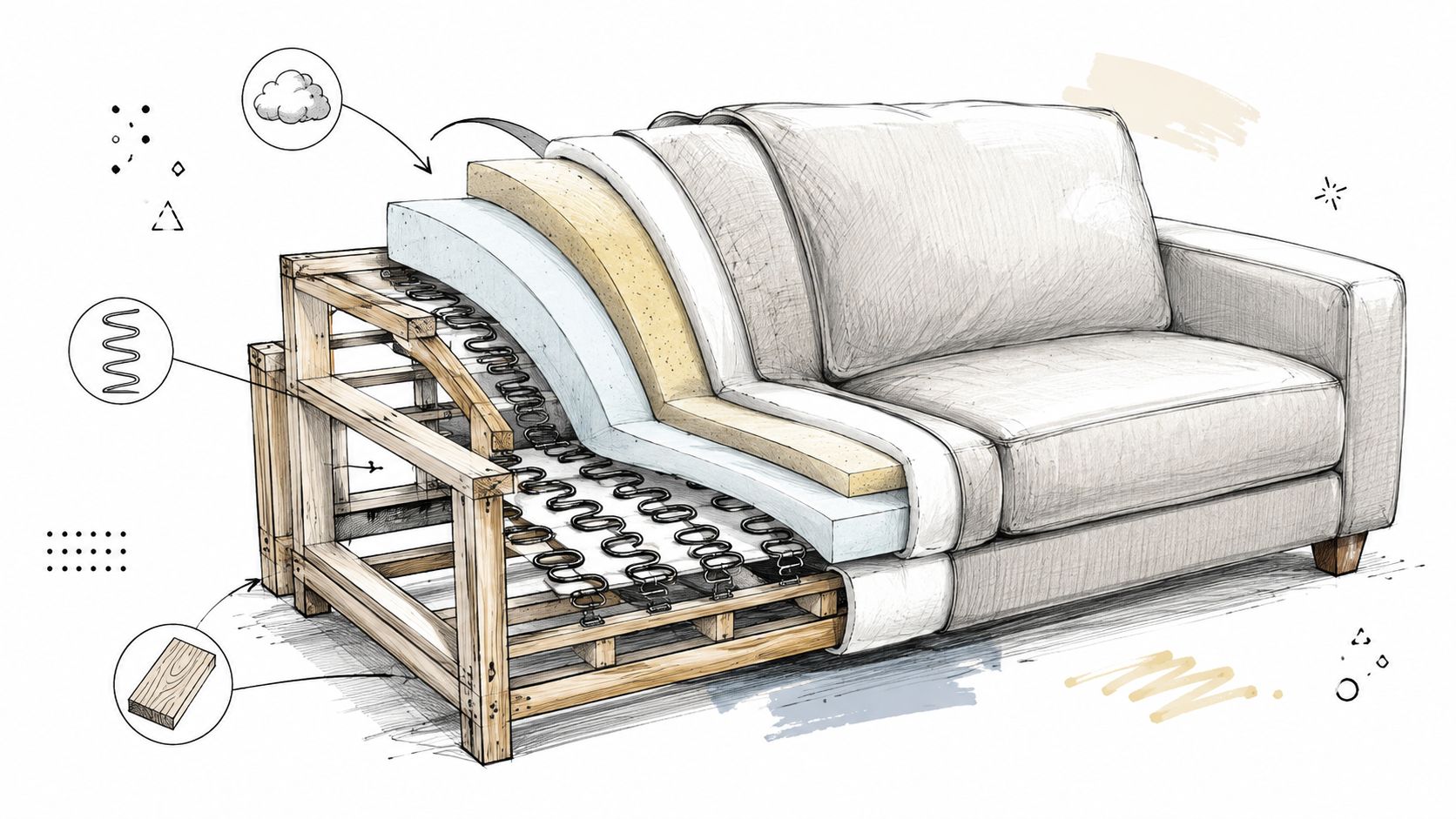
A sofa works much like a body. The frame is the skeleton, the suspension is the muscles, and the cushions and upholstery form the layer that shapes contact and comfort. A weakness in one part places extra stress on the others.
Start with the skeleton
A quality frame begins with wood that has been prepared for indoor life. Kiln-drying removes 90–95% of the wood's moisture, reducing the risk of warping, cracking, and bowing, as explained in this guide to high-quality sofa construction. The same guidance gives solid-wood frames a potential lifespan of 15–25 years, compared with 5–10 years for particleboard or softwood construction.
The joinery deserves equal attention. Dowels, screws, and corner blocks create stronger connections than a frame that depends only on staples or adhesive. Corner blocks reinforce the places where the rails meet, helping the sofa resist twisting when someone sits heavily on one side or leans against an arm.
A shopper can't always see the frame, so staff should be able to explain its material and construction. A vague answer doesn't prove poor quality, but a clear specification gives the buyer something real to compare.
Check the support beneath the cushions
Suspension distributes body weight between the frame and cushions. Eight-way hand-tied springs create an interconnected support network, while well-made sinuous springs use shaped steel wires to provide consistent support across the seat. Neither label should be accepted blindly. The relevant questions concern the spring material, spacing, attachment, and how the system is engineered for the model.
A strong suspension system helps prevent the cushions from taking all the load. If the support flexes unevenly, the cushion can compress in the same spot repeatedly, producing a hollow or tilted seat.
Treat cushion fill as a specification
Comfort isn't the same as softness. A cushion can feel plush on the first day and still lack the resilience needed for daily use. Daily-use couch cushions are commonly recommended at 2.5 to 2.9 lb/ft³, with 1.8 lb/ft³ often treated as a practical minimum for seating, according to foam cushion guidance from Foam Order. Low-density foam around 1.2 to 1.7 lb/ft³ may flatten within two to three years under daily use, while high-density foam in the 2.5 to 3.0+ lb/ft³ range can last well over a decade.
High-resilience foam provides a supportive core. A down or fiber wrap adds surface softness without asking the outer material to provide all the structure. Removable cushions also allow rotation and inspection, although reversibility depends on the design.
For a deeper look at how silhouette and upholstery choices work together, shoppers can explore this mid-century sofa cover design resource from The Sofa Cover Crafter. A practical construction checklist is also available in this guide to what to look for in a new sofa or chair.
Practical rule: A sofa is only as dependable as the relationship between its frame, suspension, and cushions. Premium wording applied to one component can't compensate for a weak component beneath it.
Choosing Upholstery That Survives Your Real Life
The fabric is the part of the sofa that meets muddy paws, denim, snack crumbs, sunlight, and repeated cleaning. A strong frame won't make a delicate upholstery choice suitable for a busy family room. Durability starts with matching the textile to the room's workload.
The Martindale test gives shoppers a more useful comparison than the word “durable.” The fabric is rubbed in a controlled circular motion until visible wear or yarn breakage appears, and the result is recorded as the number of cycles completed. For everyday household sofas, 25,000 to 30,000 cycles is commonly described as sufficient, while higher-use settings may call for 30,000+ cycles, according to this Martindale rub test explanation.
Families with children, pets, or frequent entertaining can look for 25,000 to 35,000 rubs for heavy domestic use. Another upholstery guide identifies 30,000+ rubs as a common benchmark for high-traffic family use, while 20,000 to 25,000 rubs is more typical for standard residential sofas. Those thresholds don't predict stain resistance, fading, pilling, or comfort, but they do provide a concrete abrasion benchmark.
Upholstery durability by household use
| Fabric / Threshold | Best For | Watch Outs |
|---|---|---|
| 20,000 to 25,000 rubs | Standard residential seating and lower-traffic rooms | May be a limited choice for pets, children, or constant lounging |
| 25,000 to 30,000 rubs | Everyday family rooms with ordinary household use | Abrasion resistance doesn't automatically mean stain resistance |
| 25,000 to 35,000 rubs | Heavy domestic use, including sustained daily wear | Confirm cleaning instructions and colorfastness |
| 30,000+ rubs | High-traffic family rooms and frequent entertaining | A high count can't correct poor cushion construction or unsuitable fit |
Leather isn't automatically the toughest option
Many shoppers assume leather is the safest durability choice because it looks substantial and is easy to wipe. Recent coverage summarized in Forbes' sofa buying guidance challenges that shortcut. In a 2026 Which? survey, reported damage or wear affected 16% of wool sofa owners, 21% of wool-blend owners, 40% of real-leather owners, and 57% of faux-leather owners.
That doesn't make wool the right answer for every household, and it doesn't make all leather poor. It shows why material, finish, cushion fill, pets, cleaning habits, and household behavior must be considered together. A guest room may suit a softer, lower-traffic textile. A family room may justify a higher rub threshold and removable or cleanable covers.
Before choosing, households should also plan for spills. Practical stain removal guidance from Professional Window Cleaning can help with general cleaning decisions, while the more important sofa-specific step is following the manufacturer's care code rather than applying a household cleaner at random. For a broader upholstery selection framework, shoppers can review how to choose upholstery fabric.
Reputable Quality Sofa Brands and What They Are Known For
Several names dominate conversations about quality sofa brands in the U.S. market, including La-Z-Boy, Flexsteel, Ashley, Hooker, and Bassett. Market presence shows that these companies have wide distribution. It does not prove that every sofa in each catalog uses the same frame, suspension, foam, or upholstery.
A brand works like a neighborhood guide, not a final inspection. One manufacturer may sell reclining sofas, stationary designs, entry-level collections, and upgraded configurations. Compare the individual model's specifications, because the frame is the skeleton, the suspension acts like muscles, and the cushions determine much of the daily comfort.

Match the reputation strength to the household
| Brand | Common reputation strength | Shopper priority to investigate |
|---|---|---|
| La-Z-Boy | Motion comfort and broad living-room customization | Reclining mechanism, seat feel, upholstery, and service terms |
| Flexsteel | Resilient support systems and practical comfort | Suspension details, frame construction, and replacement support |
| Ashley | Broad selection across styles and value levels | Exact collection specifications, cushion density, and fabric rating |
| Hooker | Established design presence and traditional styling | Frame, joinery, finish quality, and model-level warranty |
| Bassett | Customizable looks and upholstery choices | Fabric performance, cushion construction, frame details, and configuration fit |
Bassett deserves the same model-level review as the other names. Ask whether the selected frame uses kiln-dried components, what joins the rails, how the suspension is attached, and whether the cushion construction matches the sofa's expected use. Its customization options can help a household fit a room, but appearance and fabric choice do not verify internal durability.
Check the practical evidence behind a reputation: clear product specifications, published compliance information, and warranty language that identifies covered components. A showroom team that can answer those questions gives shoppers more useful information than a logo alone.
Verify safety and performance claims
Visual design is only one quality measure. The U.S. General Services Administration's upholstered furniture test method evaluates performance characteristics of seats, backs, arms, and legs, as described in the GSA upholstered furniture test method. California's TB 117-2013 addresses smolder resistance in cover fabrics, barrier materials, resilient filling materials, and decking materials, with criteria related to char length, smoldering, and transition to open flaming.
Shoppers do not need laboratory training. Ask whether the specific product line has independent testing compliance for structural durability and applicable flammability requirements. Quality brands should be able to connect claims to a model, material, or test record.
How to Test a Sofa in the Showroom
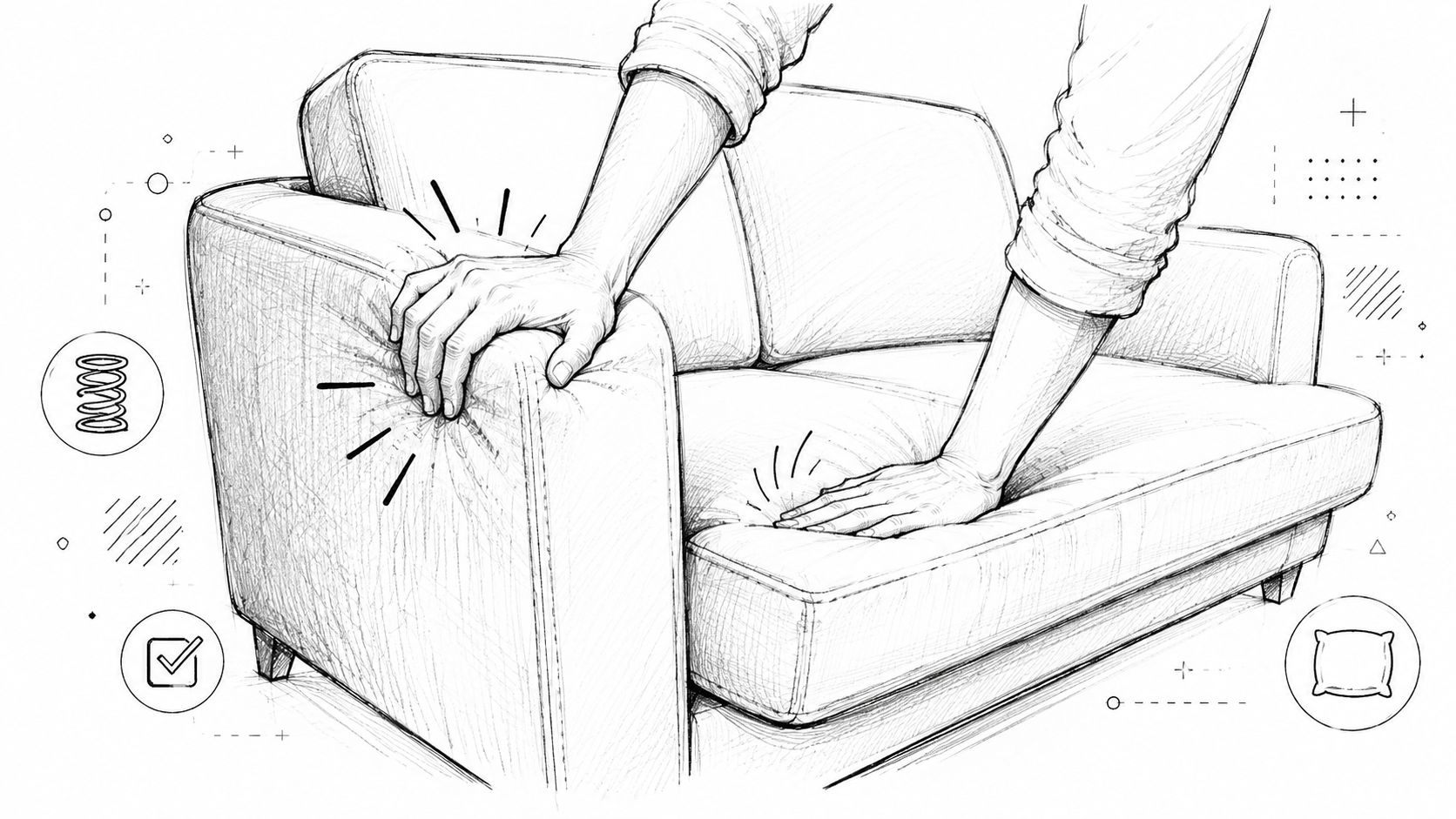
Spend five minutes in the position you use at home. Lean back, shift your weight, and place your feet where they naturally rest. This practical test shows whether the sofa supports your posture and suits your daily habits better than appearance alone.
Sit, shift, and listen
Check whether the seat supports your body without forcing an awkward position. The back height should suit your frame, while the seat depth should let you rest comfortably without pressure behind the knees.
Listen as you move. Creaking, popping, or grinding may point to movement in the frame or suspension. Ask a salesperson to explain any noise before you buy, then decide whether the cause fits the model's construction.
Test the frame without damaging it
Press the outside of an arm and the back rail. A well-assembled frame should feel firm rather than hollow or loose. A gentle side-to-side check can reveal wobble. Keep the movement controlled, since a rough shake can damage the furniture.
With staff approval, lift one front corner slightly. A substantial frame often feels solid and balanced. Weight does not certify quality by itself, but an unexpectedly light sofa deserves questions about its materials and internal support.
Showroom habit: Ask what makes this specific model durable, then compare the answer with your household's use, including children, pets, and long sitting sessions.
Inspect the parts that can be maintained
Remove a seat cushion if the design permits it. Look for a resilient core, even edges, and a cover that fits without excessive looseness. A quality zipper can simplify cleaning or service. A reversible cushion can spread wear when both sides are intended for use.
Ask four direct questions:
- What wood is used in the frame, and is it kiln-dried?
- Which suspension system supports the seats?
- What is the cushion foam density?
- What is the upholstery's Martindale rating and cleaning code?
The answers connect showroom impressions with measurable construction details. Foam density affects how a cushion supports the body and recovers from use. A Martindale rating helps indicate abrasion resistance, while the cleaning code shows which care methods the fabric permits.
A reputable showroom should answer clearly and identify the information for the specific model. That makes comparison fairer and helps shoppers choose materials suited to real household wear, rather than relying on a familiar name or polished display.
Warranties Delivery and the Full Cost of Ownership
A sofa's quality includes what happens after purchase. A strong frame and durable upholstery matter, but so do delivery planning, warranty terms, and access to repairs when a seam opens or a cushion needs replacement.
Custom ordering can involve a substantial wait. Wirecutter has noted that many custom sofa options can take two to three months to arrive. Delivery timing also affects ownership: a sofa that arrives damaged, lacks parts, or cannot pass through the entryway creates problems before anyone sits on it. Ask about lead times, inspection procedures, and the process for reporting damage before placing the order.
Read the warranty like a contract
A “limited warranty” label leaves important questions unanswered. Review these points for the specific model:
- Covered components: Check whether the frame, suspension, cushions, mechanisms, and upholstery have separate terms.
- Duration: Confirm the coverage period for each component instead of relying on one headline term.
- Labor and transport: Ask whether inspection, service, pickup, or shipping costs are included.
- Exclusions: Look for restrictions involving commercial use, stains, pet damage, normal wear, or improper cleaning.
- Remedies: Find out whether the manufacturer repairs the sofa, replaces it, supplies parts, or prorates the claim.
Miller Waldrop's warranty information shows the type of service information shoppers should review before committing to a major furniture purchase. Treat the warranty like a maintenance map. It explains which parts receive support and which everyday problems remain the owner's responsibility.
Ask what happens after delivery
Measure the sofa, doorways, hallways, turns, and stairways before ordering. Then ask how the retailer handles visible damage, concealed damage found after unpacking, missing parts, incorrect fabric, and a configuration that does not fit the room. Get the answers in writing.
Repairability affects long-term value. Removable cushions, replaceable components, and accessible service support can keep a sofa useful when one part fails. A fixed, difficult-to-service design may turn a small problem into a replacement decision. Total value includes construction, delivery protection, warranty clarity, repair support, and fit.
Shopping Quality Sofa Brands Near You in West Texas and New Mexico
Shoppers in Lubbock, Hobbs, and Ruidoso Downs can take this checklist directly to three local showrooms instead of guessing from photos online. Miller Waldrop Furniture & Decor is a family-owned retailer serving Lubbock, Texas, Hobbs, New Mexico, and Ruidoso Downs, New Mexico, with a history of over 70 years. Its showrooms carry Flexsteel, La-Z-Boy, Ashley, and Hooker, so shoppers can compare models by construction, comfort, and intended use rather than by advertising alone.
At each showroom, sit in several models long enough to notice how your posture feels. Check seat depth, arm firmness, cushion recovery, and whether the frame feels steady when you shift your weight. Ask to examine fabric specifications, available configurations, warranties, and delivery procedures. Custom-order choices can match the sofa to a room's dimensions and a household's routines. Financing, a Low Price Promise, and complimentary design guidance may also help organize the purchase.
Match the sofa to daily demands. A household with pets may place greater value on cleanable upholstery and a high abrasion rating. A formal sitting room may call for sharper tailoring and a different comfort balance. Tight doorways require careful measurements and a delivery plan that limits fit problems.
Bring the checklist, test without rushing, and request specifications in writing. Browse living room furniture options before visiting, then use the appointment to assess construction, upholstery, comfort, and service terms.
Miller Waldrop Furniture & Decor offers established-brand sofas, custom fabric and configuration choices, design guidance, financing, and delivery support. Visit with your frame, suspension, cushion, upholstery, and warranty checklist to choose with confidence.