

Pocket Coils Mattress Guide: How to Choose the Right One


The wrong mattress can turn a quiet night into a series of small wake-ups. One partner rolls over, the whole bed shifts, and the other person lies there thinking the mattress must be doing something wrong. That frustration is exactly why the pocket coils mattress became such an important design shift, and why many shoppers still end up comparing coil beds after trying one that finally feels calm, supportive, and easier to share.
Why Pocket Coils Changed the Way We Sleep
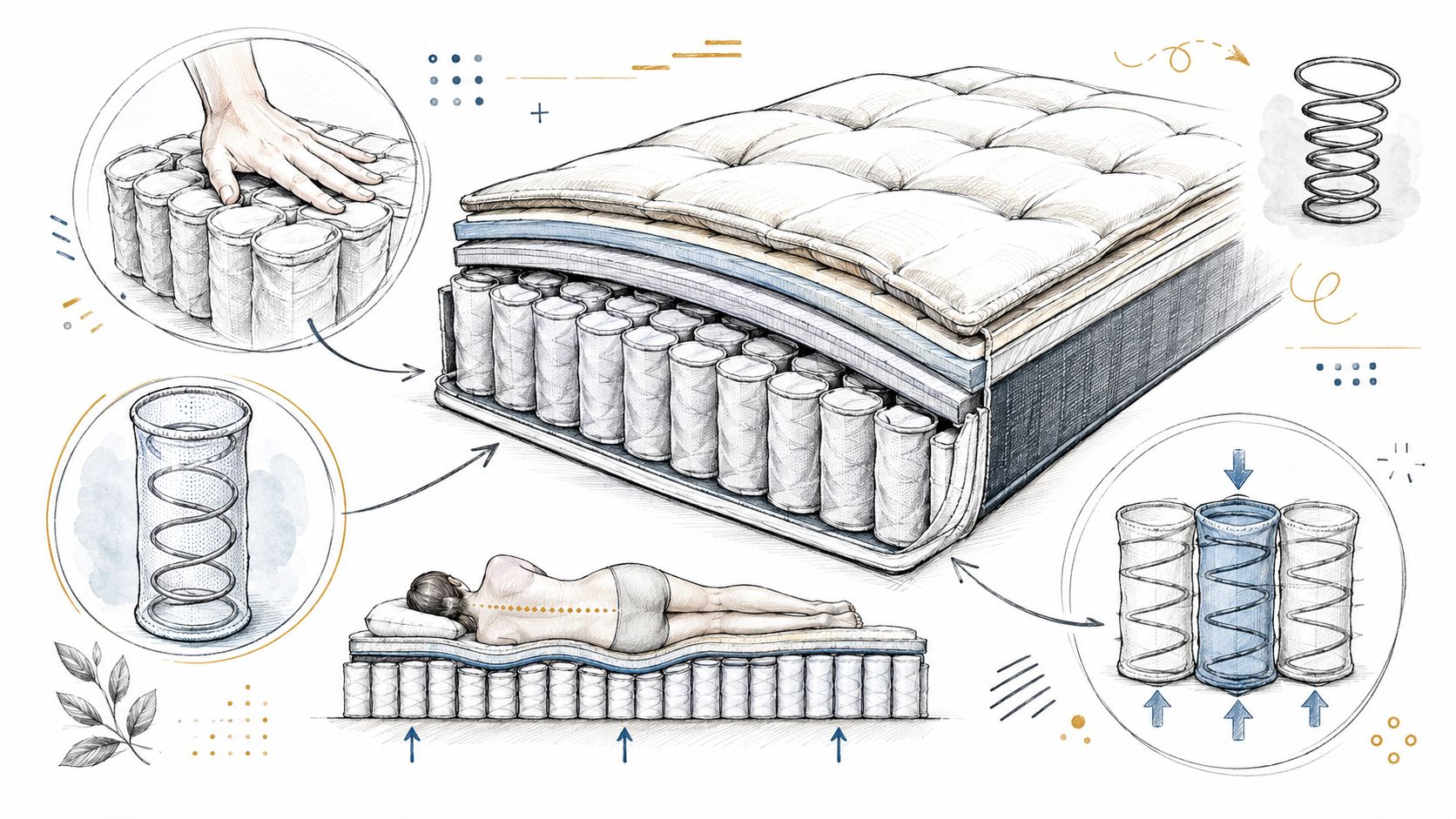
A couple in a showroom often notices the change fast. One person sits, the other lies down, and the surface feels different from the old linked-spring beds that move as a single unit. That difference comes from a simple engineering idea, each spring sits in its own fabric pocket, so the coils can respond on their own instead of dragging the whole mattress into motion, a core feature explained in pocketed coils explained.
A smarter answer to motion transfer
That independent movement matters most when two people share a bed with different habits. A light sleeper may not care how a mattress looks on the sales floor, only whether a partner's turn, stretch, or early alarm sends a ripple through the surface. Pocket coils were built to reduce that ripple by letting each spring compress where pressure lands, rather than forcing nearby springs to follow.
The design also helped the mattress contour more closely to the body. Instead of a flat, uniform push, the support can feel more customized under shoulders, hips, and lower back. That is why the technology shows up so often in premium and hybrid builds, especially for shoppers who want more stability without losing responsiveness.
Pocket coil history also helps explain why the category feels so established now. James Marshall invented the pocketed coil system in 1899 and received his first patent in 1900, and the first major commercial expansion came in 1925 when Simmons licensed the technology and launched Beautyrest, helping pocket coils move into broader distribution, according to who invented pocket coil mattresses. For a deeper look at newer mattress ideas that build on that same comfort-first mindset, sleep-improving mattress innovations offers useful context.
Practical rule: If a mattress has to work for two different bodies, the first thing to judge is not firmness on a tag, it's how well the surface handles movement from one side to the other.
How Pocket Coil Construction Actually Works
A pocket coil unit is simpler to understand than the marketing around it. Each coil is an individually wrapped steel spring, and that wrap lets the spring move without forcing every neighboring spring to move the same way, as explained in pocketed coils explained. This design works like a field of independent shock absorbers, where one wheel hitting a bump does not make every other wheel bounce in the same pattern.
What the spec sheet is really telling a shopper
Three numbers matter most on a pocket coil spec sheet, coil count, wire gauge, and turn count. A queen can range from about 600 coils at the low end to over 2,000 in premium models, while common support-wire gauges run 13 to 17 gauge and higher-quality coils often use 5 to 7 turns for more progressive load distribution and long-term resilience, according to pocketed coil mattress. Those figures do not tell the whole story, but they do tell a shopper how dense, firm, or finely tuned the support unit may feel.
Edge design matters too. Some builds use different coil treatments around the perimeter, so the sleeping surface feels steadier when someone sits on the edge or rolls near it. A DIY mattress guide describes an 8-inch pocketed-coil unit with 1,283 coils in king and 1,057 in queen, using 15-gauge interior coils and 16-gauge doubled perimeter coils for side support, while another notes a 950-coil Quantum Edge system with an added perimeter row to reduce roll-off, all of which points to the same principle, the outer ring is often engineered differently than the center, according to pocketed coils 101.
A pocket coil mattress is not just a pile of springs. It's a support map, with the center, shoulders, and edge often built to behave differently.
Real Benefits and Honest Drawbacks of Pocket Coils
Pocket coils earn their reputation for a reason. They isolate motion well, they contour more closely than interconnected springs, and they usually allow more airflow through the support core than dense solid foam. That combination makes them a strong fit for couples, mixed sleep styles, and shoppers who dislike the stuck-in-place feel of some all-foam beds.
Where the comfort story gets more complicated
The hidden trade-off is durability, or more precisely, what part of the mattress wears first. Pocket coils are not automatically the most durable choice just because they are more advanced. The upper foam, quilting, and edge support often determine when the mattress feels done, even if the coil unit is still intact, according to GoodBed's coil type guide. That matters because many shoppers focus on the spring unit and forget that the layers above it are usually what their body touches every night.
The better way to judge value is to think about how long the mattress feels supportive, not just how long the core stays intact. A bed with a strong coil system can still soften too soon if the comfort layers flatten, and a weaker edge can make a mattress feel tired long before the center loses support. That is why long-term value is really about the whole build, not a single feature on the tag.
Sleep posture also changes how benefits show up. Someone who needs better alignment may care less about fancy wording and more about how the surface holds the spine, hips, and shoulders in a steady position. For shoppers who are also trying to calm chronic stiffness, PosturaZen's guide to fixing sleep posture can be a helpful companion read because mattress choice and sleep posture work together, not separately.
Durability check: If the comfort layers feel soft or uneven in the store, the mattress can feel finished long before the coil unit is actually worn out.
Pocket Coils Versus Other Mattress Systems
Pocket coils work best when a shopper wants a balance of contouring, motion control, and a more premium feel. That said, they are not the only sensible choice. Traditional Bonnell and continuous coil beds can feel firmer and more uniform, which some sleepers prefer, while all-foam mattresses can offer a different kind of pressure relief with less bounce.
The biggest mistake is treating every mattress as if it solves the same problem. A restless couple often wants motion isolation, while a stomach sleeper may want less hip sink and more pushback. That is why a comparison should focus on how each construction behaves, not just how modern it sounds.
| Mattress Coil and Construction Comparison | Motion Isolation | Edge Support | Durability | Best For |
|---|---|---|---|---|
| Pocket coils | Strong, because springs move independently | Often strong, especially with perimeter engineering | Depends on the full build, not the coil unit alone | Couples, side sleepers, mixed-position sleepers |
| Bonnell innerspring | Lower, because coils are linked more directly | Can feel stable, but varies by build | Often sturdy in simple constructions | Firm-feel shoppers, basic support needs |
| Continuous coil | Lower, because the rows move together | Can feel rigid and structured | Can resist sagging in simple use cases | High-use settings, firmer feel preferences |
| All-foam | Usually strong | Depends on foam density and reinforcement | Depends heavily on foam quality | Pressure relief, quiet feel, motion reduction |
| Hybrid | Often strong when pocket coils are paired with comfort layers | Often reinforced by the mattress perimeter | Depends on the foam and support stack | Shoppers who want balance and more surface complexity |
If the choice feels split between foam and coil, a side-by-side reading of hybrid mattress vs memory foam can help frame the trade-off in plain terms.
The Coil Count Myth and What Really Matters
More coils can sound better on paper, but that number alone doesn't tell the whole story. A mattress with a huge coil count can still feel wrong if the wire gauge, zoning, or comfort layers don't match the sleeper's body and position. The smarter question is not how many springs are inside, but how those springs are tuned to work together, as noted in do more pocket springs mean a better mattress.
Why a lower count can still win
Coil gauge changes how firm or flexible the mattress feels. Turn count affects how the spring distributes pressure over time. Zoning can make one area feel firmer or softer, which matters more than a flashy coil total when the goal is spinal alignment and a steady sleep surface.
That also explains the contrarian case that surprises many shoppers. Connected coils may be better for some stomach sleepers because they resist excessive sink in the hips, according to the same source. In other words, a mattress with fewer pocketed springs can still outperform a high-count design if it keeps the pelvis from dipping too far.
A showroom tag that leans heavily on coil count can distract from the fit question. Body type, sleep position, and comfort-layer quality decide whether a mattress feels balanced or awkward. The right choice is the one that supports the sleeper's actual posture, not the one that wins the number game.
How to Test a Pocket Coils Mattress In Store
A showroom test should feel more like a fitting than a guess. Start by lying down in the position used most often at home, then roll slowly from back to side and notice whether the mattress follows the body without creating pressure points. The goal is not to find the softest bed in the room, it's to find the one that holds shape where the body needs it.
What to feel for on the floor model
The first check is contouring. The body should feel supported without sinking too much that getting up feels awkward. The second check is edge support, since many people sleep near the perimeter or sit there to get dressed.
Motion transfer deserves its own test. One partner can lie down and shift positions while the other stays still, then both can judge whether the movement feels contained or exaggerated. That simple check often reveals more than the label ever will.
Miller Waldrop's Sleep Experts utilize a high-tech bed matching system that identifies pressure points to provide personalized recommendations for the best adjustable bases and mattresses for every body type. That kind of fitting helps translate body shape and sleep habits into a more practical choice, especially when the showroom has options from brands such as Beautyrest and Serta.
For shoppers who know they move around at night, a useful starting point is best mattress for combination sleepers. It gives the fitting process a clearer target before anyone starts lying down on every bed in the room.
A good mattress test should answer one question clearly, does the bed support the body in the positions it actually sleeps in?
Your Next Steps to Better Sleep
The best pocket coil choice depends on a few things that matter more than marketing language, body type, sleep position, durability expectations, and whether the sleeper wants more contouring or firmer pushback. A pocket coil mattress can be a strong fit for couples and for anyone who wants better motion control, but the core decision comes down to the full construction, not the coil count alone.
A shopper who is still comparing mattress builds can also think about the foundation underneath it. The right base changes how any coil system performs, and the mattress should match the support below it, not fight against it. For a practical look at that piece of the setup, box springs foundations is worth reviewing before finalizing a purchase.
Home care matters too, especially in a bedroom that needs to stay clean and well maintained over time. If pest prevention is part of the broader plan for protecting sleep space and bedding, prevent bed bug infestations at home offers a useful reminder that mattress care is about more than comfort alone.
The smartest next step is hands-on testing with guidance from someone who can translate feel into fit. That's where a showroom visit helps, because a mattress is personal, and the right one should feel right under a real body, not just on a spec sheet.
Miller Waldrop Furniture & Decor offers curated mattresses, adjustable bases, and in-store guidance that helps match support to body type and sleep style. Visit Miller Waldrop Furniture & Decor to compare pocket coil options, test them in person, and choose a setup that fits the way the body sleeps.