


Your 10 Foot Curtain Rod Guide for Large Windows


A large window can make a room feel bright and open. It can also leave a homeowner standing in the aisle, staring at hardware, wondering why none of the curtain rod options seem straightforward. The confusion usually starts with one assumption: if the window is about 10 feet wide, a 10 foot curtain rod should fit it.
That's the mistake that changes a finished room from polished to frustrating. Curtains bunch over the glass, light gets blocked, and the whole wall feels tighter than it should. A better result comes from treating the rod as part of the design, not just the thing that holds fabric.
Table of Contents
- The Power of a Well Dressed Window
- Choosing Your Perfect 10 Foot Rod
- The Golden Rule of Measuring for Large Windows
- Your Step by Step Installation Guide
- Styling Your Curtains for a Polished Look
- Your Design Partner in West Texas and New Mexico
The Power of a Well Dressed Window
A wide living room window or sliding glass door often becomes the biggest visual feature in the room. When it's left bare, the wall can feel unfinished. When it's dressed well, the whole space feels warmer, taller, and more settled.
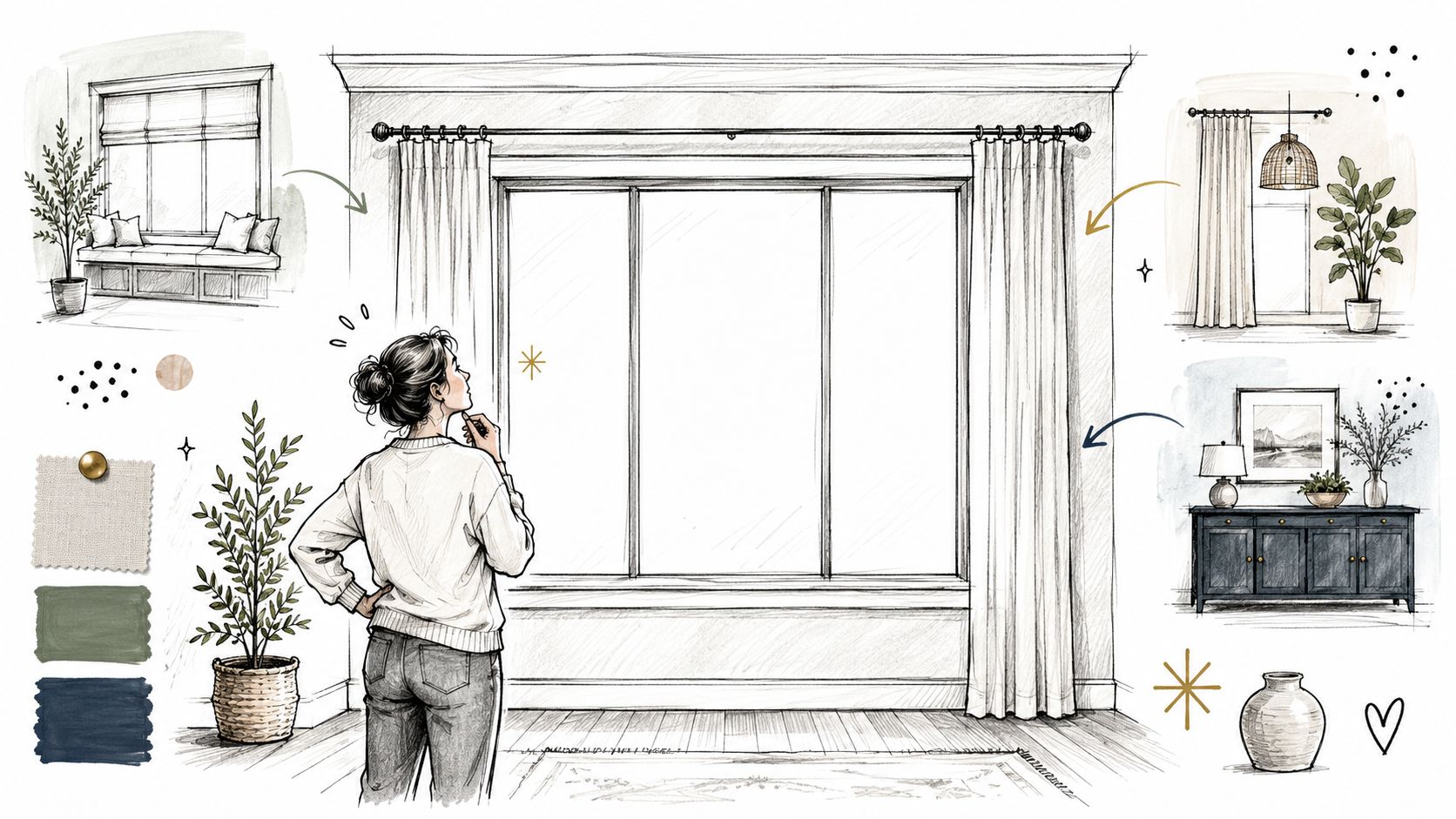
That's one reason the 10 foot curtain rod matters so much. It isn't a niche size. It's a core part of the category. The curtain rods market outlook from Market Research Future notes that the global curtain rods market was valued at $4.416 billion in 2024 and is projected to reach $6.771 billion by 2035, and it identifies the 10-foot (120-inch) rod as a critical standard size for large window spans and sliding glass doors that often exceed 80 inches in width.
Why this hardware changes the room
A long rod does more than support curtains.
- It frames the architecture. Large windows need visual weight around them, especially in rooms with tall walls or open floor plans.
- It softens hard lines. Glass, drywall, trim, and flooring can feel sharp together. Fabric balances that.
- It gives the eye a focal point. A rod placed well and paired with the right panels turns a difficult wall into a finished feature.
A bare large window usually feels temporary. A dressed one feels considered.
There's also a practical side. Big windows often bring glare, heat, privacy concerns, or all three. For homeowners dealing with strong sun exposure, Sparkle Tech Screen Service's complete guide to solar window screens is a helpful companion resource because it explains another layer of window control that can work alongside curtains.
Why many rooms still look off
Most disappointing results don't come from poor taste. They come from one small purchasing decision made too quickly. Someone sees “10 foot curtain rod,” sees a window that seems close to 10 feet, and assumes the match is obvious.
It isn't.
A rod this size can be the tool that makes a room feel custom and refined. But that only happens when the rod is chosen for the span, the fabric weight, and the way the curtains need to sit when open. Once those pieces line up, a large window stops feeling like a problem wall and starts acting like the strongest design feature in the room.
Choosing Your Perfect 10 Foot Rod
The right long rod has to do two jobs at once. It needs to look right for the room, and it needs to stay straight under the weight of the curtains. If either part gets ignored, the result usually looks cheaper than it was.
Why a long span changes the decision
A short rod can get away with more. A long rod can't. Once the span reaches 120 inches, the hardware needs more structural discipline.
A curtain rod size guide states that a 10-foot curtain rod (120 inches) used for heavyweight drapery typically needs a minimum diameter of 1 1/8 inches to help prevent sagging under loads of 10–12 lbs or more, because standard 1-inch rods don't provide enough rigidity for spans exceeding 90 inches. That's the detail many shoppers miss.
Practical rule: On a long span, diameter isn't a style detail. It's a support decision.
For lightweight panels, a slimmer rod may still be appropriate. For blackout drapes, lined panels, or velvet, the rod has to act more like a beam than a decorative accent.
Curtain Rod Material Comparison
| Material | Pros | Cons | Best For |
|---|---|---|---|
| Metal | Clean profile, stronger feel for long spans, works well in modern and transitional rooms | Can feel cold in softer spaces if the finish is too stark | Heavy curtains, wide windows, sliding doors |
| Wood | Adds warmth, pairs beautifully with traditional and rustic interiors | Bulkier appearance, may feel visually heavy in smaller rooms | Formal rooms, warm palettes, layered spaces |
| Mixed material | Combines decorative appeal with a custom look | Finish matching matters more, so mistakes stand out | Designer-focused rooms with specific style goals |
A room's finish palette should guide the choice. Matte black usually reads crisp and architectural. Brass-toned finishes feel warmer and often pair well with layered textiles. Stained wood can calm a room that already has a lot of metal.
What to look for before buying
Shoppers often focus on the visible end of the rod and forget the middle. The middle is where problems show up first.
A strong buying checklist looks like this:
- Check the diameter. For heavier drapery on a 10 foot curtain rod, look for the minimum threshold noted above.
- Review whether the rod is telescoping or fixed. Fixed or non-telescoping options often feel steadier across a long span.
- Inspect the brackets. Decorative hardware only works if the brackets feel substantial enough for the load.
- Match the rod to the curtain style. A formal pleated drape asks for a different visual weight than a casual grommet panel.
Some rooms also need a custom approach because off-the-shelf finishes or lengths won't align with the rest of the design. For readers exploring fabric, finish, or configuration flexibility, custom order options can help turn a close-enough solution into one that feels intentional.
A final note on quality: the least expensive rod often costs more in the long run if it bows, pulls away from the wall, or forces a curtain change later. With large windows, good hardware protects the look of the entire room.
The Golden Rule of Measuring for Large Windows
The professional secret is simple. A 10 foot curtain rod isn't usually for a 10-foot window.
That sounds backward at first, but it solves the most common large-window mistake in one sentence. Curtains need room to move off the glass when open. If the rod only matches the window width, the fabric stacks over the window instead of beside it.

Why the common measurement fails
A standard curtain rod length guide explains that most homeowners buy a rod that matches the window width, but rods should extend 4–12 inches beyond the frame on each side to clear drapery fabric. That's why a 10-foot window typically requires an 11–12-foot rod.
Readers usually get frustrated when the rod size they thought would fit feels too short, even though the number seems correct. The number only describes the rod itself. It doesn't account for how curtains behave once they're installed.
When the panels stack on the glass, the window looks smaller than it is.
The confusion gets worse with decorative finials and thick fabrics. The rod may technically span the width, but the usable space shrinks once those visual elements are added.
A simple measuring method that works
A better method starts with the outside edges of the window frame, not the glass. Then extra width gets added for side extension and curtain stack-back.
This process keeps the room looking balanced:
- Measure the full frame width. Use the outer edges of the trim as the starting point.
- Add extension on both sides. That extra width gives the fabric somewhere to rest when opened.
- Think about the curtain fabric. Heavier and fuller panels need more room off the glass.
- Consider the room's visual goal. A more generous width often makes the whole wall feel grander.
Another helpful guideline comes from Superior Home Improvement's measuring guide, which can help readers become more precise with frame measurement before selecting hardware.
A few measuring mistakes show up again and again:
- Measuring only the glass. That almost always undersizes the rod.
- Ignoring curtain fullness. Fabric needs physical space when open.
- Forgetting side clearance. Nearby walls, cabinets, or light switches can affect where the stack can sit.
- Buying by label alone. A “10 foot curtain rod” label doesn't mean it's right for a 10-foot-wide opening.
Done well, measuring changes the look of the entire room before a single panel is hung. The window appears wider, the wall feels calmer, and natural light has room to come through.
Your Step by Step Installation Guide
A long rod installation feels intimidating because the mistakes are visible from across the room. The good news is that the process becomes manageable once it's broken into smaller decisions.

A curtain rod measuring and placement guide from Spiffy Spools notes that for a 10-foot rod, mounting it 8 to 10 inches above the window frame is a standard recommendation to create the illusion of a taller ceiling, and the rod should extend 3 to 4 inches from each side of the window frame to reduce light gaps and improve visual height.
What to gather first
Before any holes go in the wall, it helps to have every tool on hand:
- Tape measure
- Level
- Pencil
- Drill and suitable bit
- Screws and anchors if needed
- Stud finder
- Step ladder
- Rod, brackets, and center support
That center support matters on a long span. Without it, even a good rod can struggle to stay level over time.
How to mount the rod straight and secure
The cleanest installs usually follow this order.
- Mark the height first. Start by locating the line where the brackets should sit above the window. Height changes the whole look, so it should be established before width.
- Mark the side placement. Once the height is set, mark where the rod should extend beyond the frame.
- Check for studs. If a bracket location aligns with a stud, that's ideal. If it doesn't, use wall anchors suited to the wall type.
- Install the outside brackets loosely. This gives a little adjustment room before final tightening.
- Set and mark the center support. On a long rod, the center area needs support to resist bowing.
- Level the rod before tightening everything down. Small shifts become very obvious on a wide window.
A long rod should be treated like structural decor. It has to be pretty, but it also has to carry weight without drifting out of line.
Where large-window installs usually go wrong
The most common problem isn't crooked drilling. It's uneven planning.
Some brackets are mounted based on the trim instead of the overall visual line. That creates a lopsided result if the trim itself isn't perfectly consistent. Other installs fail because the center support is skipped to keep the look “clean.” The look doesn't stay clean for long if the rod begins to dip.
A few practical fixes make a major difference:
- If one side looks off, recheck from the floor and ceiling. Walls and trim aren't always perfectly square.
- If the curtain catches at the center support, adjust ring placement before changing bracket placement.
- If the rod feels weak after hanging the panels, the issue may be the anchor strength or the rod capacity, not the curtains themselves.
A successful installation is less about speed and more about sequencing. Mark carefully, drill carefully, and test the hardware before the full curtain weight goes on. A patient install almost always looks more expensive than a rushed one.
Styling Your Curtains for a Polished Look
Once the hardware is secure, the window starts to feel less like a project and more like part of the room's personality. Fabric shape, fullness, and header style then change the mood.
How header style changes the mood
A 10 foot curtain rod can look relaxed or formal depending on what hangs from it.
Grommet panels slide easily and give a clean, contemporary line. They work well in casual family rooms and spaces with simpler furniture silhouettes.
Rod pocket curtains feel softer and more traditional. They're often better when the curtains won't be opened and closed constantly.
Pinch pleat drapes usually create the most refined appearance. They bring order to a large wall and pair beautifully with rooms that already have stronger architectural features.
A reader trying to connect curtain choice with the rest of the room may enjoy this decor style spotter guide, especially when the challenge isn't only the window but how the whole space should feel.
How to make open curtains look intentional
This is the part many people don't plan for. They picture the curtains closed, then feel disappointed when the open view looks bulky or crowded.
A polished result depends on three styling ideas:
- Use enough fullness. Flat panels can make a large window look skimpy, even on a substantial rod.
- Respect stack-back. Open curtains should sit neatly to the side instead of creeping into the glass area.
- Match fabric weight to the room. Airy linen-like panels create movement and softness. Heavier drapes create presence and privacy.
Open curtains should frame the view, not interrupt it.
Large windows also benefit from restraint. If the rod has decorative finials, the fabric can stay simpler. If the curtains have a strong pattern or texture, quieter hardware usually gives a better balance. The most elegant rooms don't ask every element to be the star at once.
Your Design Partner in West Texas and New Mexico
A well-finished window changes more than one wall. It can change the scale of the room, the quality of the light, and the way the furniture grouping feels. Once a homeowner understands why a 10 foot curtain rod isn't automatically meant for a 10-foot window, better decisions follow quickly.

That confidence matters, especially in homes across West Texas and Southeastern New Mexico where large windows, bright light, and open layouts are common. Good proportions make those architectural features feel intentional instead of hard to decorate.
Some projects still benefit from another set of eyes. A homeowner may know the rod needs more width, but still want help choosing fabric, finish, room scale, or the right mix of privacy and softness. That's where professional guidance saves time and prevents expensive trial and error. Readers who want support with room planning, furniture scale, or finishing layers can explore design services.
The strongest design results rarely come from copying a single formula. They come from understanding the rules well enough to apply them to a real room. Large windows can absolutely feel elegant, functional, and welcoming. They just need the right hardware, the right measurements, and a little patience during installation.
Miller Waldrop Furniture & Decor has helped families create comfortable, well-designed homes for over 70 years. For homeowners in Lubbock, Hobbs, and Ruidoso Downs who want expert help choosing furnishings, fabrics, and finishing details that work beautifully together, Miller Waldrop Furniture & Decor offers the tools and guidance to bring the whole room together with confidence.