

How to Shop for a Mattress: Your Guide to Finding the Perfect Bed

Shopping for a new mattress can feel overwhelming, but you have the power to make a confident choice. It all comes down to one simple idea: matching the right support and comfort to your unique body and the way you sleep. This guide is your tool to understand your sleep profile, decode the differences between materials like foam and hybrids, and test options like a pro to find that perfect fit for deep, restorative sleep.
Your Journey to Better Sleep Starts Here
If you’re feeling lost in a sea of mattress options, you’re not alone. Think of this guide as your personal roadmap, designed to cut through the marketing noise and confusing jargon so you can feel empowered in your decision.
You’ll stop guessing and start understanding exactly what to look for based on your body type, sleep habits, and personal comfort preferences. We'll give you the tools to make a smart choice that leads to years of incredible rest.
Why Your Mattress Matters More Than You Think
A great mattress is one of the most important investments you can make in your health. When you sleep poorly, you don't just feel tired—it can tank your mood, kill your productivity, and even affect your long-term health. Your mattress truly is the foundation for a successful day.
So many of us don't realize how much a worn-out or mismatched mattress is holding us back. We accept waking up with an aching back, tossing and turning all night, or feeling groggy as "normal." These are actually huge red flags that your mattress isn't doing its job.
A truly supportive bed can transform your sleep so profoundly that you might find you need less time in bed to feel fully rested. The goal isn't just to sleep, but to get that deep, restorative rest that recharges your body and mind.
Taking Control of Your Sleep Health
This guide puts you in the driver's seat. Instead of letting someone sell you a mattress, you're going to learn how to choose one for yourself. By the time you're done, you'll have the know-how to pick a bed that genuinely improves your life.
Here’s a quick look at what we’ll cover:
- Building Your Sleep Profile: We'll help you pinpoint what your body needs based on your go-to sleep position, your weight, and what just feels comfortable.
- Decoding Mattress Types: You'll finally understand the real-world differences between innerspring, memory foam, and hybrid models to find your perfect match.
- Testing Like a Pro: We’ll share the secrets to testing a mattress in a showroom so you can be sure it's the one.
Ready to take the first step? Your journey to better sleep begins right now. Explore our curated collection of high-quality mattresses to see the possibilities, and let's find you a better night's rest.
Create Your Personal Sleep Profile
Before you even think about browsing online or walking into a showroom, the most critical part of your mattress search begins right now. It's all about you. To find a mattress that feels like it was made just for you, you first have to understand your own sleep habits and needs. This "sleep profile" will be your North Star, guiding every decision from here on out.
Think of it this way: you wouldn't buy a car without knowing if you're hauling kids or commuting solo. The same logic applies to your mattress. A few minutes of honest self-assessment now will save you from being dazzled by marketing buzzwords later. It ensures your choice is based on real comfort, not just a good sales pitch.
What Is Your Primary Sleep Position?
How you sleep is arguably the biggest piece of the puzzle. The goal is simple: keep your spine in a straight, neutral line from your neck to your tailbone all night long. The position you favor puts unique pressure on your body, and your mattress needs to push back in all the right places.
-
Side Sleepers: Most of us fall into this category. If you sleep on your side, you need a mattress with enough give to let your shoulder and hip sink in comfortably. This prevents painful pressure points. At the same time, it needs to be firm enough to support your waist so you don't sag. A medium-soft to medium feel is often the sweet spot.
-
Back Sleepers: Sleeping on your back is great for natural alignment, but the wrong mattress can ruin it. The main challenge here is supporting the natural curve of your lower back. You need something that prevents your hips from sinking too deep, which can cause a painful arch. A medium-firm mattress usually nails this balance.
-
Stomach Sleepers: This can be a tricky position for your spine. Stomach sleepers almost always need a firmer mattress. Why? It keeps your hips from dipping into the bed, which is a common cause of morning backaches.
-
Combination Sleepers: If you're a "rotisserie chicken" sleeper, tossing and turning all night, you need a mattress that can keep up. Look for something responsive—a bed that lets you move freely without that quicksand feeling. A medium-firm option is a fantastic starting point because of its versatility.
To explore this further, you can learn how to choose the right mattress for your sleeping style in our detailed guide.
Consider Your Body Type and Weight
Your weight and build play a huge role in how a mattress feels. What one person calls "firm," another might call "soft." It all comes down to how much pressure you're putting on the foam and springs.
As a general rule, sleepers under 130 pounds often feel more comfortable on a slightly softer mattress that can properly contour to their frame. Those between 130 and 230 pounds typically find their perfect match in the medium-firm range. For anyone over 230 pounds, a firmer, more robust mattress with a reinforced support core isn't just a suggestion—it's essential for proper support and durability.
Answering Key Comfort Questions
Beyond your sleep position and body type, a few other personal details will really help you zero in on the perfect mattress. A little honesty here goes a long way.
The right mattress doesn’t just support your body; it solves your specific sleep problems. By identifying issues like back pain or overheating before you shop, you can focus on mattresses engineered to provide the relief you need.
If you're feeling a bit lost, this decision tree can help you see the path from mattress-shopping confusion to total confidence.

It’s a simple visual reminder that whether you follow a guide or talk to an expert, the goal is to get you from "I don't know" to "I know exactly what I need."
So, ask yourself these final questions:
- Do you sleep hot? If you’re constantly throwing off the covers, look for mattresses with cooling features like gel-infused foam, breathable latex, or hybrid designs that allow for better airflow.
- Do you have back or joint pain? Proper support is non-negotiable here. Your mattress should be a source of relief, not another cause of aches. Look for a balance of pressure-relieving comfort and solid spinal support.
- Do you share your bed? If so, motion isolation is your new best friend. A mattress that absorbs movement means you won’t feel every toss and turn from your partner.
- What is your budget? A quality mattress is a serious investment in your health. Figure out what you're comfortable spending, and remember that our Sleep Experts can always walk you through flexible financing options to get you the bed you deserve.
With this personal sleep profile complete, you're officially ready for the next step: understanding the different kinds of mattresses on the market.
Get to Know the Different Mattress Types
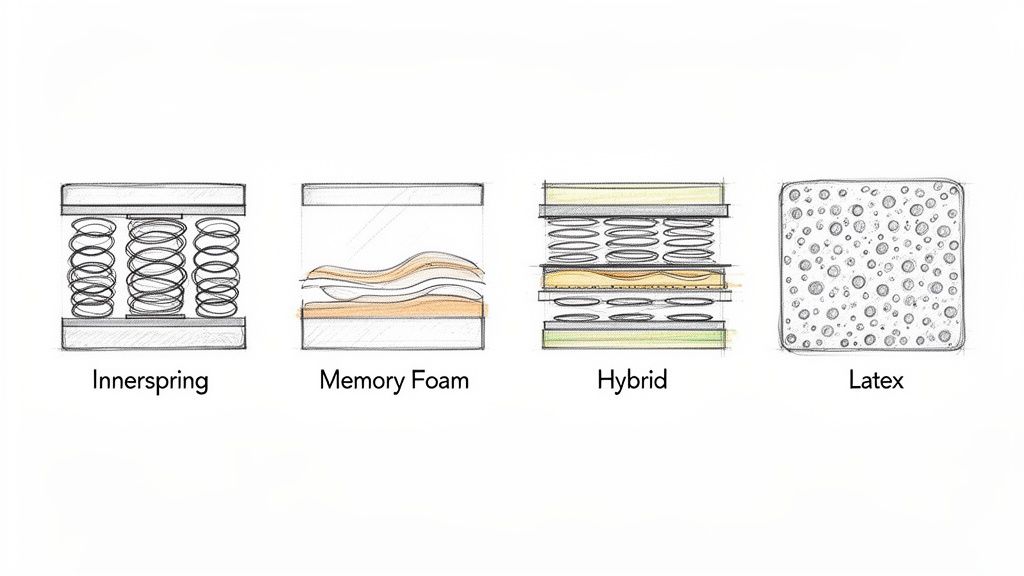
Now that you have a clear picture of your personal sleep needs, you can start exploring the different types of mattresses available. Walking into a showroom can feel overwhelming with terms like innerspring, memory foam, and hybrid being thrown around. But don't worry—it’s not as complicated as it sounds.
Your goal here isn't to find the single "best" mattress type on the market. It’s to find the one that’s the best fit for you. Each one offers a totally different feel and set of benefits, so let’s break down what makes them unique.
Innerspring: The Classic Choice
This is the mattress most of us grew up with. Innerspring models get their support from a core of steel coils, giving them that traditional bounce and responsive feel. One of their biggest advantages is excellent airflow, which is a huge plus for anyone who tends to sleep hot.
The quality of an innerspring really comes down to its coil system—specifically the coil count (how many) and coil gauge (how thick). Generally, more coils mean more points of support for your body. It's a time-tested design that's stuck around for a reason.
In fact, innerspring mattresses still make up about 66% of the global market share. Their popularity proves they strike a great balance between reliable support and affordability.
Memory Foam: The Contouring Champion
If you struggle with aching joints or pressure points, memory foam might be your new best friend. Originally developed by NASA, this material is engineered to react to your body heat, softening and molding to your exact shape. It creates a signature "cradling" sensation that can feel incredible, especially for side sleepers.
Another huge benefit is motion isolation. If your partner tosses and turns all night, a memory foam mattress will absorb that movement so it doesn't transfer to your side of the bed. The one thing to keep in mind is that older memory foams could trap heat, but today’s versions are much better, often infused with cooling gels or designed with an open-cell structure for more airflow.
The "sinking" feeling of memory foam is its defining feature. Some people love it and describe it as a comforting hug. Others feel a bit stuck. This is purely personal preference, which is why trying them out in person is so important.
Hybrid: The Best of Both Worlds
Can't decide between the sturdy bounce of coils and the plush contouring of foam? You don't have to. A hybrid mattress is designed to give you the benefits of both. It starts with a supportive innerspring coil base and then layers premium memory foam or latex on top for comfort.
This brilliant combination delivers the deep-down support and breathability of coils along with the pressure relief you get from foam. Hybrids are fantastic all-arounders, making them a go-to choice for couples with different sleep styles or anyone who just wants a balanced feel. If you're weighing these popular options, you can learn more by exploring our detailed guide on innerspring vs. memory foam mattresses.
Latex: The Natural and Responsive Option
Latex offers a feel that's completely its own. While memory foam slowly contours to your body, latex has a more buoyant and uplifting feel. It provides a gentle cradle but responds instantly, so you never feel "stuck" in the mattress. It’s also incredibly durable and naturally hypoallergenic.
Perhaps the biggest perk of latex is how cool it sleeps. Its natural open-cell structure promotes constant airflow, making it one of the most breathable materials you can find. It's an ideal pick for hot sleepers or anyone who prefers a mattress made from more natural materials.
Mattress Type Comparison at a Glance
Feeling a bit overwhelmed by the options? This quick-reference table breaks down the key features of each mattress type to help you see how they stack up side-by-side.
| Mattress Type | Key Feature | Best For… | Considerations |
|---|---|---|---|
| Innerspring | Bouncy, responsive feel with great airflow | Back and stomach sleepers, hot sleepers, budget-conscious shoppers | Can have less pressure relief and more motion transfer |
| Memory Foam | Deep body-contouring and pressure relief | Side sleepers, couples, people with joint pain | Can sometimes retain heat; some dislike the "sinking" feel |
| Hybrid | A balanced blend of support and comfort | All sleep positions, couples with different preferences | Can be heavier and more expensive than other types |
| Latex | Buoyant, responsive support that sleeps cool | Hot sleepers, eco-conscious shoppers, those with allergies | Tends to be a higher-priced option with a unique feel |
Understanding these core differences is the most important step you'll take. Now you're ready to walk into a showroom and know exactly what you're looking at and, more importantly, what you want to feel.
You’ve done the research online, compared specs, and read the reviews. That’s a great start. But let's be honest—the only way you'll really know if a mattress is the one for you is to lie down on it.
Think of visiting a showroom as the final, most crucial step. This isn't just about giving a mattress a quick push or perching on the edge for a few seconds. To make a confident choice, one that will serve you well for years, you need a game plan. This is your chance to feel how your body actually responds to the support and comfort you've been reading about.
Come Prepared for Your Test Drive
Success in the showroom begins before you even walk through the door. A little prep work makes all the difference.
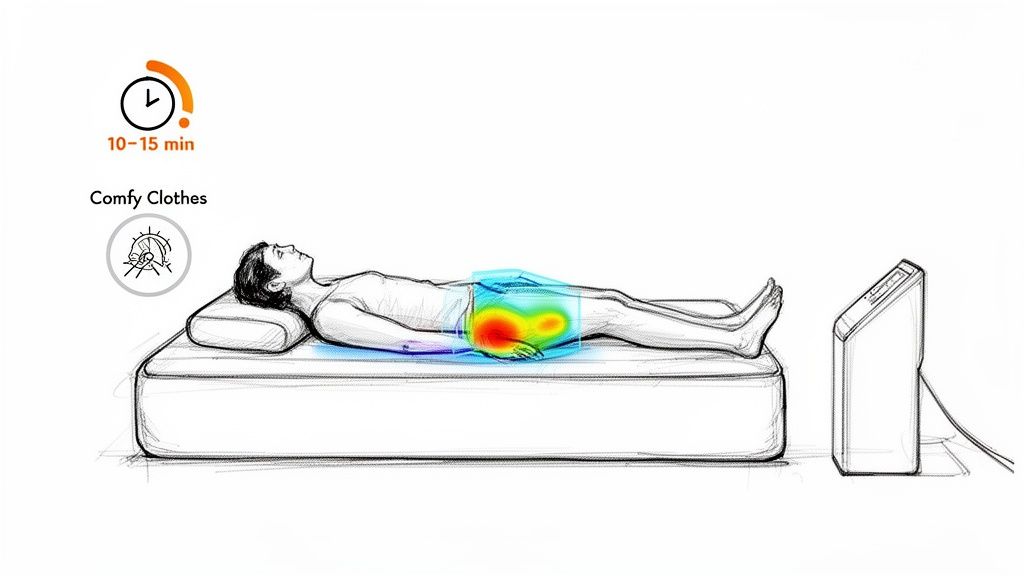
First, dress for comfort. Wear something loose and casual, with shoes you can easily slip off. You’re going to be moving around and lying down, so this isn't the time for stiff jeans or business attire.
And if you share your bed, bring your partner along. A mattress can feel completely different with two people on it. It’s the perfect opportunity to see how it handles movement and ensure there’s enough room for both of you to sleep soundly.
The 15-Minute Rule: How to Properly Test a Mattress
Once you're in the showroom and have a few top contenders, it’s time for the real test. Don't be shy—this is a big investment in your well-being, so be thorough.
The goal is to mimic how you actually sleep at home. Lying on your back for two minutes won't tell you much if you're a dedicated side sleeper. You need to spend at least 10 to 15 minutes on any mattress you're seriously considering.
Here’s a simple routine to follow:
- Settle into your go-to position. Spend most of your time lying how you normally would at night—whether that's on your side, back, or stomach. This gives you the most accurate feel for long-term comfort.
- Move around. Even if you have a favorite position, you likely shift during the night. Spend a couple of minutes rolling over to see how the mattress responds. Is it easy to move, or do you feel stuck?
- Check for support gaps. While on your back, try to slide your hand into the small of your back. If there’s a big gap, the mattress might be too firm. If you can’t get your hand in at all, it might be too soft. You’re looking for a gentle contour that supports the natural curve of your spine.
- Scan for pressure points. When on your side, pay close attention to your shoulders and hips. Do you feel any uncomfortable pressure building? A great mattress will cradle these areas, relieving pressure while keeping your spine straight.
Go Beyond "Feel" with Data-Driven Matching
While personal comfort is king, technology can eliminate the guesswork. This is how you move from "what feels good right now" to "what is scientifically right for my body."
At Miller Waldrop, we use a high-tech bed matching system that provides a data-driven map of your body. It pinpoints your unique pressure points and support needs with incredible accuracy. This allows our Sleep Experts to recommend mattresses that are genuinely suited to your body type and sleep style, not just the one that felt okay for a few minutes.
This kind of expert guidance is invaluable. The global mattress market is huge—valued at around USD 46.5 billion in 2024—and filled with endless options. For shoppers in places like Lubbock, Texas, or Hobbs, New Mexico, that means turning to trusted local experts is more important than ever. Miller Waldrop Furniture & Mattress has been a family-owned staple here since 1952. We've already done the hard work of curating the best from top brands like Serta, Beautyrest, and Mattress 1st, focusing on the foam segment—the largest and fastest-growing globally. You can find more details on the market's expansion in this in-depth industry analysis.
By pairing your in-person test drive with this personalized data, you’re not just hoping you’ve found the right bed—you have the proof.
Ready to find your perfect match? We invite you to experience our bed matching system firsthand. Let our Sleep Experts introduce you to our collection of Serta mattresses and other trusted brands. Your journey to better sleep is just a visit away.
Putting It All Together: Your New Sleep System
You’ve done the research, laid on a few beds, and narrowed it down to "the one." Now it’s time for the final, and often overlooked, step: turning that mattress into a complete sleep system. This is where you go from just buying a mattress to truly investing in your long-term health and well-being.
Thinking beyond the mattress itself is what separates a good purchase from a great one. We need to talk about the details that protect your investment—like warranties and trial periods—and the accessories that can take your comfort to a whole new level. Let's make sure every piece of the puzzle fits perfectly.
The Fine Print: What Warranties and Sleep Trials Really Mean
Once you’ve settled on a mattress, it's easy to breeze through the paperwork, but this is where some of the most important details live. A warranty isn't just a marketing gimmick; it’s your protection against defects down the road.
Most warranties will cover things like deep body impressions (usually 1.5 inches or more, with no one on the bed) or coils that have gone haywire. What they almost never cover is you simply changing your mind about how it feels. That's what a sleep trial is for.
The sleep trial is your real-world road test, often lasting 90 to 120 nights. It’s impossible to know how a mattress will feel after eight hours of sleep from just 15 minutes in a showroom. It takes your body weeks to truly adjust, and this trial period gives you the peace of mind to make sure you made the right choice.
Beyond the Mattress: Building Your Complete Sleep System
A great mattress is the heart of your bed, but the right foundation and accessories are what make it sing. This is where you can dial in personalized comfort and make sure your new mattress performs exactly as it was designed to.
The first thing to consider is what your mattress will sit on. While a traditional box spring works for some, today’s memory foam and hybrid mattresses often need a solid, supportive foundation to prevent sagging. Even better? An adjustable base.
An adjustable base turns your bed from a static slab into a personalized comfort station. With the press of a button, you can elevate your head to help with snoring or acid reflux, or lift your legs to take the pressure off your lower back. You can dive deeper into the benefits of an adjustable base in our guide to see just how much it can improve your sleep.
And don’t forget the finishing touches:
- Pillows: A new mattress changes how your body is aligned, which means that old, flattened pillow is probably not going to cut it anymore. Your pillow is critical for proper head and neck support.
- Mattress Protector: This is a must-have, plain and simple. A quality protector guards your new mattress against spills, dust mites, and allergens. Plus, using one is almost always required to keep your warranty valid.
Getting It Home: Delivery and Financing
The last few steps—getting your bed into your home and making sure it works for your budget—should be completely hassle-free. When you’re looking at delivery options, find a service that does more than just leave a box on your porch. A real white-glove service will bring the mattress inside, set it all up for you, and even haul your old one away.
At Miller Waldrop, we know a great night's sleep is an essential investment. Our team is here to walk you through flexible financing options that work for you. Combined with our Low Price Promise, you can rest easy knowing you got the absolute best value.
Ready to put the finishing touches on your perfect bed? Our Sleep Experts can help with everything from picking an adjustable base to arranging delivery. Visit our showroom and let's get you on your way to better sleep.
A Few Final Questions About Mattress Shopping
As you get closer to making a decision, a few practical questions almost always come up. We hear these a lot in our showrooms, so we've put together some straightforward answers to help you feel completely confident in your final choice.
How Often Should I Really Be Replacing My Mattress?
A good rule of thumb is every 7 to 10 years for a quality mattress. But honestly, your body is the best guide.
If you’re waking up sore when you weren't before, or if you can feel permanent dips and lumps where you sleep, those are huge red flags. The ultimate test? If you get a better night's sleep in a hotel bed, it’s definitely time for an upgrade, regardless of the mattress's age.
What’s the Big Deal with Trial Periods?
Think of it as a test drive, but for a full night's sleep instead of a quick trip around the block. Lying on a mattress for 15 minutes in a store is a great start, but it can't tell you how you'll feel after eight hours.
A sleep trial, which usually runs for 90 to 120 nights, gives your body the time it needs to truly adapt. It’s all about peace of mind, knowing you have a safety net if, after a few weeks, you realize it’s just not the right fit for you.
Do I Absolutely Need a Box Spring?
Not always! The days when every mattress needed a box spring are long gone. While traditional innerspring beds still pair best with them, most of today's memory foam and hybrid models do better on a solid, supportive surface. This could be a platform bed, a foundation, or a slatted base. Just be sure to check the warranty, as it will often specify the kind of support required to keep it active.
A fantastic modern alternative is an adjustable base. It offers incredible support and lets you customize your comfort for everything from reading in bed to reducing snoring.
How Can I Be Sure I'm Picking the Right Firmness?
Firmness is incredibly subjective, but your sleep style and body type offer some great clues.
- Side sleepers usually need a softer to medium feel to let their shoulders and hips sink in just enough to keep the spine aligned.
- Back and stomach sleepers often require a medium-firm to firm surface to prevent their hips from sinking too low.
Of course, the best way to know for sure is to take the guesswork out of it. Our in-store bed-matching technology is designed for this exact purpose—it maps your body's pressure points and helps us find the firmness level that’s scientifically right for you.
Choosing a new mattress is a major investment in your health and happiness. At Miller Waldrop Furniture & Decor, our Sleep Experts are here to guide you through the process, making sure you find the perfect match for your body, budget, and lifestyle. Come explore our curated collection of high-quality mattresses and let's get you on the path to truly restorative rest.