

Best Leather Recliner Sofa: A Buyer’s Guide for 2026


You’re probably doing what most families do when they start shopping for the best leather recliner sofa. You sit on one that feels soft for thirty seconds, look at another that looks good online, then wonder why the prices are all over the map and why none of the tags tell you what matters.
That confusion is normal. A leather recliner sofa isn’t a throwaway purchase. It’s where your family lands after work, where guests end up during holidays, and where somebody always decides to fall asleep during the second quarter or halfway through a movie. In West Texas and Southeastern New Mexico, it also has to stand up to dry air, dust, daily use, and rooms that aren’t always built with oversized furniture in mind.
I’ve seen shoppers get hung up on the wrong things for years. They focus on color first and construction last. They fall for overstuffed cushions that feel good today but won’t hold up. They buy a sofa that technically fits the room, then discover it won’t fully recline without scraping the wall.
A good choice isn’t about luck. It comes from knowing what to inspect before you buy.
Your Guide to Finding the Perfect Leather Recliner Sofa
A family walks into the showroom with a familiar story. Their old sofa started peeling, the seats sagged, and the recliner handle got harder to use every month. They want leather this time because they’re tired of fighting fabric, dog hair, and everyday messes. But they also don’t want to overspend on features they’ll never use.
That’s the right question. Not “What’s the fanciest sofa?” but “What will serve this home well for years?”
The best leather recliner sofa usually comes down to four decisions. Leather quality, mechanism, seat support, and fit in your room. If you get those four right, style becomes the enjoyable part instead of the risky part.
Buy for the way your family lives on a sofa, not the way a staged living room looks in a catalog.
In our part of the country, practical details matter more than showroom drama. Dry air can be hard on low-grade upholstery. Compact dens and older homes can punish bulky recliner frames. Families with kids, grandkids, or pets need surfaces and cushions that can recover from real life.
Here’s the good news. Once you know how to judge the leather, test the motion, read the seat construction, and measure your space, the search gets a lot simpler. You stop guessing. You stop comparing apples to oranges. You start spotting the difference between a sofa that’s merely attractive and one that’s built to stay comfortable.
That’s how you choose with confidence, and confidence is what keeps buyer’s remorse out of your living room.
Decoding Leather Quality The Foundation of Durability
If you remember one thing from this guide, remember this. Not all leather is equal. Some leather gets better with age. Some starts failing far too soon, especially on furniture that moves every day.
The easiest way to think about leather grades is the way you’d think about cuts of beef. Better cuts keep more of the natural character and strength. Lower grades are processed more heavily, patched together, or built to hit a price point instead of a lifespan.
What you want to see first
For a recliner sofa, my recommendation is simple. Start with top-grain leather and work up from there. In premium leather recliner sofas, top-grain cowhide matters because it keeps the natural grain and stronger outer layer of the hide. It also has a reported tensile strength of about 200 to 300 psi, which helps it handle repeated stretching from reclining motion without cracking, while lower-grade leathers can split after 2 to 3 years of daily use according to this top-grain leather durability guide.
That matters even more on motion furniture than on a stationary sofa. A recliner sofa flexes, shifts, and stretches in the same areas over and over. Weak upholstery gets exposed fast.
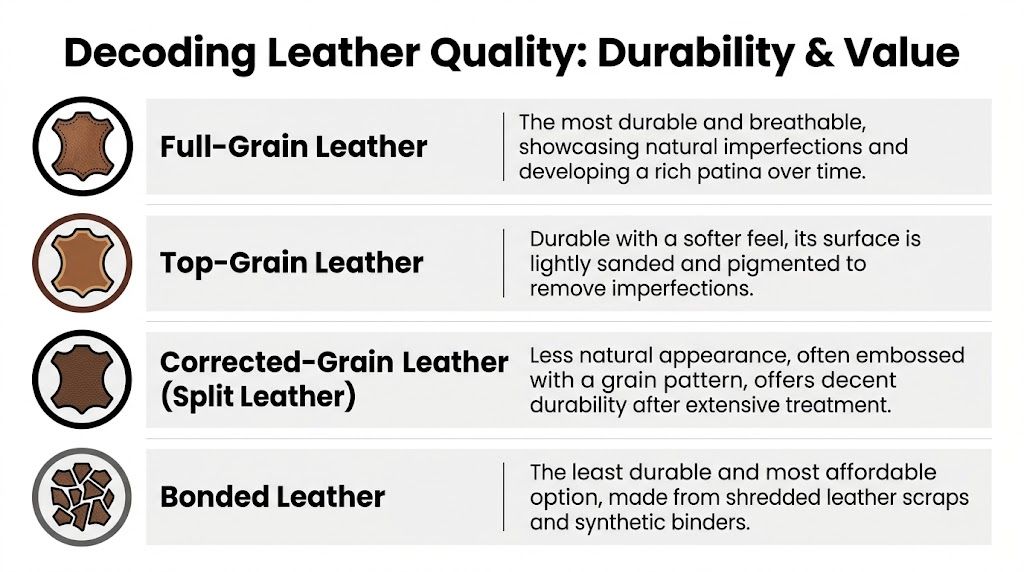
Leather type comparison
| Leather Type | Description | Feel & Appearance | Durability / Lifespan |
|---|---|---|---|
| Full-Grain Leather | The most natural cut of the hide with minimal processing | Rich character, visible natural markings, develops patina | Excellent long-term durability |
| Top-Grain Leather | High-quality outer layer, lightly refined for a smoother finish | Soft, refined, clean look | Excellent choice for motion seating |
| Corrected-Grain Leather (Split Leather) | More processed leather, often embossed to create a uniform grain | More uniform, less natural depth | Moderate durability compared with higher grades |
| Bonded Leather | Leather scraps combined with synthetic binders | Can look acceptable at first, but lacks depth and richness | Lowest durability of the group |
How to judge leather in person
When you’re standing in front of a sofa, trust your hands and eyes.
- Look for depth in the surface. Good leather has variation. It shouldn’t look like plastic stretched over foam.
- Feel for suppleness. Quality leather feels substantial but not stiff.
- Check high-stress zones. Seat fronts, arms, and headrests tell the truth faster than the back panel.
- Ask where genuine leather is used. Some sofas use top-grain on seating areas and a leather match elsewhere. That can be fine, but you need to know what you’re paying for.
If you’re also thinking ahead to spills, especially in a home where entertaining happens often, this guide on removing red wine stains from your sofa is a useful practical read. It’s the kind of real-world maintenance question people should ask before the accident, not after it.
Practical rule: If the leather looks overly uniform, feels thin, and the price seems suspiciously low for a recliner sofa, slow down and ask tougher questions.
Why this matters in West Texas homes
Dry conditions can be unforgiving. Low-grade materials often show it first through stiffness, surface wear, or cracking in the places your family uses every day. That’s why routine care matters almost as much as leather grade. If you already own leather or want to protect a new purchase properly, Miller Waldrop’s guidance on how to protect leather furniture is worth bookmarking.
The best leather recliner sofa doesn’t just look upscale on delivery day. It keeps its shape, feel, and finish after years of sitting, reclining, and everyday living. That starts with the hide.
Understanding Recliner Mechanisms and Frame Construction
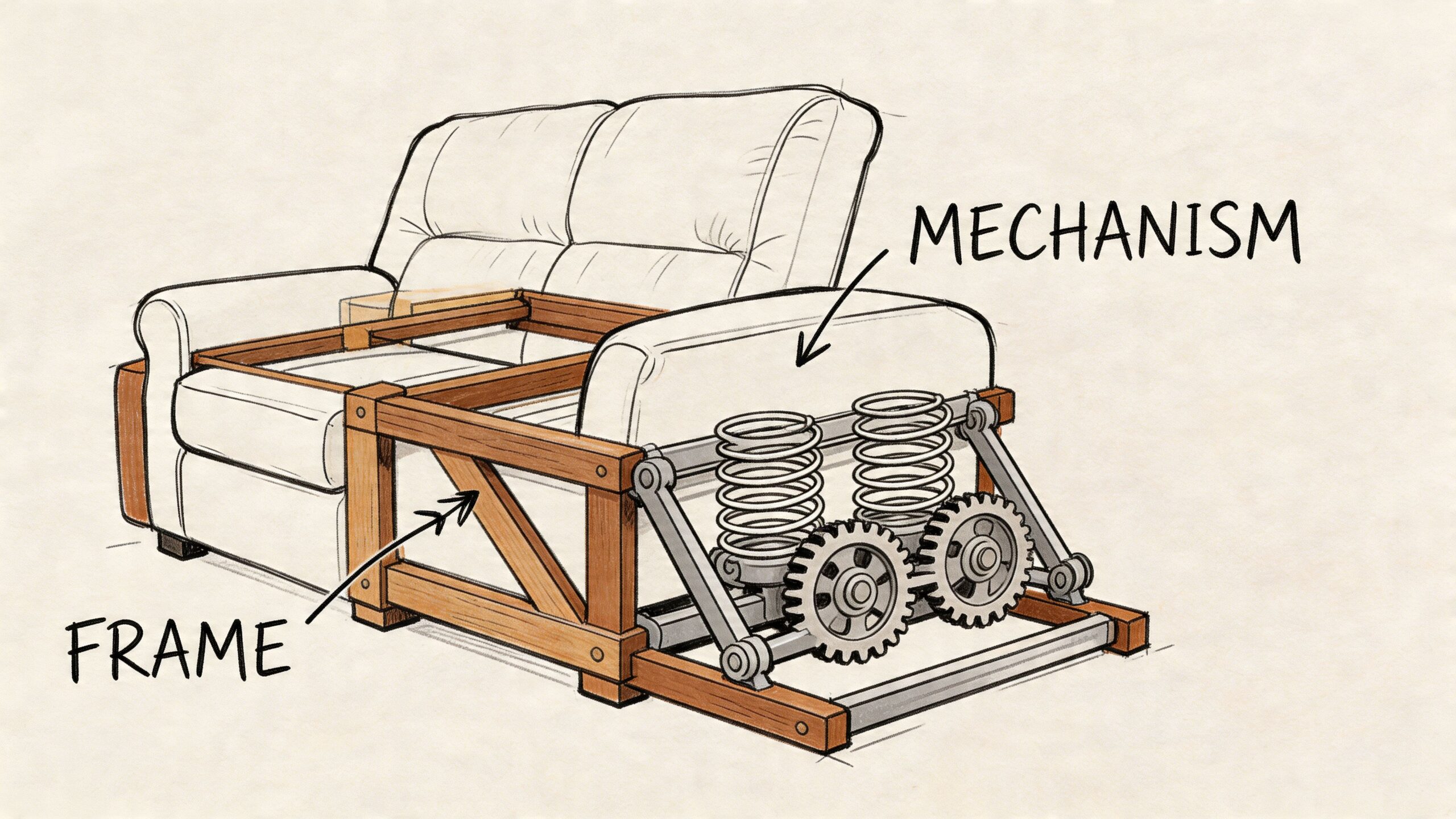
A recliner sofa can wear beautiful leather and still disappoint you if the mechanism is clunky or the frame lacks backbone. Motion furniture lives or dies underneath the upholstery.
This is the part shoppers often ignore because they can’t see it. That’s a mistake.
Manual or power
Manual recliners still have a place. They’re straightforward, familiar, and often easier on the budget. If you like fewer moving parts and don’t care about fine-tuning your position, manual can make sense.
Power recliners win on control. They let you stop exactly where your back, neck, and legs feel supported instead of settling for one or two preset positions. They’re also easier for many people to operate, especially after a long day when nobody wants to wrestle a footrest.
If you want a plain-language breakdown of what separates one from the other, this guide on what is a power recliner lays it out well.
Standard recliner or wall-hugger
For many homes in Lubbock, Hobbs, and Ruidoso Downs, this is the decision that saves the room.
A standard recliner usually needs more breathing room behind it. A wall-hugger, sometimes called a zero-clearance style, moves forward as it reclines instead of pushing deep into the wall space. According to this reclining sofa clearance guide, wall-hugger models need just 3 to 5 inches of wall clearance, while standard recliners need 8 to 10 inches or more.
That’s not a minor detail. That changes whether a sofa works in a den, apartment, media room, or open-concept layout where every walkway matters.
What a strong frame feels like
You don’t need to crawl under a sofa to judge frame quality, but you do need to test it like you mean it.
Look for these signs:
- Stable sit-down feel. The sofa shouldn’t rock, twist, or shift when you sit on one end.
- Smooth motion. The mechanism should open and close without jerking.
- Solid arms. Grab the arm and apply light pressure. A weak frame often reveals itself there.
- Quiet operation. Small squeaks in a showroom usually become louder at home.
If the frame feels loose on day one, it won’t get tighter with age.
My advice on motion construction
For a forever sofa, choose the mechanism that matches how you live. If your room is tight, don’t force a standard recliner because it was on sale. If comfort matters more than simplicity, don’t talk yourself out of power just to save a little upfront.
A recliner sofa is part seating, part machine. The best leather recliner sofa gets both jobs right.
Prioritizing True Comfort and Ergonomic Support
Most shoppers confuse softness with comfort. They’re not the same thing.
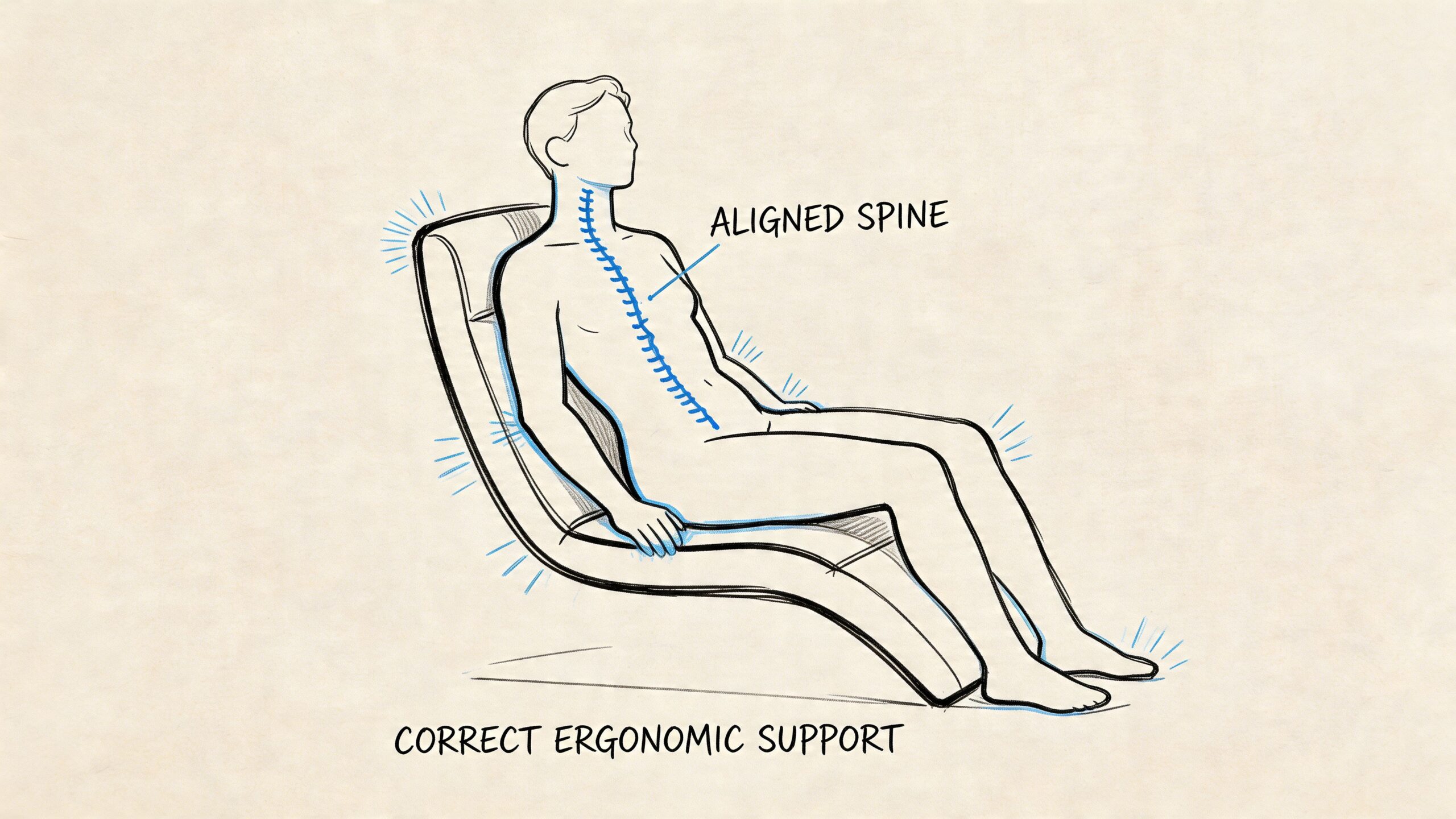
A sofa can feel plush for the first minute and still leave you shifting around after an hour because the seat lacks support. Real comfort has structure under it. That’s what keeps your hips level, your lower back supported, and your body from sinking into a bad posture.
What’s inside the seat matters most
If you’re shopping seriously, ask about the cushion core. Don’t settle for vague words like “premium comfort” or “luxury seating.” Those phrases don’t hold up your spine.
For strong long-term support, look for high-density foam rated at 2.0 to 2.5 lbs/ft³ paired with pocket coil seat cushions. According to this reclining sofa support guide, that combination can retain up to 90% of its original firmness after 100,000 compressions, while lower-density foams can lose 40% of their support.
That’s the difference between a seat that still feels dependable years later and one that starts swallowing you.
Why pocket coils beat flat foam
Pocket coils work a lot like a better mattress. They respond more independently and help distribute weight more evenly. When combined with dense foam, they give you both cushion and lift.
Here’s what that changes in daily use:
- Less bottoming out. You won’t feel like you’re dropping through the seat.
- Better support for longer sits. TV night, game day, and afternoon naps feel different when the seat keeps doing its job.
- More consistent comfort across the sofa. One seat doesn’t break down long before the others.
For readers who want a broader explanation of body support and posture, this overview of the principles of ergonomic design gives useful context.
Features that are worth paying for
Not every upgrade deserves your money. A few do.
Power headrests are useful if one person likes to recline fully and another likes to sit more upright while reading or watching TV. Adjustable lumbar support is a strong feature for people who know their lower back gets cranky on soft seating. Seat depth also matters more than most folks realize. If your feet don’t land comfortably or the back cushion pushes you too far forward, the sofa is the wrong fit regardless of price.
Comfort should hold up after an hour, not just during the first sit.
What to ignore
Don’t let giant pillow tops fool you. Too much loose puffiness can mask weak support underneath. Don’t assume a deep seat equals luxury either. If the proportions don’t fit your body, it won’t become comfortable through wishful thinking.
When I help somebody narrow down the best leather recliner sofa, I care less about whether the seat feels extra fluffy and more about whether it keeps them supported without strain. Softness is easy to sell. Enduring comfort takes better construction.
Choosing the Right Size and Layout for Your Home
A recliner sofa can be perfectly built and still be the wrong purchase if it overpowers your room or gets stuck at the front door. Practical planning saves you from a delivery-day headache.
I’ve seen buyers measure the wall and stop there. That’s not enough. You need to measure the path, the room, and the reclined footprint.
Measure the room first
Start with the living area itself. If you need help getting square footage straight before you map furniture, use this room tool for calculate square feet of a room.
Then go beyond square footage and answer three questions:
- Where will people walk when the sofa is fully reclined?
- What other furniture shares the space?
- Does the room need one long sofa, a sectional, or a smaller-scale piece?
A leather recliner sofa should support the room’s flow, not interrupt it.
Measure the delivery path second
Here, smart shoppers separate themselves from frustrated shoppers.
Check these points in order:
- Front door and storm door clearance
- Hallways and tight turns
- Stairwells if the sofa goes upstairs or downstairs
- Entry benches, rails, and light fixtures that reduce usable space
Write it all down. Don’t trust memory.
Map the reclined footprint
A recliner sofa changes shape when it’s in use. That means the upright size isn’t the whole story.
Use painter’s tape on the floor to outline:
- The sofa’s width
- Its depth when closed
- Its depth when fully reclined
- The walking lane in front and beside it
This simple step tells you whether the room will still feel easy to live in after the new sofa arrives.
A sofa can fit the wall and still fail the room.
Match the scale to local home styles
In older homes and smaller rentals, a wall-hugger or compact-frame recliner sofa often makes more sense than a bulky deep-seat model. In larger open living rooms, you may have room for broader arms, more generous seating, or a sectional layout without crowding traffic paths.
That’s why fit isn’t just about dimensions on a tag. It’s about how the piece behaves once real life starts around it.
The best leather recliner sofa feels like it belongs in your home. Not like it barely made it in.
Navigating Brands and Price Tiers for Real Value
Price matters, but price by itself doesn’t tell you much. A lower tag can mean smart value, or it can mean shortcuts in leather, cushions, mechanism, or frame. A higher tag can mean better construction, or it can just mean features you don’t need.
You have to know what each tier usually buys.
What the price bands usually mean
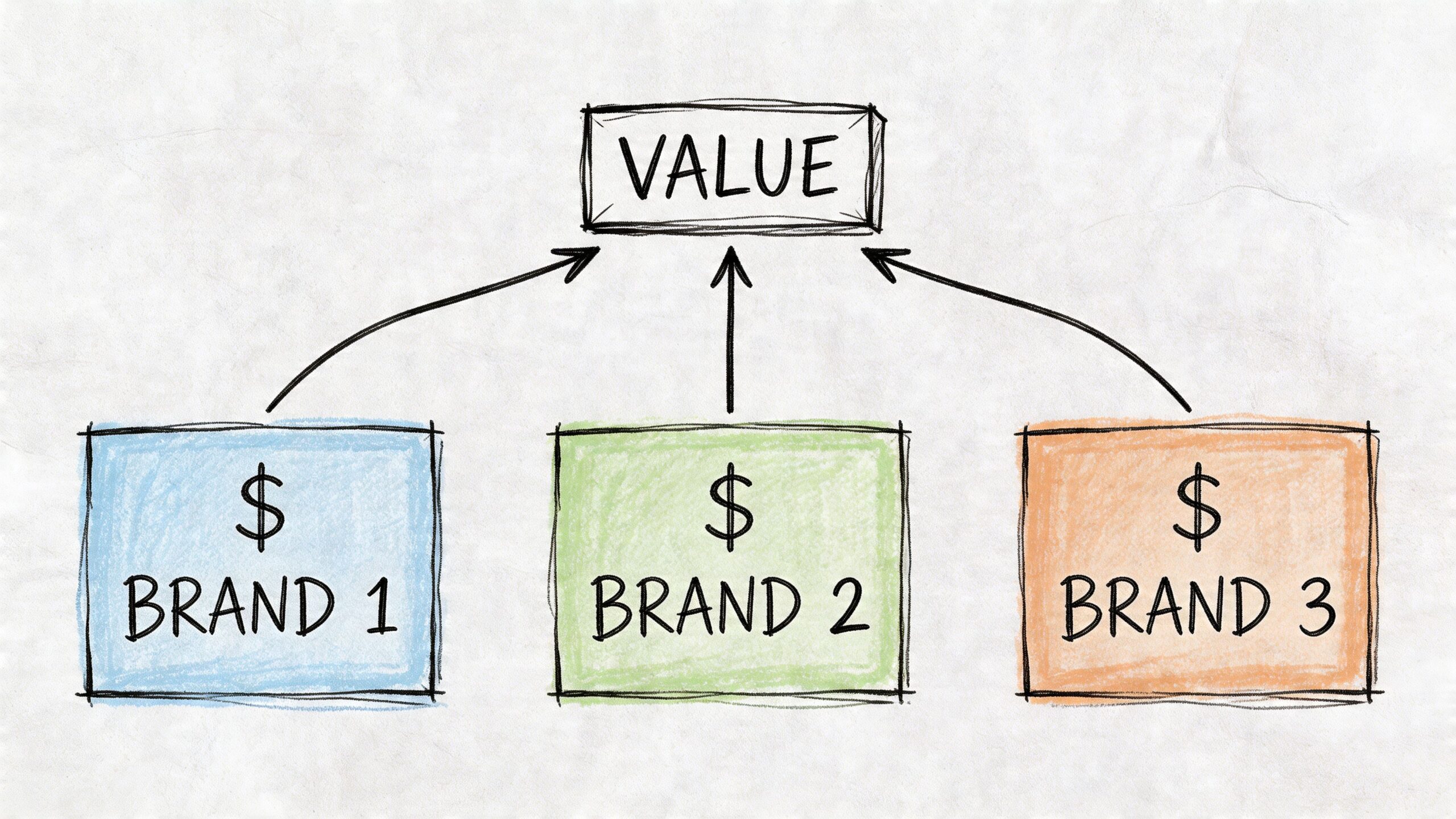
The market has clear stratification. According to this brand comparison of reclining sofa tiers, budget options start around $600 to $700, mid-range offerings from La-Z-Boy run about $1,200 to $3,500, and premium brands like Flexsteel range from $1,500 to $4,500. That same source notes that Flexsteel’s Sawyer collection was the top-selling reclining leather group in 2024.
That tells you two useful things. First, there’s a real jump in construction and features as you move up the ladder. Second, buyers do reward proven product lines when the comfort and build are there.
My read on the major tiers
Budget recliner sofas can work for short-term use, guest rooms, rentals, or first apartments. But you need to inspect them harder because lower-grade upholstery and weaker seat support are commonly found in these.
Mid-range brands are where many families should start. This tier often gives you a stronger mix of leather quality, mechanism reliability, and comfort without pushing into heavy customization costs.
Premium models make sense when you know exactly what you want and plan to keep the piece for years. Such models often feature better tailoring, stronger warranty positioning, more leather options, and more advanced power features.
Which brands deserve a closer look
I’d put La-Z-Boy on the shortlist if you want broad style selection, dependable comfort, and a long-established reputation in motion furniture. I’d give Flexsteel a hard look if structural feel, refined styling, and stronger premium positioning matter most to you.
If you want a concrete example of what a premium motion sofa looks like in practice, the Sawyer Power Reclining Sofa with Power Headrests and Lumbar is a relevant product to study because it sits right in the category many serious buyers compare.
Don’t compare by sticker alone
Use this filter instead:
- Leather first. Cheap upholstery makes every other feature less valuable.
- Seat construction second. A good mechanism can’t rescue weak cushions.
- Mechanism and fit third. The room and the user decide whether manual, power, standard, or wall-hugger makes sense.
- Brand reputation last. A respected name helps, but it should confirm the build, not replace inspection.
The best leather recliner sofa isn’t the most expensive one on the floor. It’s the one where the materials, motion, comfort, and scale line up with the way your household lives.
Your In-Store Mission How to Test a Recliner Like an Expert
A showroom can make every sofa seem comfortable for five minutes. Your job is to test beyond first impressions.
Start by sitting the way you sit at home. Lean back. Put your feet up. Shift your weight. If you always nap on the sofa, test it that way. If you read upright, test that too. Don’t do a polite quick sit and call it good.
The checklist I’d use
- Run the mechanism several times. Open and close it more than once. Listen for smooth movement and pay attention to any hesitation or jerkiness.
- Stay seated longer than feels necessary. Give it enough time for pressure points to show up.
- Press on the arms and back. You’re checking for wobble and frame confidence.
- Feel the seams. Good stitching looks clean and feels secure, especially in high-contact areas.
- Check the head and lumbar position. If your neck feels pushed forward or your lower back feels unsupported, keep moving.
Questions worth asking the salesperson
Some questions separate helpful answers from sales talk.
Ask what leather is used in the seating areas. Ask about cushion construction. Ask whether the model is better for compact rooms or larger layouts. Ask how the recline behaves near a wall. Ask what options exist if you need a different configuration or scale.
If a salesperson can’t explain what’s inside the seat or how the mechanism differs from another model, you’re not getting enough information to buy confidently.
What to notice that most shoppers miss
Notice how easy it is to get in and out of the reclined position. Notice whether your feet hit the floor naturally when upright. Notice if the seat edge cuts into the backs of your legs. Notice whether one person in the household loves it but everyone else merely tolerates it.
That last one matters. A family sofa doesn’t need to fit everybody identically, but it shouldn’t feel custom-built for one body and awkward for the rest.
Testing furniture like an expert isn’t complicated. It just requires slowing down and acting like you plan to live with the piece, because you do.
Build Your Perfect Living Room with Confidence
By now, you know how to sort contenders from lookalikes. You know that leather quality drives longevity, that the mechanism changes how the sofa lives in the room, that cushion construction decides long-term comfort, and that measurements protect you from expensive mistakes.
That’s how you buy the best leather recliner sofa with a clear head instead of crossed fingers.
You also don’t need to chase every feature on the market. Most families do best when they focus on a short list. Top-grain leather, supportive seat construction, a mechanism that matches the room, and a scale that fits the home. If a sofa gets those right, you’re close.
For homeowners and renters across West Texas and Southeastern New Mexico, the smartest move is to bring your room measurements, your questions, and your daily habits into the decision. Good furniture shopping gets easier when the conversation starts with how you live, not just what’s on sale.
A forever sofa should earn that title. It should feel good after a long day, fit your space without compromise, and keep doing its job year after year. That’s not asking too much. That’s buying wisely.
If you’re ready to compare options in person, explore Miller Waldrop Furniture & Decor and visit a showroom in Lubbock, Hobbs, or Ruidoso Downs. Bring your room measurements, your layout questions, and your must-have comfort features. Their team can help you sort through leather quality, motion styles, and sizing so you can choose a sofa that fits your home and your family’s routine.