

Hutch and Credenza: Which Is Right for Your Home?

A lot of households reach the same point at once. The dining room is catching overflow from the kitchen, the living area needs storage that doesn't look temporary, and the home office is trying to coexist with real life. The room isn't short on furniture. It's short on the right kind of furniture.
That's where the hutch and credenza become useful. These aren't old-fashioned labels that only matter in formal homes. They're two very different storage tools, and choosing the right one can change how a room works every day. In West Texas and Southeastern New Mexico, where homes often need to handle entertaining, family routines, work-from-home demands, and open sightlines all at once, that distinction matters.
The credenza has especially deep roots. Its story traces back to 14th-century Italy, where it began as a piece associated with a food-tasting ritual tied to trust and protection before serving nobility, then evolved over time into the refined storage cabinet recognized today, as noted in this history of the credenza. For anyone sorting through furniture terms before a move or redesign, practical prep matters too. Good Home Removals Sydney storage advice can help protect wood pieces if a room isn't ready yet or a transition takes longer than expected.
For readers still sorting out related dining pieces, this guide on what a buffet table is used for helps clarify where these categories overlap and where they don't.
Table of Contents
- Your Guide to Stylish and Functional Home Storage
- Hutch vs Credenza The Defining Differences
- Choosing the Right Piece for Your Room Layout
- Styling Your Hutch or Credenza Like a Designer
- Use Cases Beyond the Traditional Dining Room
- Find Your Perfect Match at Miller Waldrop
- Your Hutch and Credenza Questions Answered
Your Guide to Stylish and Functional Home Storage
A home can look polished and still feel unsettled. That usually happens when storage is scattered into smaller pieces that never quite create order. A stack of serving pieces lands on the dining table. Office supplies drift into baskets. Decorative items sit on random surfaces because there isn't one piece doing the main work.
A well-chosen hutch or credenza solves more than clutter. It gives a room a center of gravity. One leans low and horizontal. The other builds upward and creates display space. Both can make a room feel more intentional when they're matched to the way the household lives.
In homes across Lubbock, Hobbs, and Ruidoso Downs, the challenge often isn't having too little square footage. It's using the room in more than one way. A dining area may also need to hold work materials. A living room may need hidden storage without looking heavy. A guest room may need to double as a study.
A storage piece should do two jobs at once. It should organize what needs to disappear and support what deserves to be seen.
That's why the hutch and credenza deserve a closer look. One can hold visual presence along a tall wall. The other can calm a busy room by keeping the profile low and the surface useful.
Hutch vs Credenza The Defining Differences
A client will often point to a wall and say, "I need storage here," but the question is what the room can tolerate. Some spaces need a low piece that keeps the wall open. Others need storage that climbs upward because the floor plan is already doing too much.
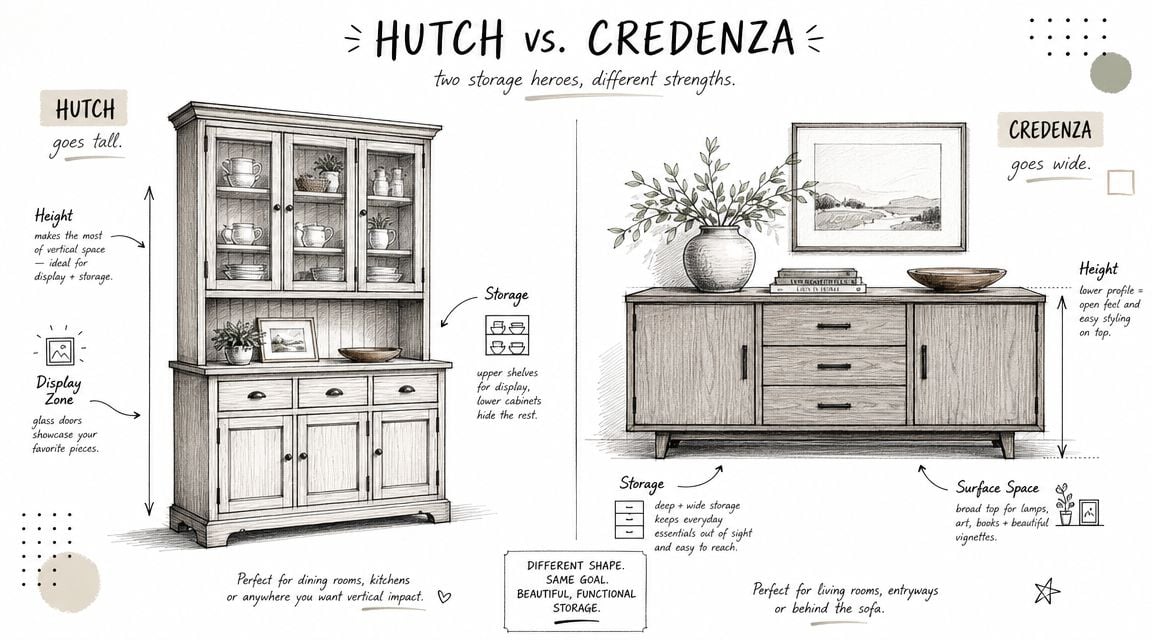
Hutch vs. Credenza at a Glance
| Feature | Hutch | Credenza |
|---|---|---|
| Form | Base cabinet with an upper section attached or stacked above | Low, elongated cabinet with enclosed storage |
| Typical height | Tall enough to use wall height and create a display zone | Usually kept low enough to preserve open space above |
| Visual effect | More vertical presence and stronger focal-point energy | More horizontal and visually quieter |
| Best for | Combining closed storage with shelves, glass doors, or display space | Hidden storage, serving surface, media use, or office organization |
| Primary function | Adds storage upward when width is limited | Keeps essentials accessible without crowding sightlines |
What actually separates them
A credenza sits low on purpose. That lower profile gives you a usable top surface and keeps the room from feeling top-heavy. In a dining room, that might mean space for lamps, serving pieces, or artwork above. In a home office, it gives printers, files, and chargers a place to live without turning the wall into a bank of tall cabinetry.
A hutch changes the equation because it uses vertical space. You still get the lower cabinet, but the upper section adds shelves, glass-front storage, or enclosed compartments higher on the wall. That makes a difference in homes where one piece has to carry more of the storage load.
The trade-off is visual weight.
A credenza usually blends into an open-concept room more easily, especially under a television, beneath art, or along a passage wall where a tall piece would feel crowded. A hutch asks for more commitment. It becomes part storage piece, part architecture. In the right room, that is exactly what you want. In the wrong room, it can make the ceiling feel lower and the wall feel busier than it is.
How the difference plays out in daily use
The easiest way to choose is to look at what needs to stay hidden and what deserves space at eye level. If the answer is paperwork, devices, table linens, or everyday overflow, a credenza often handles the job better. Doors and drawers do the heavy lifting, and the top stays useful.
If the room needs both storage and display, a hutch earns its footprint. I recommend it most often for clients who want to store serveware below and keep collected pottery, books, or bar pieces above, or for a home office that needs cabinet storage without stretching across the entire wall.
That matters when an older piece is no longer working. Before clearing space for a better fit, it helps to review practical online furniture selling methods so the transition is easier.
Practical rule: Choose a credenza when the room needs storage that stays quiet. Choose a hutch when the room needs storage density and can handle a taller focal point.
The short version designers use
A credenza spreads storage across the wall.
A hutch stacks storage up the wall.
That sounds simple, but it solves real layout problems. In a modern dining area that also works as a workspace, a credenza keeps the room flexible and open. In a guest room office or a compact dining nook, a hutch can add meaningful capacity without asking for more width.
Choosing the Right Piece for Your Room Layout
Most buying mistakes happen before finishes and fabrics even enter the conversation. The wrong piece usually fails because of fit. Not style. Not quality. Fit.
A hutch and credenza differ in footprint, vertical clearance, and visual weight, and that makes room constraints more important than dictionary definitions, as discussed in this room-fit guide. In practical terms, the room should decide first.
Start with the room, not the furniture
Begin with the wall where the piece will live. Measure the available width, then look up. A low cabinet can sit comfortably below art, windows, or a television. A hutch needs uninterrupted wall height and enough overhead clearance to avoid feeling crammed.
Then study traffic flow. In a dining room, chairs need room to move back. In a home office, the cabinet shouldn't crowd the desk zone. In an open-plan home, the piece has to make sense from more than one angle.
Three questions usually sort the decision quickly:
- How much wall height is available: Tall storage needs visual breathing room above and around it.
- What needs to be hidden versus displayed: Closed cabinets are forgiving. Open shelves ask for curation.
- How busy is the room already: A space with beams, large windows, or multiple focal points often benefits from a calmer, lower piece.
A practical room-fit checklist
Designers usually look at more than the furniture dimensions on a tag. The room has its own demands.
- Measure width first. The piece should feel intentional on the wall, not squeezed in as an afterthought.
- Check vertical clearance. Ceiling height matters, but so do vents, sconces, window trim, and art placement.
- Stand in the doorway. If the piece is the first thing seen, visual weight matters more.
- Think about daily reach. Frequently used items belong in the easiest zone to access.
- Map the surface use. A credenza top often becomes serving space, lamp space, or office staging space.
Rooms don't just need storage. They need storage in the right shape.
Where each piece usually works best
A credenza often wins in rooms with lower ceilings, multiple openings, or a strong need for flexibility. It keeps the wall from feeling top-heavy and allows the eye to travel. That's especially helpful in open-concept layouts where every major piece affects the whole view.
A hutch usually performs better where there's solid wall height and a need for layered storage. Dining rooms with one dominant wall often welcome that vertical presence. So do studies, libraries, and larger breakfast areas where collections, books, or serving pieces deserve a home.
For families trying to make one room do several jobs, the deciding factor is often not what looks nicest in isolation. It's what keeps the room comfortable on a Tuesday afternoon and ready for guests by Friday night.
Styling Your Hutch or Credenza Like a Designer
Once the right form is in place, styling turns storage into part of the architecture. The goal isn't to fill every inch. It's to create rhythm, balance, and a sense that the piece belongs in the room instead of merely occupying it.
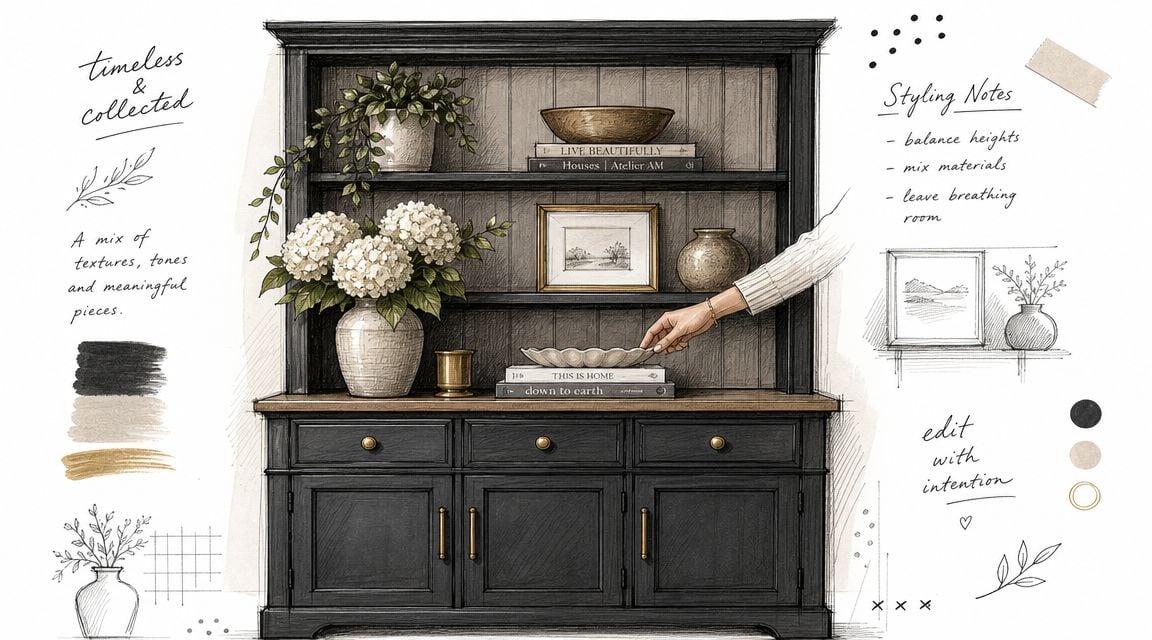
How to style a hutch without crowding it
A hutch looks best when the upper section has variation. That means mixing practical pieces with decorative ones. A run of matching dishes can look stiff on its own. A shelf with only decor can look ungrounded. The best arrangements combine both.
Useful styling moves include:
- Group with intention: Keep similar items together so the display feels collected, not random.
- Change the height: Stack plates, stand a few books upright, and add one taller object to break the line.
- Leave open space: Shelves need empty areas so the eye can rest.
Glass doors or open shelving make every choice visible. That's why editing matters as much as arranging. If everything is meaningful, nothing stands out.
How to style a credenza so it anchors the room
A credenza usually carries the room through its top surface and the wall above it. That composition should feel wider than tall, with one stronger vertical element to add lift. A lamp, large artwork, or a mirror often does that work well.
A few dependable combinations are easy to live with:
- Art plus two supporting accents: One large art piece over the cabinet, then a lamp and a lower sculptural object on the surface.
- Mirror with layered accessories: A mirror opens the wall, while trays, books, and a plant keep the cabinet grounded.
- Functional top styling: In a dining area, a credenza can hold serving pieces and still look refined.
For more surface styling ideas that translate well to dining and living spaces, this guide to buffet table decorating ideas offers useful inspiration.
Good styling follows the furniture's job. If the piece works hard every day, the decor should support that function, not compete with it.
Material choices matter too. Warm wood can soften a room with stone or metal finishes. Painted cabinetry can brighten a darker wall. Hardware should relate to nearby finishes, but it doesn't have to match them exactly. Cohesion beats strict uniformity.
Use Cases Beyond the Traditional Dining Room
A client closes the laptop after their workday, looks across the open living area, and still sees a printer, charging cords, paper stacks, and serving pieces with no real home. That is the kind of problem a hutch or credenza solves well. These pieces are no longer limited to formal dining rooms. In many Texas and New Mexico homes, they do their best work in rooms that need storage to look calm and lived-in at the same time.
In the living room
A credenza often makes more sense than a larger cabinet in a living room, especially in an open plan where every piece is visible from more than one angle. The lower profile keeps sightlines open and gives you concealed storage for remotes, throws, games, and the everyday items that collect in shared spaces. It can also double as a media piece if the proportions are right for the television and the wall.
A hutch belongs here too, but only with intention. It works best when the goal is to add storage and display without building in custom cabinetry. Books, pottery, framed art, and collected objects all sit comfortably in a hutch. Televisions usually do not. In practice, a hutch asks for more editing because whatever sits in that upper section becomes part of the room's visual weight.
In the home office
Home offices rarely need only desk storage. They need a place for the equipment and paper trail that make a room feel busy long after work is done. A credenza handles that well because it gives the office a second work zone. Printers, files, chargers, and notebooks can move off the desk and behind doors, which matters even more in a guest room office or a study that opens to the main living area.
A hutch supports office use differently. The upper storage keeps reference books, binders, samples, and frequently used materials within reach. That is useful if you work from paper, meet with clients at home, or need vertical organization more than hidden storage.
The trade-off is simple. A credenza helps a room read less like an office. A hutch keeps more of the work visible, but it can earn that space if access matters more than concealment.
One relevant product path for this category is Miller Waldrop Furniture & Decor's accent cabinet selection, which aligns well with credenza-style storage for living spaces, offices, and dining areas.
In open-concept homes and flex spaces
Open layouts are less forgiving. A piece that is too tall can interrupt the room. A piece that is too low can leave one wall feeling unfinished and still fail to hold what the household needs.
I usually start with the pressure point in the room. If the space already has height from windows, a fireplace, beams, or shelving, a credenza often brings better balance. If one wall feels empty and the room lacks storage, a hutch can define that zone without adding construction.
Flex spaces are where these pieces really prove their value. A breakfast area can hold serveware now and school supplies later. A guest room can carry office storage today and extra linens next season. That kind of adaptability matters in homes where rooms change jobs over time.
In West Texas and across New Mexico, many homes have open sightlines, hardworking rooms, and a mix of entertaining, remote work, and daily family use under one roof. A well-chosen hutch or credenza gives those routines a place to land without making the house feel overfurnished.
Find Your Perfect Match at Miller Waldrop
A family room in Lubbock or a mixed-use dining area in Hobbs rarely asks furniture to do just one job. One piece may need to store serving pieces, hide office supplies, support a lamp, and still look settled with the rest of the room. That is usually the point where the right choice becomes clearer.
Choose by space, function, and finish
I narrow the decision to three checks. Space, function, and finish.
Start with daily use. If you need a surface that stays active with lamps, trays, printers, or a coffee setup, a credenza often keeps the room calmer and easier to live with. If the room needs more storage capacity and a stronger visual anchor, a hutch can solve both at once, especially on a wall that still feels underused.
Then study the details that make the piece belong in the home. Wood tone, hardware, door profile, shelf style, and overall scale all affect whether it feels collected or out of place. In Texas and New Mexico homes, where rustic woods, painted finishes, iron accents, and cleaner modern lines often mix in the same room, those choices matter more than the label on the piece.
Some decisions come down to maintenance, too. A busier household may do better with a finish and top surface that forgive daily wear, especially in an open living area or home office. If you want the piece to age well, this guide on how to care for wood furniture helps you choose with upkeep in mind.
What helps when the decision still feels close
The close calls are usually about proportion and lifestyle, not terminology. Maybe the room needs hidden storage below but a little display above. Maybe you already have older case goods in the house and the new piece needs to relate to them without matching exactly. Maybe the wall is wide, but traffic flow still has to stay easy.
That is where seeing pieces in person helps. In the showroom, it is easier to judge depth, door swing, shelf spacing, finish variation, and whether a hutch or credenza fits the way the room works. Clients often arrive focused on style and leave realizing the better choice came down to access, scale, and what they need to put away every night.
Miller Waldrop Furniture & Decor gives shoppers a chance to compare those differences in person at the Lubbock, Hobbs, or Ruidoso Downs showrooms and choose a piece that fits the room, the storage load, and the way the home is really used.
Your Hutch and Credenza Questions Answered
Can a hutch top sit on any base
Usually not.
A hutch top and base are typically built as a matched set, with the same width, depth, fastening points, and weight balance. In practice, I only recommend mixing pieces when a cabinetmaker has confirmed the fit and the wall can safely support the load if needed. A top that is even slightly too deep or too heavy for the base can look awkward and create real stability problems.
Are hutches and credenzas outdated
They still work well in current homes. The better question is whether the piece fits the way you live.
A credenza often suits open-concept spaces because it keeps storage low and visually quiet. In a home office, it can hold printers, files, and charging clutter without making the room feel crowded. A hutch earns its place when you need more vertical storage, want a spot for books or display pieces, or need to make one wall work harder in a smaller footprint. The trade-off is that a hutch asks for more editing. If the shelves stay too full, the room starts to feel busy fast.
What's the quick difference between a credenza, sideboard, and buffet
In everyday shopping, those terms overlap quite a bit. What matters most is how the piece functions in your room.
A credenza usually has a lower profile and often fits offices, living rooms, and multipurpose spaces better than taller case goods. Sideboard and buffet are labels people still use more often for dining storage, especially when serving pieces, linens, or extra dishes need a home. In West Texas and Southeastern New Mexico homes, I often see clients choose based less on terminology and more on depth, door clearance, and whether they want concealed storage or a display area above.
If you expect daily wear from kids, guests, or regular work-from-home use, it helps to review wood furniture care and maintenance tips before you decide on a finish.
A well-chosen hutch or credenza can solve storage problems in a dining room, home office, or open living area without forcing the room into a formal look. Miller Waldrop Furniture & Decor helps shoppers compare those options in person and choose a piece that fits the room, the storage load, and everyday life.