


Your Guide to the Perfect Modern Living Room Sofa Set


A lot of living rooms reach a turning point at the same time. The old sofa sags. The room doesn't flow. Family movie nights happen on furniture that no longer feels comfortable, and guests end up perched wherever there's space. That's usually when the search begins for a modern living room sofa set that looks fresh online but also works in real life.
That search is common. In 2018, 16.3% of U.S. consumers bought a new stationary sofa, and roughly 30% were actively looking for a new one, which shows how often households revisit this decision in everyday home furnishing life (U.S. sofa purchase and shopping data). For families across West Texas and Southeastern New Mexico, the challenge isn't finding inspiration. It's translating inspiration into a room that can handle traffic, conversation, naps, pets, kids, and the way a home gets used.
A good sofa set becomes the heart of the room. It anchors the layout, sets the tone, and shapes how people gather. The right choice doesn't come from chasing one trend. It comes from understanding space, use, build quality, and what will still feel right years from now.
Table of Contents
- Your Home's New Centerpiece
- Mastering Your Space Before You Shop
- Decoding Modern Sofa Styles and Configurations
- The Anatomy of a High-Quality Sofa
- Budgeting Styling and Long-Term Care
- Bring Your Vision to Life with an Expert Partner
Your Home's New Centerpiece
A sofa set usually carries more responsibility than any other piece in the living room. It has to look good in daylight, feel comfortable at night, hold up to regular use, and make the room feel settled instead of crowded. That's why this purchase feels bigger than picking a color or a silhouette.
In real homes, the sofa is where the day starts to slow down. Someone stretches out after work. Kids pile in for a movie. Friends linger longer because the seating feels easy and welcoming. A modern living room sofa set shapes those moments, but only if it suits the room and the household instead of fighting both.
Practical rule: A sofa that photographs well but disrupts traffic flow will feel wrong every single day.
That mismatch happens often with trend-led shopping. Low profiles, extra-deep seats, oversized arms, or dramatic shapes can all work beautifully. But they need the right room, the right scale, and the right purpose. A family that lounges every evening needs something different from a homeowner styling a more formal sitting area.
The better approach is to treat the sofa set as the room's working centerpiece. That means asking better questions:
- How does the room function daily. Quiet reading, entertaining, TV watching, homework, or all of the above.
- Who uses it most. Adults, children, guests, pets, or a mix.
- What should the room feel like. Open and airy, cozy and grounded, structured and polished.
- What has frustrated the current setup. Tight walkways, not enough seating, awkward angles, hard-to-clean fabric, or a sofa that overwhelms the space.
A strong decision starts there. Once those answers are clear, style becomes easier, and the room starts to come together around real needs instead of showroom fantasy.
Mastering Your Space Before You Shop
The most expensive sofa mistake usually isn't fabric. It's size. A piece can be beautifully made, perfectly colored, and still fail the minute it blocks a walkway, crowds a doorway, or can't make it through the hall.
Start with the room and the route
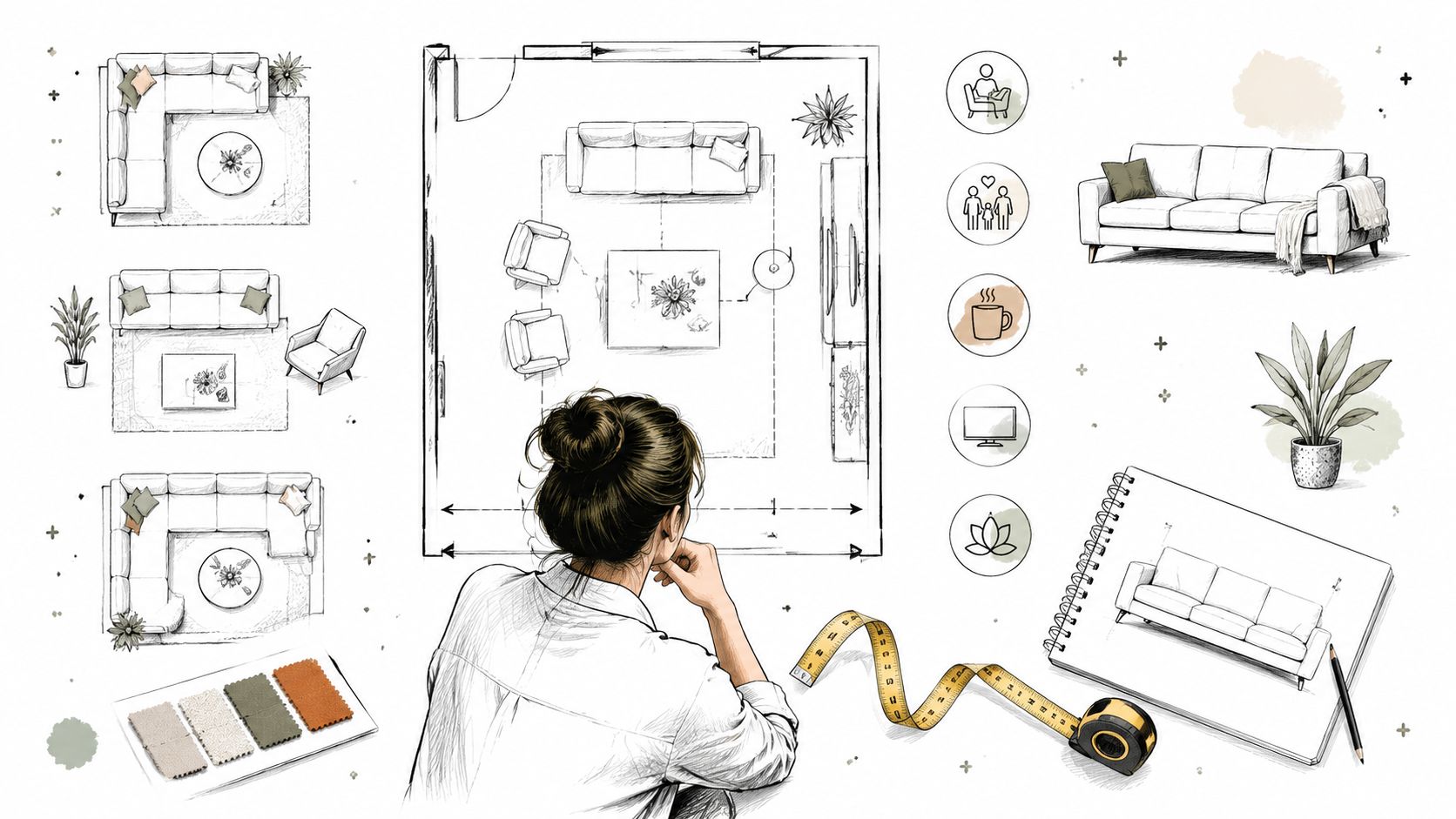
Measure the room first, then measure everything between the room and the outside world. That includes front doors, entry turns, hallways, stair landings, and any tight corner the piece has to clear during delivery. A sofa that fits the room but not the house is still the wrong sofa.
Standard dimensions give a useful starting point. Typical modern sofas are about 72 to 96 inches wide, and a 12×12-foot room can generally handle a 72 to 78-inch sofa, while larger U-shaped sectionals are better suited to 16×16-foot or larger spaces (standard sofa dimensions and room fit guidance). That's not a design law, but it is a strong filter.
For circulation, common layout guidance recommends 30 to 36 inches of walkway space between large furniture pieces and 16 to 18 inches between a sofa and coffee table (living room spacing rules). Those clearances are what keep a room feeling usable instead of packed.
A room renovation can also shift what's possible. Homeowners thinking about broader layout changes may find helpful context in Aureli Construction open concept remodels, especially when walls, sightlines, and traffic patterns are part of the bigger plan.
Use tape before spending money
Painter's tape is one of the simplest tools in furniture planning. Mark the full sofa footprint on the floor, then live with it for a day or two. Walk around it. Open the recliner if the model has one. Check where a side table would land. See whether the coffee table clearance feels natural.
Tape outlines reveal problems that product photos hide.
This quick test usually answers the hardest questions fast:
Does the scale feel balanced
The right sofa should anchor the room, not swallow it.Can people move through the space comfortably
Walk the usual paths to the kitchen, hallway, windows, and main seats.Will the layout support the room's real purpose
A conversation room, a TV room, and a multipurpose family room all need different spacing priorities.
For households refining a floor plan, this guide to living room furniture layout ideas can help translate measurements into a usable arrangement before a purchase is made.
Decoding Modern Sofa Styles and Configurations
Style matters, but configuration does more of the heavy lifting. The right shape supports how the room works. The wrong one creates a beautiful inconvenience.
Which setup fits daily life
Some homes need one strong anchor piece. Others work better with several lighter pieces that can shift over time. The decision usually comes down to how the room gets used.
| Configuration | Works well for | Watch out for |
|---|---|---|
| Three-seat sofa | Balanced living rooms, cleaner sightlines, easy pairing with chairs | May not provide enough lounging space on its own |
| Sectional | Family movie nights, corner use, open spaces needing definition | Can dominate a room if the scale is off |
| Modular seating | Homes that change often, entertaining, flexible zones | Pieces need thoughtful planning so the layout feels intentional |
| Apartment sofa or compact sofa | Smaller rooms, secondary seating areas, tighter floor plans | Too-small scale can look underfurnished in larger rooms |
A sleek, low-profile sofa often gives a room a modern look fast. But lower backs and cleaner lines don't automatically mean more comfort for long sitting sessions. Some households prefer the visual lightness. Others need deeper support, easier lounging, or motion features that make daily use more comfortable.
When adaptability matters more than a look
Current design thinking points toward flexibility. The strongest choice often isn't the piece with the boldest styling. It's the one that still works when the room has to host guests, support work-from-home hours, or shift around holiday gatherings. Guidance on modern layouts increasingly favors adaptable zoning and flexible furniture ecosystems, such as modular seating or a sofa paired with swivel chairs, instead of rigid wall-hugging arrangements (modern sofa adaptability and flexible layouts).
That's especially useful in West Texas and Southeastern New Mexico homes, where one living room may have to do several jobs at once.
Consider these trade-offs:
- A sectional gives generous seating, but it fixes the room into one main arrangement.
- A sofa with accent chairs feels lighter, and it's often easier to rebalance later.
- Modular pieces adapt well, but they need discipline in scale and proportion so the room doesn't feel pieced together.
- Power features add convenience, though they can affect wall clearance and visual bulk.
For households weighing flexible arrangements, modular sofas for small spaces offers helpful examples of how configuration can solve practical layout problems without giving up a modern look.
The Anatomy of a High-Quality Sofa
A modern sofa proves itself after the excitement of delivery day wears off. In West Texas and Southeastern New Mexico homes, that usually means kids dropping onto the cushions, guests staying longer than planned, pets claiming a favorite corner, and one room carrying a lot of family life. The quality question is simple. Will the sofa still feel supportive, look clean, and sit square a few years from now?
What matters under the upholstery
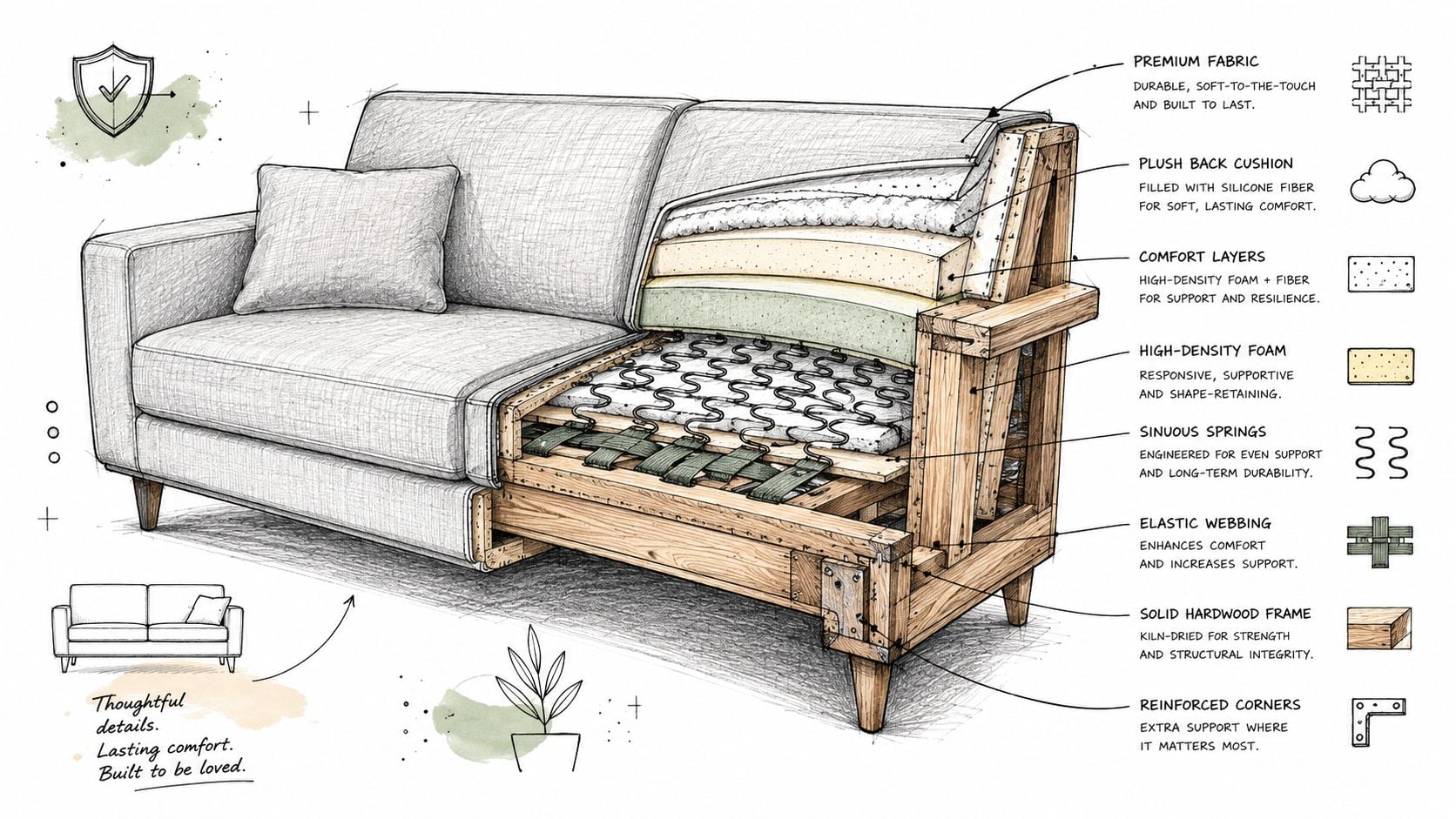
The frame does most of the long-term work. A well-built sofa usually starts with kiln-dried hardwood and joints secured with more than staples or glue alone. That part stays hidden, but it affects whether the sofa stays quiet and steady or starts creaking and shifting under regular use.
Seat support matters just as much. Good suspension should feel consistent across the whole seat, especially in the spots your family will use every day. If one cushion feels firm and the next feels hollow, the problem often starts underneath, not in the fabric on top.
Use this checklist in the showroom:
Frame material
Kiln-dried hardwood tends to hold shape better over time than particleboard or lighter softwoods.Joinery
Dowels, screws, corner blocks, or metal reinforcement usually outlast staple-heavy construction.Seat suspension
The seat should feel even, supportive, and stable from one end to the other.Deck and rail strength
Press lightly on the front rail and seat deck. Excess flex is a warning sign.
One weak structural choice can shorten the life of the whole piece.
Comfort choices that change daily use
Comfort depends on fit, not just softness. A sofa can look perfect in an online photo and still feel wrong once you sit in it for ten minutes. That gap between inspiration and daily living shows up fast in real homes, especially when the living room has to handle TV time, conversation, naps, and overflow seating during holidays.
Seat depth is a common trade-off. Deeper seats feel relaxed and casual, but shorter family members or older relatives may find them harder to use comfortably without extra pillows. Firmer cushions usually keep their shape better and make it easier to stand up. Softer cushions can feel inviting at first, though they often need more maintenance to keep a neat appearance.
Upholstery deserves the same level of scrutiny. Leather, performance fabrics, and textured woven materials each solve different problems. Households with children, pets, or frequent entertaining should spend time choosing upholstery fabric for daily wear and cleanup instead of picking by color alone.
Natural light also changes how upholstery performs and appears. If your room gets strong afternoon sun, fading and glare become part of the decision, not an afterthought. Coordinating the sofa fabric with the room's light control plan starts with understanding various window treatments, especially if you want the room to feel polished without making it harder to live in.
A practical in-store test works better than a quick sit:
- Sit upright with your feet flat on the floor.
- Lean back the way you would during a movie or long conversation.
- Check whether the seat edge hits comfortably behind the knees.
- Test the arm height if anyone in the home uses it while reading or napping.
- Ask what fills the back and seat cushions, and how often they need rotating or fluffing.
A curated retailer can be a useful filter rather than just a sales floor. Miller Waldrop Furniture & Decor gives shoppers a way to compare frame feel, cushion construction, upholstery options, and custom-order details in person, which makes it easier to match an online idea to the way a real family room needs to function.
Budgeting Styling and Long-Term Care
A modern living room sofa set shouldn't consume the whole room budget by surprise. It should guide the budget. When the seating is chosen well, the rest of the room becomes easier to finish with intention.

Spend for value, not just for the tag
The smartest budgeting move is deciding where quality matters most. In a sofa set, that usually means structural integrity, comfort, and upholstery that suits the household. Decorative extras can come later if needed. Replacing a weak sofa early costs more than waiting a little longer for one that fits the room and the routine.
A simple priority order helps:
- First. Buy the right size and configuration.
- Next. Protect comfort and construction quality.
- Then. Choose upholstery that matches wear, maintenance, and lifestyle.
- Last. Layer in accent pieces, occasional tables, and styling details.
Financing can also be a practical tool when it keeps the purchase aligned with long-term use instead of forcing a compromise that will be regretted later.
Style the room around how people move
Real living rooms rarely have one perfect focal point. Many have a TV and a fireplace. Some have a large window, an open passage, or a traffic path cutting through the seating area. In those rooms, a single large sofa isn't always the best solution. Guidance for awkward layouts often favors two sofas or a sofa paired with accent chairs, along with 16 to 18 inches between the sofa and coffee table, because the room has to balance seating with movement (layout guidance for multiple focal points and traffic flow).
That principle changes styling choices in a useful way.
Use a rug to define the zone
A well-scaled rug helps the seating arrangement read as intentional.Add chairs when the room needs flexibility
Chairs often solve balance problems better than one oversized sectional.Control light thoughtfully
Window glare affects comfort, TV viewing, and fabric appearance, so understanding various window treatments can help when finishing the space around the sofa.
For upholstery planning, this guide to choosing upholstery fabric can help narrow the choice between softer decorative materials and more hardworking options.
Protect the investment with simple habits
Care doesn't need to be complicated, but it does need to be consistent. Rotate seat cushions if the design allows it. Vacuum creases and arms regularly. Address spills quickly using the manufacturer's care instructions rather than guessing. Keep direct sun exposure in mind when placing the piece near bright windows.
A sofa lasts longer when the household treats maintenance as routine, not rescue work.
The biggest mistake in long-term care is waiting until visible wear becomes hard to reverse. Small habits keep the room looking settled and save the sofa from premature aging.
Bring Your Vision to Life with an Expert Partner
By this point, the decision is no longer guesswork. The room has been measured properly. The right configuration is clearer. Construction details make more sense. The budget is tied to value instead of impulse. That's usually when furniture shopping becomes much less stressful and much more productive.
A showroom visit is most useful when a shopper arrives with real information. Bring measurements, photos, notes about the room's traffic flow, and a short list of what didn't work in the last setup. That changes the conversation from browsing to problem-solving. It also makes fabric, scale, and seating comfort easier to judge in person.
For households planning beyond the purchase, upkeep matters too. Practical cleaning habits can protect both fabric appearance and comfort over time, and Neat Hive's sofa cleaning insights offer a helpful starting point for routine upholstery care.
For families in Lubbock, Hobbs, and Ruidoso Downs, working with an experienced design consultant can help connect all the moving parts. The right modern living room sofa set should suit the room, the people using it, and the years ahead. That's when the space starts to feel finished in the way that matters most. Comfortable, functional, and ready for daily life.
Ready to turn ideas into a room that works beautifully every day? Visit Miller Waldrop Furniture & Decor to explore living room seating, compare configurations in person, and get help choosing the right sofa set, fabric, and layout for your home in West Texas or Southeastern New Mexico.