

Memory Foam Mattress Pros and Cons a Buyer’s Guide

A side sleeper in Odessa may spend the night shifting away from an innerspring mattress that digs into the shoulder. Then the replacement arrives, a soft memory foam mattress, and the pressure disappears, but the sleeper sinks so that turning over becomes a chore. That is the decision behind the memory foam mattress pros and cons. Memory foam isn't automatically an upgrade. It's a fit question involving body weight, sleep position, room temperature, foam construction, and the base underneath it.
The material's strongest quality is still pressure relief. Its biggest risks are heat retention, slow movement, weak perimeter support, and poor long-term fit for some heavier or stomach sleepers. The right choice matches foam density, ILD, firmness, and cooling features to the person using the bed, rather than treating every memory foam model as interchangeable.
This guide follows the material from its engineering origins through five performance pillars, body-type testing, common myths, and climate-specific pairings for West Texas and Southeastern New Mexico. It also provides a practical showroom checklist. Readers with sensitive shoulders or hips, partners who disturb each other, and warm sleepers willing to choose the right cooling design should read closely. Shoppers who prefer a buoyant surface, sleep mostly on the stomach, or need firm edge support should pay particular attention to the hybrid and latex alternatives discussed along the way. A concise overview of memory foam mattress benefits can also help establish whether contouring is the right starting point.
Is a Memory Foam Mattress the Right Choice for You
The first test is simple. A sleeper should lie in the position used most often, stay there long enough for the foam to respond, and notice what happens at the shoulders, hips, waist, and knees. If those areas feel cushioned while the spine stays level, memory foam is doing its job. If the body feels trapped, overheated, or folded at the middle, the mattress is solving one problem while creating another.
Start with pressure, then check movement
Side sleepers usually notice memory foam's appeal first. The material softens with body heat and pressure, allowing the shoulder and hip to settle into the surface instead of forcing those areas to carry the load on a narrow contact point. That close fit can be especially useful for people who wake with pressure around the shoulders, hips, or other joints.
The same contouring can frustrate combination sleepers. Traditional memory foam responds slowly, so repositioning requires more effort than it does on a springier construction. A sleeper who changes positions repeatedly may prefer a responsive hybrid or a firmer foam design with a more mobile comfort layer.
Practical rule: Pressure relief matters only when the sleeper can still change position without fighting the mattress.
Match the construction, not the label
“Memory foam” describes a material family, not one uniform feel. Foam density, ILD, layer thickness, base structure, cover fabric, and cooling treatments all affect the final result. A softer comfort layer may suit a lighter side sleeper, while a heavier sleeper generally needs stronger underlying support to prevent excessive sinkage.
The showroom should answer five questions:
- Where does the comfort layer sit? A thick, soft top can feel luxurious at first but may allow too much immersion.
- What supports the comfort layer? A resilient base or coil system can improve alignment and movement.
- How does the cover handle heat? Breathable materials, phase-change treatments, and conductive additives can make a meaningful difference.
- What happens near the edge? Sit on the perimeter and roll toward it. Excessive collapse signals lost usable space.
- Can the base adjust? Head and leg elevation may improve comfort, but the mattress must flex appropriately with the base.
The right memory foam mattress should feel supportive rather than merely soft. Side sleepers who want pronounced contouring, couples who value quiet movement, and hot sleepers prepared to choose a cooling cover are strong candidates. Stomach sleepers with higher support needs, people who rely on the edge to stand, and sleepers who dislike a slow “in-the-bed” sensation should examine alternatives before committing.
How Memory Foam Went From NASA Labs to Your Bedroom
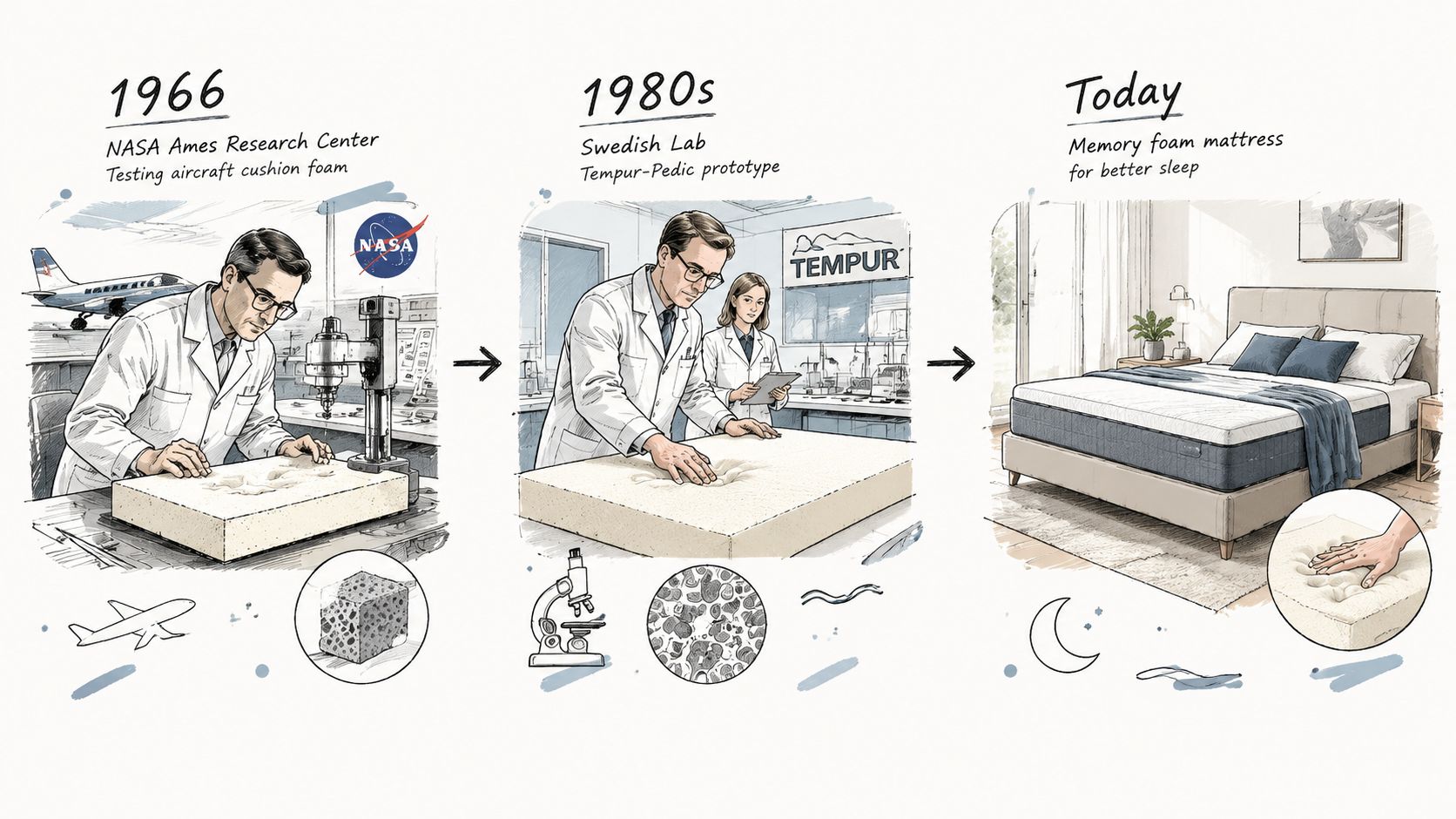
A mattress that hugs your shoulders and hips traces its design back to aerospace engineering, not bedroom furniture. In 1966, Charles Yost helped develop viscoelastic foam through NASA-funded research, creating material that improved cushioning and distributed force more evenly. That broad, conforming contact later suited mattresses because it could reduce concentrated pressure. This account of memory foam's development follows the material from laboratory development to consumer bedding.
NASA released related intellectual property in the 1980s, allowing wider experimentation. Medical applications followed, particularly where pressure management mattered. The first commercial memory foam mattress arrived in the early 1990s, and memory foam mattresses reached the United States in 1994. The timeline explains the category's defining feel: close body conformity was built into the material from the start.
Why the original benefit created later complaints
Viscoelastic foam responds gradually to pressure and body heat. It spreads weight across more of the surface, allowing the mattress to contour around the shoulders, hips, and other pressure-sensitive areas. That response built memory foam's reputation for cushioning and pressure relief instead of bounce.
The same response creates its main drawbacks. Close conformity can hold warmth against the sleeper, while slow recovery can make turning and repositioning feel effortful. Traditional foam structures also allowed limited airflow. Manufacturers responded with open-cell designs and additives such as gel, graphite, and copper. By 2010, polymer gel beads were being added to improve thermal conductivity, showing how cooling had become a major engineering focus.
The history gives shoppers a practical filter. Pressure relief is memory foam's original engineering strength, not a random marketing feature. Heat retention, slow response, and weaker edges follow from that same close-fitting construction. A mattress can reduce those drawbacks with cooling materials, stronger support layers, or an adjustable base, but those additions change the feel and deserve an in-store test. For hot sleepers in West Texas or Southeastern New Mexico, lie on the model long enough to judge warmth, then test head elevation and edge sitting before buying.
The Five Core Strengths and Weaknesses of Memory Foam
A memory foam mattress can feel excellent in a climate-controlled showroom and sleep too warm at home. That difference matters in West Texas and Southeastern New Mexico, where hot, dry conditions make heat retention more noticeable. Evaluate the material by its five defining traits: pressure relief, motion isolation, temperature, durability, and movement.
The five-pillar verdict
Comfort and pressure relief are clear wins. Memory foam conforms to the body and spreads load across a broader contact area. Side sleepers often feel less sharp pressure at the shoulder and hip. A prospective cohort study associated pressure-redistributing foam mattresses with an 88% lower risk of pressure injury development, with an odds ratio of 0.12 and a 95% confidence interval of 0.03 to 0.56. The PLOS One study supports more even interface pressure management, but the mattress still must keep the spine aligned. Test shoulder comfort and pelvic support together, not separately.
Motion isolation is elite. Memory foam absorbs movement, so one partner's turning is less likely to disturb the other. That makes it a strong choice for couples, light sleepers, and anyone sharing a smaller sleep surface. The tradeoff is reduced bounce. People who change positions frequently may feel delayed by the same absorption that protects a sleeping partner.
Heat retention is the category's main weakness. Traditional foam fits closely and leaves less room for heat to escape. Open-cell construction, gel, graphite, copper, breathable covers, and phase-change materials can moderate warmth, but “cooling” on a label proves little. Lie on the actual model long enough to notice heat buildup. In West Texas or Southeastern New Mexico, also test an adjustable base with the head raised. Elevation can increase airflow around the upper body, but it does not turn a warm foam surface into a cool one. Independent comparisons score memory foam 9.48 for pressure relief and 9.30 for cooling, slightly behind spring mattresses on both measures, according to the independent temperature-control guidance.
Durability depends heavily on density. Memory foam around 3 lb/ft³ is associated with roughly 5 to 7 years of use, around 4 lb/ft³ with about 7 to 10 years, and 5 lb/ft³ or higher with about 10 to 15 years, according to this memory foam density and lifespan guide. Lower-density foam is more likely to develop visible impressions and sag sooner. Density does not determine lifespan alone, but it belongs on the specification sheet. Heavier sleepers should inspect the support layers and sit on the edge before deciding.
Ease of movement is the fit-sensitive weakness. Slow recovery can make turning harder, especially for combination sleepers or anyone who dislikes a settled feel. Ask the showroom to adjust the base, then move from the back to the side and sit at the perimeter. A responsive foam model or an adjustable base may reduce the effort, while a soft, thick comfort layer usually increases it.
| Pillar | Side Sleepers | Back Sleepers | Stomach Sleepers | Couples |
|---|---|---|---|---|
| Pressure relief | Clear winner for shoulders and hips | Strong if the pelvis doesn't sink too far | Useful only with sufficient firmness | Helpful when partners have different pressure needs |
| Motion isolation | Excellent | Excellent | Excellent | Category-leading strength |
| Heat retention | Risk without cooling features | Moderate concern | Moderate concern | Higher concern when two bodies share the bed |
| Ease of movement | Can feel restrictive | Depends on response and firmness | Often needs a firmer, more mobile surface | Quiet but less buoyant |
| Durability | Strong with appropriate density | Strong when alignment remains stable | Fit-sensitive under higher loads | Edge and center durability both matter |
Choose memory foam for pressure relief and quiet, not bounce. In hot regional climates, prioritize a cooling construction you can test in person, pair it with adjustable head elevation when that improves comfort, and treat density, edge feel, and movement as purchase requirements rather than minor details.
Why Body Weight, Sleep Position, and Edge Support Change Everything
A memory foam mattress can feel perfectly supportive to one sleeper and completely wrong to another. Body weight changes how far the sleeper compresses the layers, while sleep position determines where support is needed. Edge use adds a third test that many showroom demonstrations ignore.
Fit by profile
A lighter side sleeper may enjoy the deeper cradle because the shoulders and hips receive more cushioning without requiring extreme force to compress the mattress. A back sleeper needs a balance between contouring and pelvic support. Too much sinkage can disturb spinal alignment even when the surface feels comfortable during the first few minutes.
Higher-weight stomach sleepers face the most obvious mismatch. Current expert reviews note that memory foam may feel too soft for higher-weight stomach sleepers, may lack adequate support for sleepers over 230 pounds, and often has weak edge support. The AARP mattress guidance highlights those fit-dependent concerns. A stomach sleeper who loses support under the abdomen may wake with lower-back stiffness, while a heavier combination sleeper may find slow recovery makes turning unnecessarily difficult.
Edge support is a daily-use issue
Traditional all-foam beds commonly compress at the perimeter. That matters for couples who use the full width of the mattress, older adults who sit down before lying back, and anyone who pushes off the edge to stand. Reinforced edge coils, firmer border foam, and a substantial base can improve stability, but the improvement must be felt in person.
| Sleeper Profile | Pressure Relief | Support and Alignment | Edge Stability | Best Match |
|---|---|---|---|---|
| Lighter side sleeper | High | Usually favorable with suitable firmness | Model-dependent | Contouring foam with a breathable cover |
| Average back sleeper | Moderate to high | Needs balanced pelvic support | Moderate in all-foam builds | Medium-feel foam or foam hybrid |
| Stomach sleeper over 230 pounds | Potentially high at first | Greater risk of excessive sinkage | Often a concern | Firmer hybrid or structured foam build |
| Combination sleeper | Useful at pressure points | Depends on recovery speed | Moderate to weak in basic all-foam beds | Responsive hybrid or latex alternative |
| Older adult or edge user | Good in the center | Must be tested during entry and exit | Critical | Reinforced-edge construction with an adjustable base |
Fit test: A mattress passes only when the sleeper can lie comfortably, roll, sit at the edge, and stand without excessive effort.
The clearest recommendation is to consider a hybrid or latex alternative when movement, edge stability, or strong stomach support outranks deep contouring. Memory foam remains compelling when pressure relief is the primary need, but body weight and position should decide firmness and construction.
Busting the Biggest Memory Foam Myths
Some complaints describe older constructions accurately but no longer apply to every current mattress. Other complaints remain valid and deserve a real test instead of a dismissal.
Myth one says every memory foam mattress sleeps hot
Traditional memory foam can retain heat because it conforms tightly and restricts escape routes around the body. That weakness is documented in independent testing guidance, which also describes the development of open-cell designs and gel, graphite, and copper additives as responses to the problem.
Modern cooling features can improve comfort. Breathable covers, phase-change materials, conductive infusions, and open-cell foam may reduce the trapped sensation. They don't make every memory foam mattress automatically cool. A shopper should lie on the specific model long enough to notice whether the cover feels breathable and whether the body sinks into a warm pocket.
Myth two says off-gassing lasts forever
New polyurethane-based foam can release VOCs after unpacking, with emissions highest immediately and then declining. In a 32-day simulated consumer-use study of two new memory foam mattresses, concentrations of several compounds and total VOCs peaked on day one and fell over the following month. Modeled average total VOC concentrations were about 20 and 33 μg/m³ over the study period, while estimated one-year averages were 2.7 and 4.2 μg/m³, below available health-based benchmarks, according to the published consumer-use study.
That doesn't mean every sleeper will like the initial odor. Aired ventilation remains sensible, especially for people who are odor-sensitive. The practical question is whether the retailer explains unpacking, ventilation, and return procedures clearly.

Myth three says memory foam can't work with an adjustable base
Modern memory foam generally flexes with an appropriate adjustable base. Elevating the head can change how the sleeper experiences pressure and positioning, while a suitable base can make it easier to find a comfortable posture. Compatibility still depends on the mattress construction and the base manufacturer's requirements, so the specification sheet matters.
The myth-busting conclusion is practical. Cooling technology has improved the heat problem, ventilation addresses the early odor issue, and adjustable bases can complement contouring. None of those features eliminates the need to test firmness, response, and edge stability for the actual sleeper.
Memory Foam, Climate, and Adjustable Base Pairings
West Texas and Southeastern New Mexico make temperature testing especially important. A mattress that feels pleasantly conforming in a cool bedroom can feel uncomfortably warm during a hot, dry night. Air conditioning helps the room, but it doesn't automatically remove heat held close to the body by dense foam.
Match the regional problem to a feature
The first showroom test should focus on the cover and upper comfort layers. Hot sleepers should compare a standard cover with a breathable or phase-change design, then spend time lying still instead of judging the surface after a quick sit. Gel, graphite, copper, open-cell foam, and airflow-oriented covers can address heat differently, so the actual feel matters more than the label.
A second test concerns support. Dry winter air doesn't change the foam's engineering, but seasonal bedding, clothing, and bedroom temperature can alter how warm or insulated the sleeper feels. A zoned support design can help maintain lumbar comfort when a sleeper chooses a softer shoulder area, provided the hips don't sink too far.
An adjustable base can become a useful problem-solving tool. A modest head elevation may improve breathing comfort and reduce the feeling of sleeping flat, while leg elevation can alter pressure distribution. The base should be tested with the mattress, not purchased as an unrelated accessory.
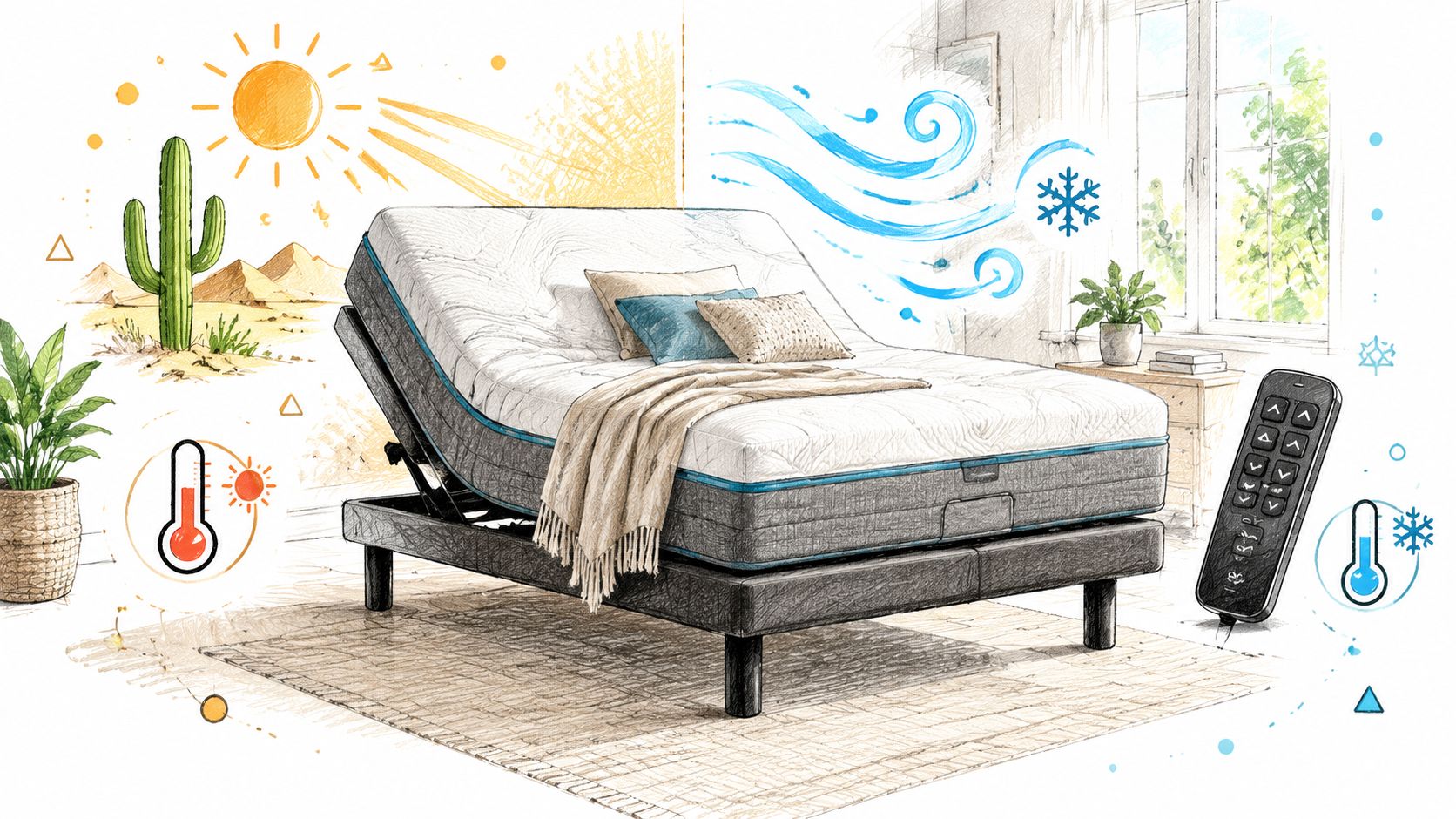
All-foam or hybrid for the desert climate
An all-foam mattress delivers the deepest motion isolation and a more enveloping feel. A hybrid memory foam mattress adds coil structure, which can improve airflow, bounce, and edge stability. For a warm sleeper in Lubbock, Odessa, Hobbs, or nearby communities, a cooling hybrid often makes more sense than choosing the softest all-foam bed available.
The memory foam mattress guidance for hot sleepers provides a useful starting point for comparing cooling-focused designs. Miller Waldrop Furniture & Decor can also provide an in-store setting where shoppers compare mattress surfaces and adjustable-base positions side by side.
Regional recommendation: Hot sleepers who also need strong edge support should start with a cooling hybrid, then move to all-foam only if its pressure relief is clearly better without creating a warmer sleep environment.
The climate-specific decision is not “foam or no foam.” It's whether the foam construction, cover, and base give the sleeper enough airflow and support for the room where the mattress will be used.
Smart Buying Tips Before You Visit the Showroom
A showroom visit should produce evidence, not a rushed preference. Lie on each finalist long enough to notice pressure, heat, support, and how easily you can change position. Choosing the softest surface after a few seconds is a reliable way to regret the purchase.
The in-store checklist
Ask for density information. Request separate details for the comfort and support layers. Density matters because it affects durability, but the quoted figure may describe only one layer, not the entire mattress. Confirm which layer carries the rating and how the remaining materials contribute to support.
Request certification documentation. Ask whether the foam has recognized low-emission certification, then request the paperwork. Certification can clarify materials and emissions. It cannot tell you whether the mattress feels too soft, sleeps too warm, or makes repositioning difficult.
Run the partner-motion test. One person should change position while the other lies still. Test the center and the edge. A mattress can isolate movement well while offering weak perimeter support.
Stay in your normal sleep position. Give each finalist enough time for the foam to warm and respond. Side sleepers should check shoulder and hip pressure. Back sleepers should notice whether the pelvis sinks too far. Stomach sleepers should assess lumbar support.
For West Texas and Southeastern New Mexico, add a heat test. Warm rooms expose dense, enveloping foam quickly. Ask to try the cooling cover or breathable construction, then compare the same mattress with the adjustable base raised. Head and foot elevation can improve airflow around the sleeper, but it cannot repair poor edge support or a mattress that feels too soft.
Inspect the fine print before purchase
Read the warranty beside the comfort details. Prorated coverage, body-impression thresholds below 1.5 inches, and mandatory box-spring requirements can restrict protection or create compatibility problems. Review trial rules closely, including return-shipping charges and any required break-in window of 30 to 60 nights.
Ask what happens if the mattress remains warm after the adjustment period, the perimeter collapses, or you cannot reposition comfortably. Review a memory foam mattress brands guide before the visit to organize options, then rely on your own in-store testing to judge fit.
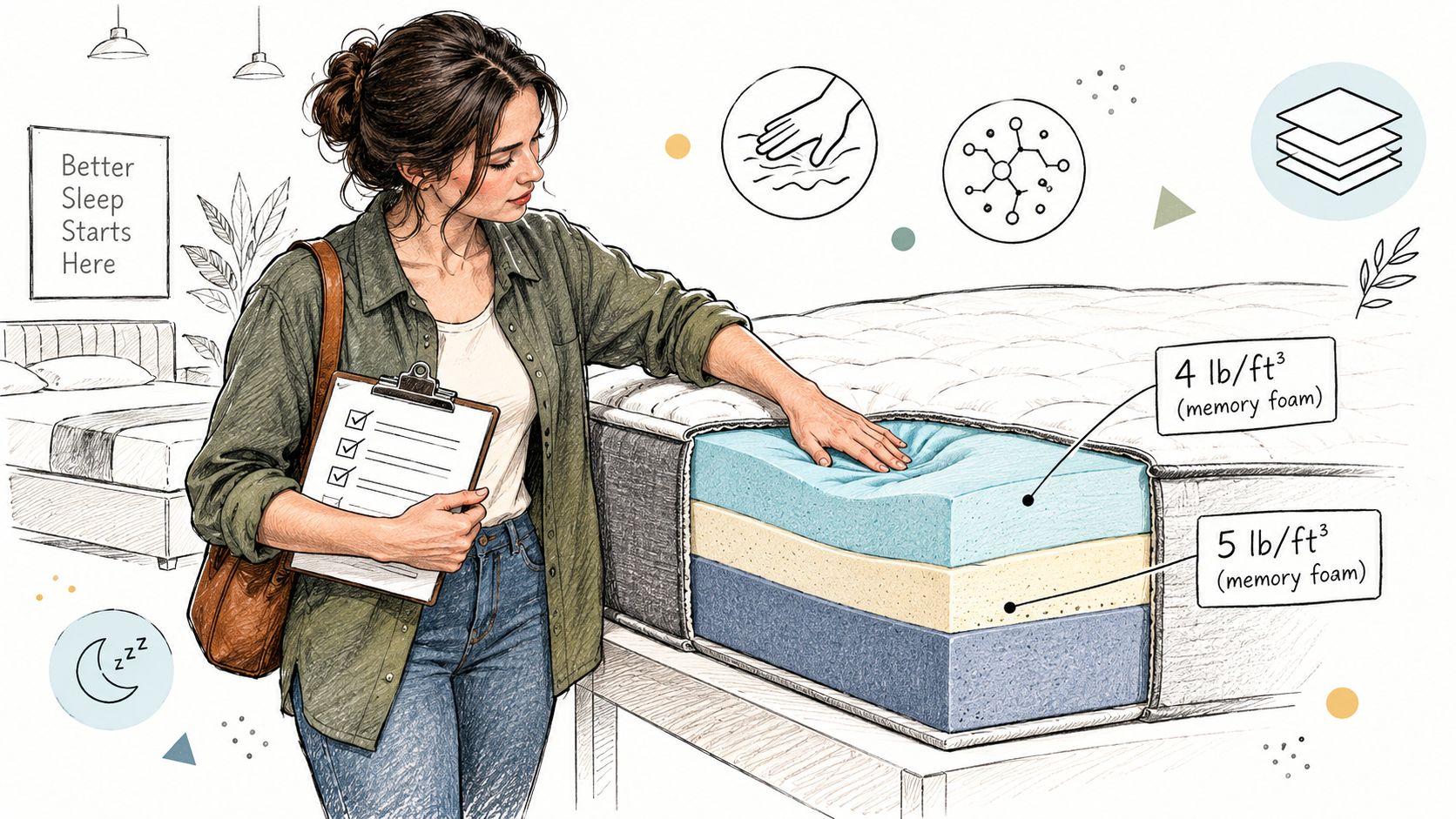
Before leaving, record the feel, cover technology, edge construction, adjustable-base compatibility, warranty terms, trial rules, and delivery details. Include the foam density if the retailer provides it. This record helps prevent a mattress from winning a five-minute showroom test and failing during a full night.
Miller Waldrop Furniture & Decor offers memory foam, hybrid, innerspring, and specialty mattresses alongside adjustable bases. Sleep Experts can help match construction to body type, sleep position, and local climate needs. Visit Miller Waldrop Furniture & Decor to test cooling features, edge support, and adjustable-base pairings in person at a showroom serving West Texas and Southeastern New Mexico.