


Living Room Furniture Dimensions: A Practical Guide

An empty living room can feel full of questions. The tape measure is in hand, the walls look bigger or smaller depending on the angle, and every sofa online suddenly seems either too huge or too tiny.
That's where most decorating mistakes begin. Not with bad taste, but with unclear scale.
A good room usually comes down to a few smart measurements, a few spacing rules, and a clear sense of how people will move through the space every day. Once those pieces are in place, choosing furniture gets much easier. A sofa stops being a guess. A coffee table stops being an afterthought. The whole room starts to make sense.
For homeowners and renters across West Texas and Southeastern New Mexico, that matters. Living rooms in this region often need to do several jobs at once. They host family time, game nights, visiting relatives, afternoon naps, and everyday lounging after long days. Furniture has to fit the room, but it also has to fit real life.
Table of Contents
- Your Guide to a Perfectly Proportioned Living Room
- How to Measure Your Living Room Like a Pro
- The Golden Rules of Living Room Layout and Spacing
- Standard Sofa and Sectional Dimensions
- Choosing Dimensions for Chairs and Accent Seating
- Sizing Your Coffee Table End Tables and Ottomans
- Finding the Right Size for TV Stands and Area Rugs
- Bring Your Vision to Life with Expert Help
Your Guide to a Perfectly Proportioned Living Room
The struggle isn't with recognizing a beautiful room, but rather with translating what looks good in a photo into a room with real walls, real windows, and real traffic patterns. That's why understanding living room furniture dimensions matters so much. It gives structure to the decision-making.
A room feels right when the furniture suits both the square footage and the way the household lives. A family that gathers around the television every evening needs different proportions than a couple creating a quiet conversation area. A long, narrow room in Lubbock may call for a different furniture plan than a more open layout in Hobbs or Ruidoso Downs.
Why proportion matters more than style alone
Style usually gets the attention first. Size should come first.
A room can have beautiful pieces and still feel off if the sofa is too deep, the rug is too small, or the chairs crowd the walkway. Proportion is what makes a room feel easy to use. It's also what helps furniture look intentional instead of squeezed in.
For readers who want a stronger design foundation beyond measurements, this guide to understanding interior design concepts gives helpful context for how balance, scale, and function work together.
A well-furnished living room doesn't happen by accident. It comes from matching the furniture footprint to the room's real limits.
A practical way to build confidence
This process doesn't require design school. It requires a plan.
Start with room measurements. Then learn the key spacing rules. Then compare furniture dimensions against that plan before buying anything. That order saves time, prevents expensive mistakes, and makes shopping far less stressful. A useful next step is this local guide on how to choose living room furniture, which helps connect room planning with actual furniture selection.
For families in this region, there's also comfort in working with a retailer that understands local homes and local needs. Miller Waldrop has served West Texas and New Mexico for over 70 years, and that kind of long-view experience matters when a room needs to be both attractive and durable.
How to Measure Your Living Room Like a Pro
A surprising number of furniture problems start before shopping even begins. The room gets measured once, quickly, wall to wall, and that single number becomes the whole plan. Then the sofa arrives, blocks an outlet, crowds the doorway, or won't make it through the hall.
A better measuring process is simple, but it needs to be thorough.
Start with the room itself
Begin with a sketch of the room on paper. It doesn't need to be fancy. A rough outline is enough.
Then record these basics:
- Wall length for every wall, not just the longest two.
- Ceiling height, especially if the room has tall windows or a large entertainment wall.
- Door locations and which direction each door swings.
- Window width and placement, including how far windows sit from corners.
- Built-ins, fireplaces, floor vents, and outlets that affect furniture placement.
These details matter because furniture doesn't live in an empty box. It shares the room with architecture.
Measure the paths furniture has to travel
This is the step many shoppers skip, and it causes some of the biggest headaches.
Measure the front door, interior doorways, hallways, stair turns, and any tight corners leading to the living room. If the home has an apartment entry, elevator, or narrow landing, measure those too. A sofa that fits the room still has to fit the route.
Practical rule: Measure the room, then measure the delivery path, then compare both against the furniture specifications.
For readers who want a visual walkthrough, this article on planning furniture layouts is a helpful companion to the measuring process.
Use painter's tape to test the footprint
Numbers on paper are useful. Tape on the floor is often what makes the plan click.
Mark the width and depth of a sofa, sectional, coffee table, or recliner directly on the floor. Then walk around those taped shapes. Open the door. Stand where the side table would go. Check whether someone can still cross the room comfortably.
That quick exercise helps answer practical questions such as:
- Will the sofa block the natural walkway? The room should still feel easy to cross.
- Does the sectional reach too far into the space? A corner piece can look fine on paper but feel bulky in person.
- Is there enough room for companion pieces? A sofa alone may fit, but the full seating group may not.
Keep one measurement sheet for shopping
Once everything is recorded, keep it in one place. A phone note, printed sheet, or simple folder works well.
The most useful measurement sheet usually includes:
- Room dimensions
- Open wall lengths
- Window and door placements
- Entry and hallway measurements
- A short wish list of furniture pieces
That sheet turns furniture shopping from guesswork into comparison. It also makes showroom visits much more productive, because the dimensions can be matched to real pieces right away.
The Golden Rules of Living Room Layout and Spacing
A living room can have the right furniture and still feel awkward if the spacing is wrong. That cramped feeling usually comes from traffic lanes that are too tight or tables that sit too far away to be useful.
Here, layout rules earn their keep.
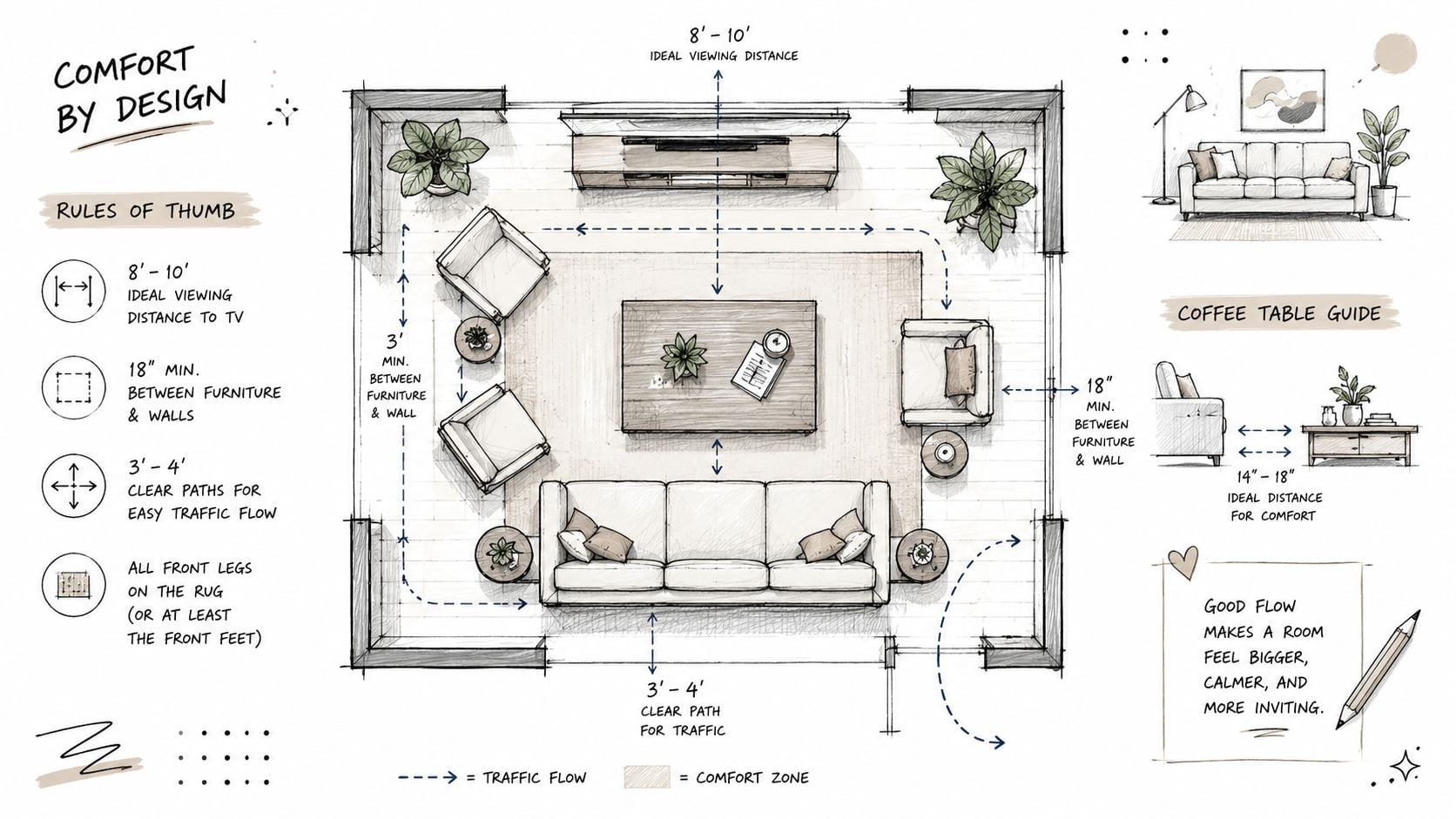
According to Houzz's living room measurement guide, an average sofa is about 84 inches long and 38 inches deep, while smaller rooms may suit a 72-inch sofa and larger rooms often use a 96-inch sofa. The same guide notes that circulation paths should stay 30 to 36 inches wide, and coffee or cocktail tables can sit as close as 12 inches from seating. Those numbers show why layout isn't just about whether a piece fits. It's about whether the room still functions once the piece is in place.
The walkway rule
The first thing to protect is the path people use naturally.
If someone has to twist sideways between the sofa and another piece, the room is overcrowded. Main circulation paths should feel open enough for daily movement. In practical terms, that means preserving a clear lane instead of filling every corner with furniture.
In many homes across West Texas and Southeastern New Mexico, living rooms connect directly to entryways, kitchens, or dining areas. That makes traffic flow especially important. A roomy sofa may still be the wrong choice if it interrupts the way people cross the house.
The conversation zone
A good living room usually has one central seating area with a clear relationship between the main pieces.
The sofa anchors the group. Chairs support it. The coffee table ties the seating together. If the pieces drift too far apart, conversation gets harder and the room feels disconnected. If they're packed too tightly, the room feels tense.
A practical check helps:
- Can someone set down a drink without leaning too far?
- Can people walk around the table without bumping their legs?
- Do the seats face each other in a usable way?
Furniture should shape the room, not clog it.
Use visualization before moving heavy pieces
Before committing to a new arrangement, it helps to preview the seating plan visually. Tools that create mock room arrangements can help a shopper test whether the room feels balanced before delivery day. Some readers may find virtual AI staging for living rooms useful for that purpose, especially when deciding between a sofa and a sectional.
The key takeaway is simple. Living room furniture dimensions only become meaningful when paired with spacing. A sofa may be the right size on paper, but if the room can't preserve comfortable movement around it, the layout still needs work.
Standard Sofa and Sectional Dimensions
A sofa is usually the largest piece in the seating area, so its dimensions shape the rest of the plan. Get this choice right, and the room starts to feel settled. Get it wrong, and even a beautiful chair or coffee table can feel out of place.
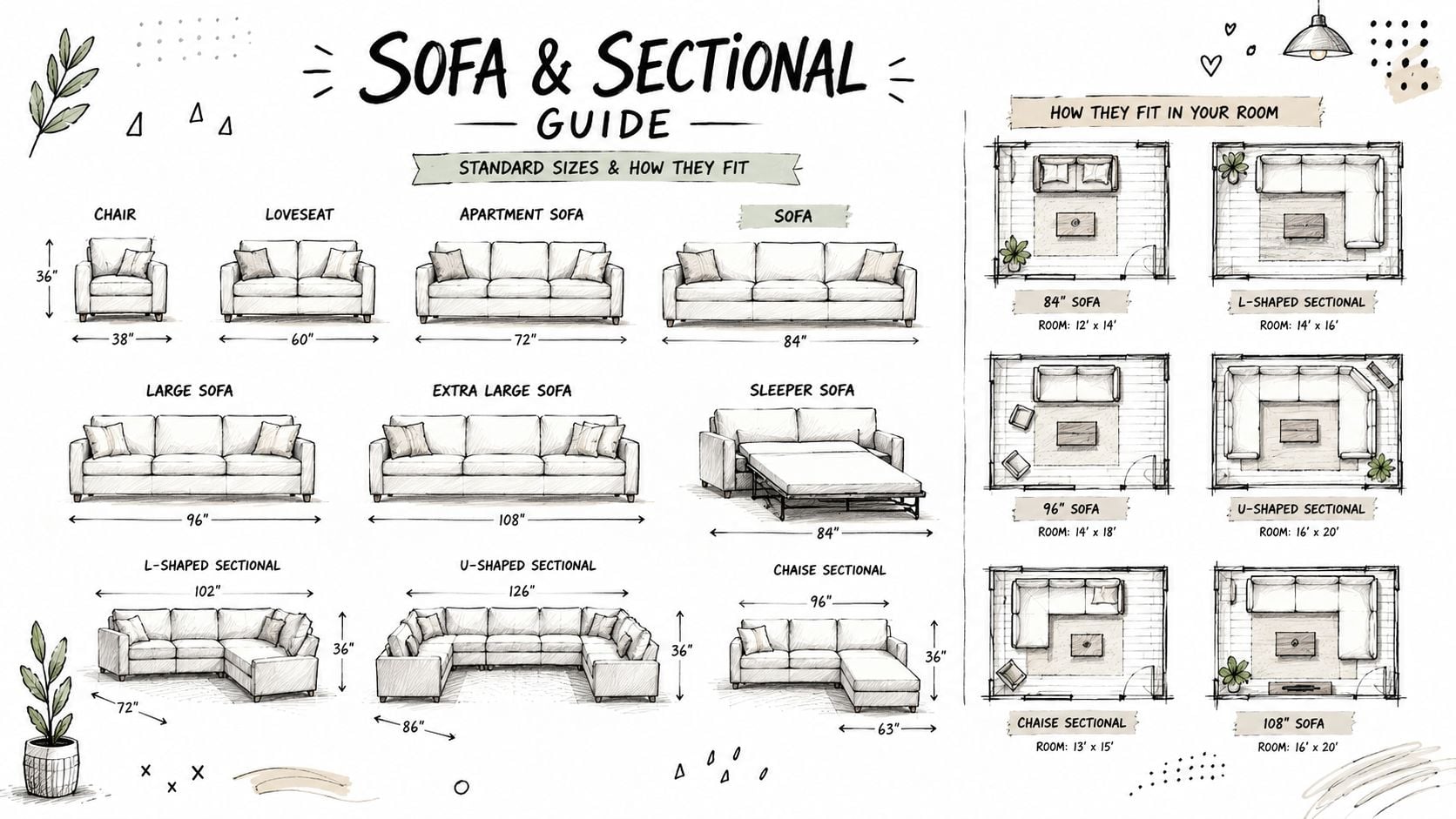
Rather than chasing a single "standard" size, it helps to read sofa dimensions in three parts: width, depth, and arm style. Width tells you how much wall or floor space the piece will claim. Depth affects how far the sofa reaches into the room and how it feels to sit in. Arm style matters too, because wide track arms can add several inches without giving you more seat space.
That last point trips up many shoppers.
Two sofas can look similar in photos, yet one may seat fewer people because the arms are bulkier or the back is thicker. In many West Texas and Southeastern New Mexico homes, where living rooms often open into kitchens or dining areas, those few inches can make the difference between a layout that feels easy to live with and one that feels crowded every day.
What common sofa sizes mean in real rooms
A two-seater sofa usually makes sense in a compact living room, a secondary sitting area, or a home where the main seating is shared between a sofa and chairs. It can also work well in a pass-through room where the furniture needs to support daily life without visually blocking the space.
A three-seater sofa is often the easiest starting point for a typical family room. It offers enough seating for everyday use, still leaves room for side tables or accent chairs, and tends to fit a wide range of layouts without feeling too small or too heavy.
A sectional changes more than seating capacity. It changes the room's shape. An L-shaped sectional can define the living area in an open-concept home, while a chaise sectional gives one person a built-in lounging spot without requiring a separate recliner. The tradeoff is footprint. A sectional spreads in two directions, so every measurement has to be checked with more care.
A simple way to picture it is this: a standard sofa acts like one strong anchor, while a sectional acts like an anchor plus a boundary line.
How to choose between a sofa and a sectional
The better question is not whether a sectional is larger. The better question is how the room needs to work.
- Choose a sofa if you want more flexibility to rearrange later.
- Choose a sofa if the room has multiple entry points or several walking paths.
- Choose a sectional if your household gathers in one main spot for TV, relaxing, or family time.
- Choose a sectional if you want the seating itself to help define the living zone in an open floor plan.
This matters in local homes especially. Many houses in our area have generous square footage, but that does not automatically mean every room wants oversized furniture. A large sectional can look right in a broad family room with one clear focal wall. In a long, narrow room, that same piece can eat up corner space and limit where tables and lamps can go.
Match the dimensions to how you live
Start with your habits. A household that hosts neighbors after church, ballgames, or weekend cookouts may prefer a sofa with separate chairs so guests can face each other more naturally. A family that settles in for movies every night may be happier with a deeper sectional or a chaise configuration.
Seat depth plays a big role here. A deeper sofa feels relaxed and lounge-friendly, but it may not be as comfortable for formal visiting unless you add supportive pillows. A shallower sofa usually feels more upright, which some people prefer for conversation and easier standing.
If you are weighing a sectional, this guide on how to measure for a sectional couch can help you connect room measurements to the actual shape of the piece before you buy.
Sizing note: The best sofa size is the one that still leaves the room useful after you account for side tables, a coffee table, and the way your household actually lives in the space.
For homes in West Texas and Southeastern New Mexico, that practical approach usually leads to better results than picking the biggest piece that fits on paper. Dimensions are not just numbers on a tag. They are the difference between a room that looks finished and a room that feels comfortable every single day.
Choosing Dimensions for Chairs and Accent Seating
Once the main sofa is chosen, accent seating does two jobs at once. It adds function, and it fine-tunes the room's personality. The challenge is choosing chairs that support the sofa instead of fighting with it.
A chair can be beautifully made and still be the wrong fit if its scale throws off the seating group.
Start with footprint, not fabric
Before looking at upholstery or arm style, check the chair's footprint.
The standard size reference in the earlier section listed an armchair at 900 mm x 950 mm, which is a helpful reminder that many accent chairs take up more room than expected. A plush chair can visually read as light, but the actual footprint may be substantial.
That matters in smaller living rooms where every inch of floor area affects circulation. In those spaces, one generous chair may work better than two bulky ones. In a larger room, a pair of chairs can help balance the sofa and create a fuller conversation area.
Keep seat heights visually compatible
A common mistake is pairing a low, loungey chair with a much taller sofa or doing the reverse. Even when both pieces are comfortable on their own, the group can feel mismatched.
Seat heights don't have to be identical, but they should feel visually related. If one person sits far lower than everyone else, the arrangement can feel awkward in both conversation and appearance. This is especially important when mixing a structured sofa with relaxed accent seating.
A few practical checks help:
- Look at the arm height beside the sofa. The chair shouldn't feel oversized or undersized by comparison.
- Check the depth if the room is tight. Deep chairs can crowd a coffee table zone quickly.
- Think about use before choosing style. Reading chairs, swivel chairs, and recliners all ask more of the room in different ways.
Recliners need room to function
Recliners deserve special attention because their usable footprint changes once they're in use.
A power recliner may look compact from the front, but it still needs enough surrounding space to open comfortably without colliding with a wall, table, or media console. That makes placement just as important as product dimensions.
A chair isn't measured only by where it sits. It also has to be measured by how it moves.
Good accent seating supports the whole layout
Accent seating works best when it solves a room problem. It can soften a sharp corner, complete a conversation area, provide a reading spot, or add flexible seating for guests.
That's a stronger approach than treating chairs as filler. In many living rooms, a single well-scaled chair and a small table can do more than a pair of oversized seats that crowd the room.
For homes in West Texas and Southeastern New Mexico, where living rooms often need to feel both welcoming and hardworking, that kind of restraint can make the whole space more comfortable.
Sizing Your Coffee Table End Tables and Ottomans
Small tables often decide whether a living room feels practical. A sofa gets the spotlight, but the coffee table and end tables are the pieces people reach for every day. When their dimensions are off, the room becomes less comfortable fast.
Proportion matters in a very hands-on way.
The coffee table should serve the seating area
A coffee table shouldn't be chosen in isolation. It belongs to the sofa and chairs around it.
Its size should reflect the seating group, not just the empty floor space. If it's too small, it looks disconnected and doesn't offer enough useful surface. If it's too large, it interrupts movement and makes the center of the room feel heavy.
The standard size reference noted earlier listed a small coffee table at 750 mm x 750 mm and a large coffee table at 1000 mm x 500 mm, which shows how common coffee table dimensions stay within a practical range rather than becoming oversized.
A useful rule of thumb is to choose a coffee table that feels visually balanced with the sofa, while still leaving easy access around it. Height matters too. The top should feel easy to reach from a seated position, not noticeably high or low.
End tables should feel easy to use
End tables are often treated as whatever can fit in the leftover gap. That usually leads to pieces that are too tall, too short, or too deep.
A better approach is to match the table to the seat beside it. If someone has to reach up awkwardly or bend too far down to place a drink, the table isn't doing its job. Depth matters as well. An end table that sticks out farther than the sofa or chair can make the room feel clumsy.
Ottomans add flexibility, but size still matters
Ottomans work hard in living rooms. They can be a footrest, extra seat, soft-edged coffee table, or storage piece depending on the design.
That flexibility makes them appealing, but they still need to match the room's scale. A large upholstered ottoman can anchor a seating group beautifully, yet it can also dominate a small room if the footprint is too broad. In tighter spaces, a compact ottoman or nested pair may offer more flexibility.
Design check: If a table or ottoman looks right but makes daily movement harder, it's the wrong size for that room.
Quick Reference Table Dimensions
| Furniture Piece | Ideal Height | Ideal Size/Length | Ideal Placement |
|---|---|---|---|
| Coffee table | At or slightly below the sofa seat height | Roughly proportional to the sofa, often around two-thirds of the sofa length | Centered within the main seating group with easy reach from the sofa |
| End table | Near the height of the sofa arm or chair arm beside it | Narrow enough to avoid jutting past the seating depth | Close enough for setting down a drink or lamp comfortably |
| Ottoman | Similar in visual scale to the seating around it | Sized to suit its job, whether footrest, extra seat, or central surface | Placed where it supports comfort without blocking movement |
| Nesting tables | Low and easy to reach from nearby seats | Compact and flexible rather than dominant | Best for small rooms that need movable surfaces |
| Storage ottoman | Comfortable for seating and practical for access | Large enough to be useful, small enough to preserve flow | Often in front of a sofa or between chairs in a multifunctional room |
The best test is still the simplest one. Sit down, reach naturally, and imagine everyday use. If the table supports that motion easily, the dimensions are probably close to right.
Finding the Right Size for TV Stands and Area Rugs
A common living room problem looks small at first. The sofa fits, the chairs fit, and the room still feels off. In many West Texas and Southeastern New Mexico homes, the missing piece is scale. The TV stand looks undersized under the screen, or the rug sits in the middle of the room like a postage stamp instead of tying the seating together.
Those two pieces do a lot of quiet work. They help the room feel settled.
TV stands should match the wall, the screen, and the room
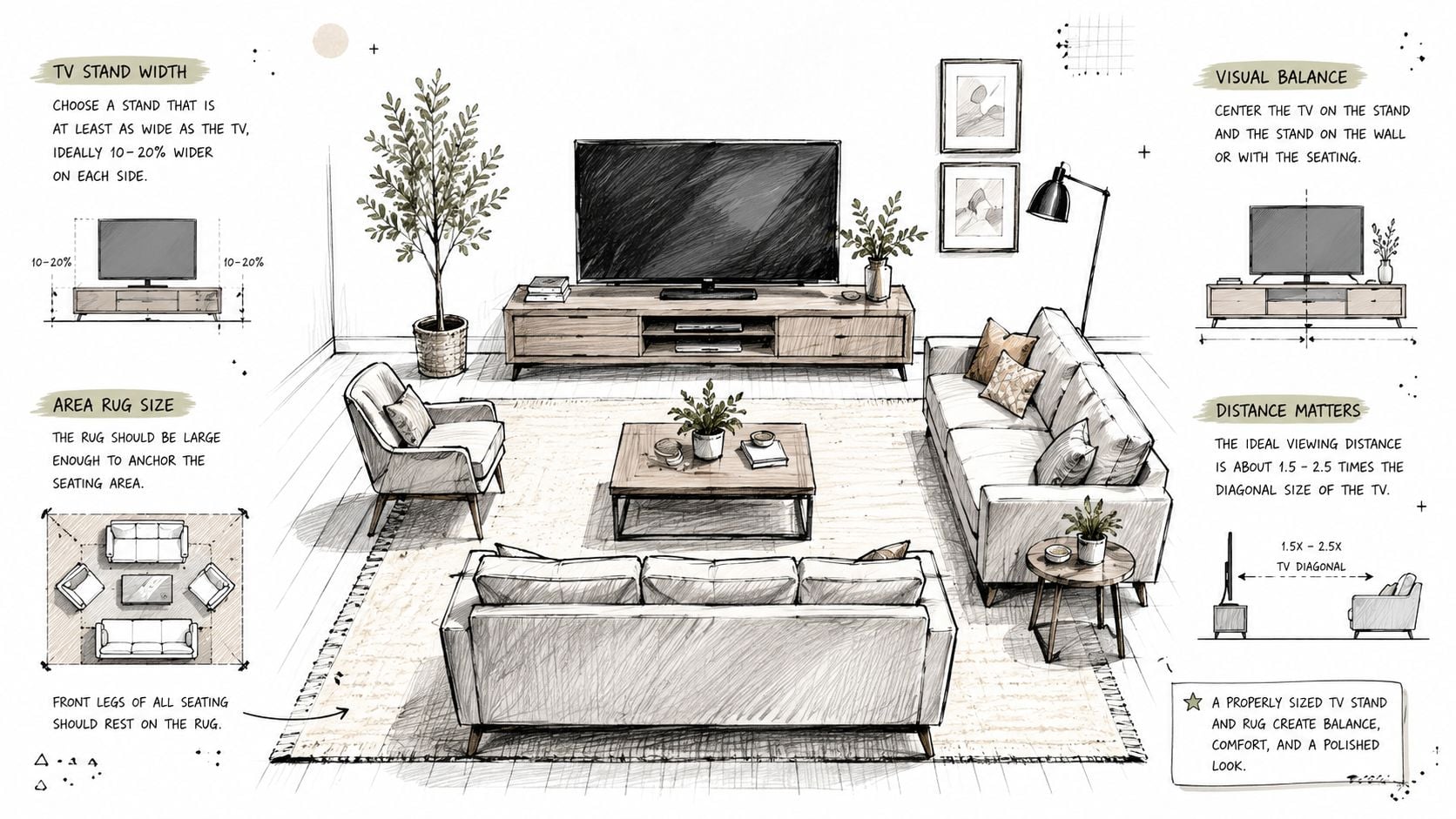
A TV stand is the visual base for the screen. If that base is too small, the television can feel top-heavy, even if the stand technically holds it. If it is too large, the wall can start to feel crowded, especially in a room that already has windows, doorways, or a fireplace competing for space.
A good way to judge it is to look at the full front wall, not just the TV. The stand should feel proportional to the screen and leave enough breathing room around nearby pieces. In a long ranch-style living room or an open-concept space common in this region, that balance matters because the media wall is often visible from more than one angle.
Comfort matters just as much as appearance. The screen should be easy to watch from the main seats without forcing everyone to crane their necks or sit uncomfortably close. That is why the media setup needs to be part of the room plan instead of an afterthought.
Rugs should connect the seating group
Rugs work like the frame around a picture. They show where the living area begins and ends.
The mistake many homeowners make is choosing a rug based only on what looks good in the store. Once it gets home, it may sit only under the coffee table, leaving the sofa and chairs stranded around it. The furniture then feels disconnected, even though each piece may be the right size on its own.
A stronger layout usually follows one of these approaches:
- All legs on the rug when the room is large enough and you want a fully grounded seating area
- Front legs on the rug when you want the group to feel connected without covering too much floor
- No legs on the rug only in a very small room, and only if the smaller scale still looks intentional
Use the rug to shape open living spaces
This matters even more in open layouts. A rug can separate the living room from the dining area or kitchen without adding walls or making the space feel chopped up. In many homes across West Texas and Southeastern New Mexico, that is a practical way to make one large room feel organized and comfortable.
If you are unsure how large the rug should be for your specific seating plan, this guide on what size rug works for a living room can help you match the rug to the furniture you already have.
A well-sized TV stand and rug will not solve every layout problem. They do something just as important. They make the room feel balanced, usable, and finished.
Bring Your Vision to Life with Expert Help
By this point, the room is no longer a mystery. The measurements are clearer. The spacing rules make sense. The major pieces can be judged by footprint instead of guesswork.
That kind of knowledge changes how someone shops. A shopper can walk into a showroom, look at the width and depth of a sofa, and understand what those numbers mean inside the home. A sectional stops being intimidating. An accent chair becomes easier to place. A rug becomes part of a plan instead of a last-minute add-on.
Knowledge makes better design decisions
The goal isn't to memorize every dimension. The goal is to recognize what a room needs.
Sometimes that means choosing a smaller sofa so the walkway stays open. Sometimes it means picking one substantial chair instead of two crowded ones. Sometimes it means skipping a bulky ottoman because the room would function better with a lighter table. Those are confident design choices, not compromises.
Good design decisions usually feel calm. The room works, people can move through it easily, and the furniture supports everyday life.
A local showroom can turn measurements into real options
There's a big difference between reading dimensions online and standing in front of actual furniture with a floor plan in hand. Seeing depth, arm height, and overall scale in person often makes the right choice much more obvious.
That's especially useful for households in West Texas and Southeastern New Mexico, where living rooms often have to balance comfort, durability, and flexible use. A family room in Lubbock may need a different seating plan than a vacation property in Ruidoso Downs or a compact home in Hobbs. The principles stay the same, but the solutions vary.
For many shoppers, expert guidance helps connect those principles to actual products, room plans, and delivery realities. That's often the step that turns a good idea into a finished room.
The strongest takeaway is simple. Living room furniture dimensions aren't just numbers on a tag. They're the tools that help a room feel welcoming, functional, and well proportioned. With the right measurements and a little planning, the room can come together with much more confidence.
A well-planned living room starts with the right measurements, but it comes together faster with experienced guidance. Miller Waldrop Furniture & Decor helps shoppers across West Texas and Southeastern New Mexico match real furniture dimensions to real homes. Bring a room sketch, doorway measurements, or even a rough floor plan to a local showroom, and the team can help turn those numbers into a layout that fits the way the household lives.